I Had Been a Mother for Seven Hours When a Nurse Handed Me a Red Bag
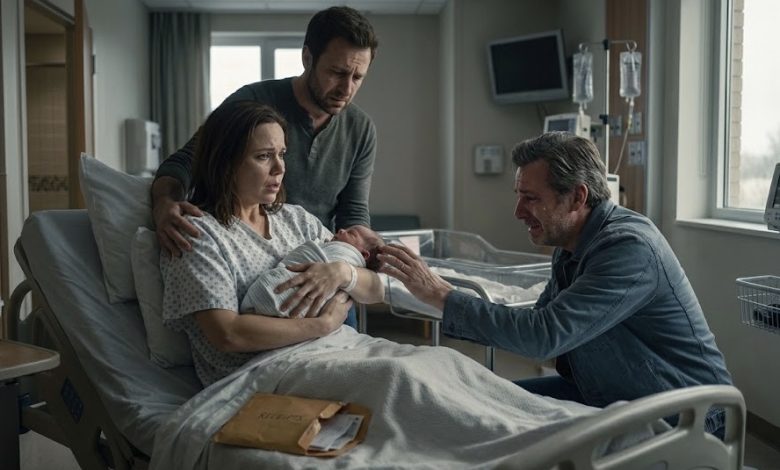
My son, Caleb, was asleep in the little clear hospital bassinet beside my bed. He was wrapped so tightly in a white blanket that only his tiny face was showing.
My husband, Marcus, had gone home for an hour to shower, feed our dog, and bring back the phone charger I had forgotten. The room was finally quiet.
There was a blue balloon tied near the sink that said “Congrats! Baby Boy!” I remember looking at it and thinking how strange it was that something as huge as becoming a mother could happen while the rest of the world kept moving normally.
Cars were still passing outside. Someone was laughing in the hallway. A cleaning cart squeaked past my door.
And then Nurse Janet came in holding that bag.
The Mysterious Red Bag
It was red leather with white stripes running around the edges. Old-fashioned. A little scuffed near the bottom. She placed it carefully on the end of my bed.
“Ellie,” she said, “does this belong to you?”
I stared at it. “No.”
She hesitated. “A woman downstairs asked us to give it to you.”
Something in her voice made me look up. “What woman?”
“She didn’t give me much information.”
“Then why did you take the bag?”
“She knew your full name. Your room number. And…” Janet stopped.
“And what?”
“She called you Ellie-Bee.”
My whole body went cold. Nobody called me Ellie-Bee. Nobody except my mother. And according to everything I had been told since I was six years old, my mother had been dead for twenty-three years.
A Shadow from the Past
I actually laughed when Janet said it. It was that strange laugh people make when their brain rejects what they’ve just heard.
“You must have misunderstood.”
“I asked her to repeat it.”
“Who was she?”
“A woman in her late fifties, maybe early sixties. Brown hair with some gray. Green coat.”
My mother would have been fifty-eight. I knew that because every year on her birthday I still quietly counted how old she would have been. Even after all that time. Even though I barely remembered her.
I remembered her perfume. I remembered her singing while she washed dishes. I remembered sitting in the back seat of an old car and seeing a red bag beside me.
I pulled the bag toward me. My hands were shaking so badly that I struggled with the zipper.
Inside were no clothes. No wallet. No money.
There was a small wooden box. A stack of envelopes held together with an old rubber band. A photograph. And one folded piece of paper with my name written across the front: ELLIE.
The Unthinkable Truth
The handwriting made my chest hurt. I had seen it before on the back of childhood photographs and on one birthday card I had kept inside a shoebox for more than twenty years: To my Ellie-Bee. Love you bigger than the sky. Mom.
I picked up the photograph first. It showed a woman sitting on the hood of a blue car. She was probably thirty, with long brown hair. A red leather bag sat beside her—the same bag that was now lying across my hospital blanket. Sitting on her lap was a little girl with messy blond hair. Me.
On the back, it read: June 18, 2002. Ellie-Bee and Mommy. Lake Parker. Best day ever. I was five years old—the year before my mother supposedly died.
Then I unfolded the note.
Ellie,
I’m sorry I chose today. I tried to stay away because I didn’t want to take anything from this moment. But when I learned you had become a mother, I couldn’t let your son’s life begin while yours was still built around a lie.
I don’t know what your father told you. I don’t know what you will believe. But I need you to know this much. I am your mother. I am alive. And your father has known where I was for twenty-three years.
Rebecca
For several seconds, I couldn’t understand what I was reading. My father had told me my mother died when I was six. He told me there had been an accident in another state and that she had been cremated. I had accepted every answer because children believe their parents.
I called my father immediately. “Come to the hospital,” I said. “Now.”
Confronting My Father
He arrived thirty-five minutes later carrying a little stuffed bear. He smiled when he saw Caleb. Then he saw the bag.
The bear slipped slightly in his hand. His face changed. That was the moment I knew the letter wasn’t a joke.
“Where did you get that?” he asked.
“A woman brought it,” I said, keeping my voice eerily calm. “She’s alive?”
Dad sat down, eyes already wet. “Yes.”
Twenty-three years of my life broke open with one word.
“You told me she was dead! You let me cry for her!”
“I know,” he whispered.
He explained that when I was five, my mother struggled severely with addiction. After a dangerous incident, she lost custody and entered treatment programs, leaving and returning repeatedly for two chaotic years.
Then he looked at the stack of unopened letters in the bag, many stamped RETURN TO SENDER.
“She got sober in 2004,” he admitted. “She started writing.”
“And you sent them back?”
“Because by then you were finally okay. I didn’t trust it.”
“For nine years?”
He looked down. “You kept asking when she’d come back. Every birthday. Every Christmas. I thought if you believed she was gone, you could move forward.”
“You let me grieve somebody who was still breathing.”
Reclaiming the Truth
My husband returned an hour later. I told him everything, and he asked just one question: “Do you want to find her?”
There was a phone number at the bottom of the last letter. I dialed it.
A woman answered after one ring. “Ellie?”
“You’re downstairs?” I asked.
“Yes,” she sobbed.
“Come up.”
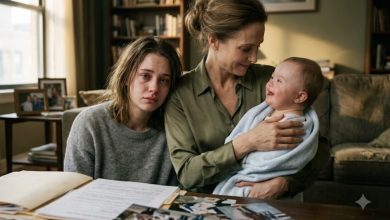
Ten minutes later, Rebecca stood in the doorway. She was smaller than I’d imagined, with gray mixed through her brown hair. She sat by the window, and for two hours, we talked.
She didn’t make herself the victim. She admitted her past mistakes and acknowledged that my father was right to take custody back then.
“He didn’t invent the first two years,” she said quietly. “I was a mess. But he invented the next twenty.”
She had been sober since I was seven. She kept track of my life from afar, knowing when I graduated, married, and became a teacher.
Before she left, I placed baby Caleb carefully in her arms. She whispered, “Hello, little man.”
Moving Forward
Real families don’t repair themselves overnight. I was angry with my father for months, but eventually, I realized I wasn’t required to choose one parent to prove I loved the other.
Caleb is almost two now and knows her as Grandma Becca. My father is still Grandpa. Their interactions are awkward, but nobody lies anymore. That is my one strict rule: no comfortable lies.
The old red bag sits in my closet, filled with every letter she ever wrote to me. It stands as a reminder that while parents can make grave mistakes, truth is the only foundation upon which a real family can be built.
Why Honest Communication Matters in Modern Families
Family secrets are often built on a desire to protect loved ones, but as this story demonstrates, prolonged deception creates far more pain than the truth itself. When parents rewrite reality to preserve appearances or avoid difficult conversations, they risk fracturing trust for generations.
Psychologists consistently emphasize that honest communication—even regarding complicated or unpleasant events—is essential for healthy emotional development. Children who grow up discovering major family lies often struggle with betrayal and mistrust later in life.
Reclaiming the truth is not always easy or comfortable, but it provides the only foundation upon which genuine healing can occur. Moving forward means breaking the cycle of silence, choosing transparency over convenience, and ensuring that future generations grow up in an environment where truth is honored above all else.