My Sister Hid Me at the Back of Her Wedding Because of My Scars — Then the Groom’s Mother Stood Up and Said Five Words
For most of my life, whenever someone asked me about the fire, I gave them the shortest answer possible.
“It happened a long time ago.”
That usually ended the conversation.
People would look at the scars along my neck and hands, notice the wheelchair, and decide they had already asked enough.
What I never told them was that I remembered almost everything.
I remembered the smell of smoke drifting under my bedroom door.
I remembered waking up confused and hearing glass break somewhere downstairs.
I remembered running into the hallway and realizing the house was already filling with smoke.
And more than anything, I remembered my little sister screaming my name.
Her name was Emily.
She was ten years old.
I was seventeen.
Our parents were at a neighbor’s anniversary dinner only a few streets away, and I had stayed home to watch her.
Emily had gone to bed early that night because she had a school field trip the next morning.
I was upstairs doing homework when the fire started.
Investigators later believed an electrical fault in the kitchen caused it.
But none of that mattered to me in those first few minutes.
All I knew was that my sister was trapped in her bedroom.
I could have gone outside.
The stairs were still clear enough for me to reach the front door.
Instead, I went toward her voice.
I don’t remember making that decision.
I simply remember doing it.
Her bedroom door wouldn’t open properly.
Something had fallen against it from inside.
I pushed until my shoulder hurt.
Eventually, the door moved just enough for me to squeeze through.
Emily was beside her bed, crying.
I wrapped a blanket around her and told her to keep her face covered.
Then I carried her into the hallway.
By then, getting downstairs wasn’t possible.
We reached a small window at the end of the hallway.
The roof of our porch was below it.
I climbed halfway out and lowered Emily as far as I could before letting her drop onto the porch roof.
A neighbor climbed a ladder and got her down.
I never made it to the ladder.
Part of the ceiling collapsed behind me.
The next thing I remember clearly is waking up in a hospital.
My parents were beside me.
My mother was crying.
My father looked like he hadn’t slept in a week.
The doctors told me I had survived.
At seventeen, you don’t understand how complicated the word “survived” can be.
I had burns across large areas of my body.
I needed multiple surgeries.
My left leg was badly injured, and complications during recovery permanently affected my mobility.
Over the following years, I learned how to use a wheelchair.
I learned how to ignore strangers staring.
I learned how to answer children’s innocent questions without becoming angry.
I learned that some mirrors were harder to look into than others.
And I learned something else.
I never regretted going back for Emily.
Not once.
She was alive.
That was enough.
At least, I thought it was.
—
Emily and I were extremely close after the fire.
For years, she called me her hero.
When she was thirteen, she wrote a school essay about me.
When she was sixteen, she told her first boyfriend that if he ever disrespected me, she would never speak to him again.
When she graduated from high school, she insisted I sit in the front row.
She hugged me afterward and whispered, “Everything I have is because you came back for me.”
I told her to stop talking like that.
“You don’t owe me your life,” I said.
“But I do.”
“No. You’re my sister. That’s different.”
For a long time, I believed she understood.
Then life moved forward.
Emily went to college.
She moved to another city.
She became successful in public relations and eventually started working for luxury hotels and event companies.
Her world slowly became filled with people who seemed to live inside polished photographs.
Beautiful restaurants.
Designer clothes.
Expensive vacations.
Perfect apartments.
Perfect parties.
Perfect smiles.
We were still sisters, but something changed between us.
Calls became shorter.
Visits became less frequent.
She stopped posting pictures with me online.
At first, I told myself I was imagining it.
Then, during one family Christmas, she asked our mother if I would mind sitting at the end of the dining table because she wanted a “clean background” for a photograph with her friends.
Mom immediately said no.
Emily laughed and claimed she had been joking.
I laughed too.
But I remembered it.
A year later, she met Daniel.
The first time I met him, I liked him.
He wasn’t anything like the people I expected Emily to date.
He was thoughtful and quiet.
When he spoke to me, he looked at my face instead of my scars.
That sounds like a small thing.
It isn’t.
A lot of people don’t realize when they’re doing it, but their eyes wander.
Daniel’s didn’t.
He asked about my job, my apartment, and the volunteer organization I worked with.
Not once did he ask about the wheelchair until I mentioned it myself.
After dinner, he helped me get my chair down the front step even though I told him I didn’t need help.
“I know,” he said. “But I’m standing here anyway.”
I liked him immediately.
A year later, he proposed to Emily.
She called me at almost midnight, screaming with excitement.
For thirty minutes, she described the ring, the restaurant, the candles, and the way he had proposed.
Then she said something that made me smile.
“I want you right there with me when I get married.”
I assumed she meant I would be part of the wedding party.
I was wrong.
A few weeks later, she told me she wanted a small bridal party consisting only of friends from college.
I said I understood.
Then she asked me not to be upset if family members weren’t seated directly beside the ceremony area.
“The photographer has a specific layout,” she explained.
Again, I told her it was fine.
Then came the dress conversation.
“You’ve decided what you’re wearing?” she asked.
“Not yet.”
“Could you maybe wear something with long sleeves?”
I stared at the phone.
“Why?”
“Oh, just because it’s going to look more formal.”
I knew what she meant.
Still, I didn’t argue.
I bought a navy dress with long sleeves and a high neckline.
It covered most of my scars.
The morning of Emily’s wedding, our mother came to my hotel room while I was getting ready.
She looked at me for several seconds before saying, “You look beautiful.”
I smiled.
“Mothers have to say that.”
“No. Mothers have to tell the truth when their daughters forget it.”
I didn’t understand what she meant until later.
The wedding took place at an old estate about forty minutes outside the city.
There were gardens, fountains, white roses everywhere, and dozens of small lights hanging from trees.
It looked like something from a magazine.
Guests were already arriving when Mom and I reached the ceremony area.
A wedding coordinator approached us.
“Mrs. Parker?” she asked my mother.
“Yes.”
“And you must be Sarah.”
I smiled.
“That’s me.”
Her expression changed slightly.
“I’m supposed to show you to your seat.”
My mother frowned.
“We know where the family seats are.”
The coordinator hesitated.
“I was given specific instructions.”
My stomach tightened.
She led us past the rows near the front.
Then past the middle rows.
Then toward the very back.
There, beside a decorative hedge, was a single empty space wide enough for my wheelchair.
My mother’s face turned red.
“This must be a mistake.”
Before the coordinator could answer, I saw Emily walking toward us.
She was already dressed for the ceremony.
Her gown was elegant and simple.
For one second, seeing my little sister as a bride erased everything else.
“You look incredible,” I said.
She didn’t smile.
Instead, she looked around nervously.
“Mom, can I talk to Sarah alone?”
“No,” Mom said immediately.
“It’s fine,” I told her.
Mom reluctantly walked away.
Emily leaned closer.
“I know this looks bad.”
“Then why am I sitting back here?”
She crossed her arms.
“The photographer suggested keeping the front area visually balanced.”
I stared at her.
“Visually balanced?”
“You know what I mean.”
“No, Emily. I don’t.”
She exhaled sharply.
“Sarah, please don’t make today difficult.”
Something cold settled in my chest.
“I’m not doing anything.”
“Then just sit here.”
I looked toward the front.
Our parents’ seats were in the first row.
Daniel’s mother was already sitting there.
A place had clearly been reserved for me beside Mom.
Someone had moved it.
“You told them to put me here?”
Emily glanced toward the arriving guests.
Then she whispered words I still wish I had never heard.
“Go sit in the back. You’re ruining my perfect wedding.”
For several seconds, I couldn’t speak.
I wasn’t angry at first.
I was embarrassed.
Then hurt.
Then strangely calm.
I looked at my little sister, the child I had carried through a burning hallway sixteen years earlier.
I wondered how that girl had become this woman.
But I didn’t remind her of the fire.
I didn’t tell her she owed me anything.
I simply moved my wheelchair into the space.
“Okay,” I said.
Her expression softened with relief.
“Thank you.”
That hurt more than anything else.
She turned and walked away.
I almost left.
I actually pulled my phone from my bag and began searching for a taxi service.
Then someone touched my shoulder.
It was Daniel’s mother, Margaret.
I’d met her only twice before.
She was in her early sixties, elegant, calm, and usually very reserved.
“You aren’t supposed to be sitting here,” she said.
“It’s fine.”
“No, it isn’t.”
“Margaret, please. I don’t want to create a scene.”
She studied me carefully.
Then she asked, “Did Emily put you here?”
I didn’t answer.
Apparently, my face answered for me.
Margaret walked away.
A few minutes later, the music began.
Everyone stood as the ceremony started.
I remained in the back.
My father looked confused when he realized where I was sitting.
Mom looked furious.
But before either of them could move, Emily appeared at the beginning of the aisle.
Everything became quiet.
She looked beautiful.
For a moment, I felt nothing but love for her.
That was the hardest part.
You can be deeply hurt by someone and still love them.
Emily began walking toward Daniel.
Then Margaret stood.
At first, people probably assumed she was adjusting her dress.
Instead, she stepped into the aisle.
The music stopped.
Daniel turned toward her.
“Mom?”
Margaret looked directly at Emily.
Then she said five words.
“She once saved my son.”
The entire garden went silent.
I stared at her.
So did Emily.
Daniel looked completely confused.
“What are you talking about?” he asked.
Margaret turned toward the guests.
“Sarah doesn’t know this.”
Neither did I.
Margaret walked toward me.
Her eyes were already filling with tears.
“Four years ago,” she said, “Daniel volunteered at a rehabilitation center after a car accident left one of his closest friends unable to walk.”
I remembered that center.
I had volunteered there for several years.
Margaret continued.
“Daniel was in a very dark place at the time. His friend blamed him for the accident because Daniel had been driving.”
Daniel lowered his eyes.
I suddenly remembered him.
Not clearly.
But enough.
A young man who used to sit in the hallway outside the physical therapy room.
He hardly spoke.
I had assumed he was simply visiting someone.
Margaret continued.
“One afternoon, Sarah sat beside him.”
A memory returned.
A young man crying quietly where he thought no one could see him.
I had sat beside him.
He had told me his best friend might never walk again.
He believed he had destroyed another person’s life.
I remembered telling him something I had learned during my own recovery.
“You can spend your life asking why it happened, or you can spend your life deciding what you do next.”
We talked for maybe twenty minutes.
I never learned his name.
Apparently, it had been Daniel.
Margaret looked at her son.
“You came home that evening and told me a woman in a wheelchair had stopped you from making the worst decision of your life.”
The air left my lungs.
Daniel slowly walked down the aisle toward me.
“That was you?”
I nodded, stunned.
“I didn’t recognize you.”
“Neither did I.”
He looked at my hands.
Then my face.
And suddenly he understood.
“I never saw your scars that day,” he said softly.
“You were wearing a coat.”
Margaret turned toward Emily.
“Your sister didn’t only save you.”
Emily had gone completely pale.
Margaret’s next words were quieter.
“She saved this family too.”
No one moved.
Then Daniel looked toward the chair that should have been beside our parents.
“Why is Sarah sitting back here?”
Emily said nothing.
Daniel looked at me.
I didn’t answer.
Then he looked at Emily again.
“Why?”
She started crying.
“It was the pictures.”
Daniel stared at her.
“What pictures?”
“I wanted everything to look perfect.”
Margaret shook her head.
“No photograph is worth making someone feel ashamed of surviving.”
Emily covered her mouth.
The photographer lowered his camera.
Guests began whispering.
I wanted the ground to open beneath me.
This wasn’t how I wanted her wedding day to unfold.
So I did the only thing I could think of.
I rolled forward.
“Stop.”
Everyone looked at me.
I turned toward Daniel.
“Don’t punish her publicly.”
Then I looked at Emily.
“But don’t ask me to pretend this didn’t happen.”
She cried harder.
“I’m sorry.”
“Not here,” I said. “Not because everyone’s watching.”
That was when Daniel did something unexpected.
He walked back to the front, picked up the chair beside our mother, and carried it down the aisle.
Then he placed it next to me.
He sat.
Margaret sat beside him.
My parents followed.
Within seconds, the entire front row had moved to the back.
Guests looked at one another.
Then several of Daniel’s relatives moved too.
Someone laughed nervously.
Another person picked up a chair.
Within ten minutes, half the wedding had reorganized itself.
The wedding coordinator looked horrified.
Daniel looked delighted.
“If Sarah sits in the back,” he said, “I guess the back is the front now.”
Even I laughed.
Emily stood alone at the beginning of the aisle.
Then she did something I didn’t expect.
She lifted the front of her dress and walked directly toward me.
She knelt beside my wheelchair.
“I’m sorry,” she whispered.
I could see mascara beginning to run beneath her eyes.
“I don’t deserve you.”
I shook my head.
“This isn’t about deserving me.”
“I became horrible.”
“No. You made a horrible choice.”
She looked at me.
There’s a difference between telling someone they are terrible and telling them they did something terrible.
One gives them somewhere to go.
The other doesn’t.
“I spent years trying to make my life look perfect,” she said. “I didn’t realize what I was becoming.”
I touched her hand.
“Then decide what you become next.”
Daniel heard me.
His expression changed.
Those were almost the same words I’d said to him years earlier.
Emily looked at him.
Then at me.
Then she stood.
“I want to start again.”
The ceremony began twenty minutes late.
This time, I sat beside my parents.
There was no perfectly symmetrical arrangement.
Some chairs were crooked.
A few guests stood because there weren’t enough seats in the new layout.
The photographer had to change almost every planned angle.
It was, visually speaking, a disaster.
And somehow, it was beautiful.
—
I wish I could tell you everything became easy after that.
It didn’t.
Emily and I had several difficult conversations after the wedding.
There were apologies.
There were tears.
There were moments when I finally admitted that her behavior hadn’t begun that day.
For years, I had noticed her slowly hiding me from parts of her life.
She admitted it.
She had become obsessed with appearances.
Her job rewarded presentation.
Her social circle rewarded it too.
Eventually, she began measuring everything in photographs.
Apartments.
Meals.
Vacations.
Friends.
Even family.
She had started treating life like a display.
And without realizing it, she had begun removing anything that didn’t fit the picture she wanted to present.
Including me.
A few months after the wedding, Emily deleted nearly all her carefully staged social media posts.
She didn’t disappear from the internet.
She simply stopped treating it like a museum of perfection.
But the biggest surprise came nearly a year later.
Daniel and Emily visited my apartment one Sunday afternoon.
Emily placed an envelope on my kitchen table.
“What’s this?”
“Open it.”
Inside were documents for a nonprofit organization.
I looked at the name twice.
Second Door Foundation.
“What is this?”
Emily smiled.
“Remember what you always say?”
I frowned.
“What?”
“Surviving something isn’t the end of the story.”
The organization would help families whose homes had been damaged by fires.
Temporary accommodation.
Clothing.
Transportation.
Counseling.
Accessibility equipment.
Things insurance didn’t always handle quickly enough.
Daniel had contributed part of his savings.
His mother had contributed too.
Emily had spent months arranging partnerships with hotels through her work.
Then I saw my own name listed as a founding board member.
I looked up.
“You didn’t ask me.”
“We’re asking now.”
I laughed.
“That’s not how asking works.”
Daniel grinned.
“We’re still learning.”
I eventually said yes.
The foundation grew faster than any of us expected.
Within two years, we had helped dozens of families.
But the strangest moment came during one of our first fundraising events.
A woman approached me after my speech.
She looked familiar, although I couldn’t place her.
She handed me an old photograph.
It showed two firefighters outside our childhood home.
One of them was carrying a seventeen-year-old girl.
Me.
The woman pointed to the firefighter.
“That’s my father.”
I looked at her.
“He was the man who brought you out.”
I’d never known his name.
She told me he had died several years earlier.
Before he died, he kept a newspaper clipping about the fire in a drawer beside his bed.
He had apparently spoken about it often.
“He always said that rescue bothered him,” she told me.
“Why?”
“Because everyone called him the hero.”
I didn’t understand.
She smiled.
“He said by the time he arrived, the real rescue had already happened.”
I looked at the photograph for a long time.
For sixteen years, people had called me brave because I saved my sister.
For years after that, I hated when strangers stared at what the fire had left behind.
At my sister’s wedding, I thought my scars were the reason I didn’t belong in the perfect picture she wanted.
But I finally understood something.
Those scars weren’t evidence of what the fire destroyed.
They were evidence of what survived.
My sister.
My future.
Daniel’s future, in a strange and unexpected way.
And eventually, dozens of families we would meet through the foundation.
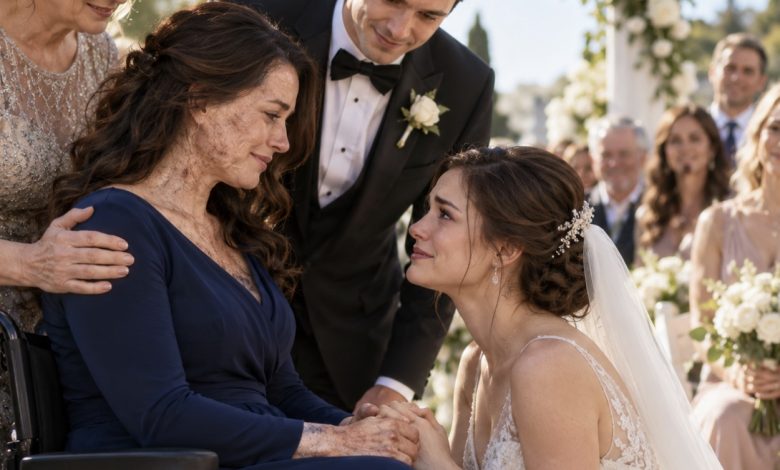
The photograph from that wedding still hangs in Emily’s house.
It isn’t the elegant portrait she originally imagined.
Chairs are scattered everywhere.
People are sitting in the wrong places.
Daniel’s tie is crooked.
Margaret is laughing.
My mother looks like she’s been crying.
Emily’s makeup isn’t perfect.
And I’m right in the middle of the photograph.
A few years ago, I joked that she should replace it with one of the prettier pictures.
She shook her head.
“No.”
“Why?”
She looked at the photograph for a moment.
Then she gave me an answer I never expected from the woman who once told me I was ruining her perfect wedding.
“Because this is the first picture where I finally understood what perfect means.”
And that’s the photograph she kept.