The Old Man in Room 412 Had No Visitors – Until My Therapy Dog Refused to Leave His Side
It’s past two in the morning and I’m still sitting in my car in the hospital garage in Spokane, because I can’t make myself turn the key. Juniper is asleep on the passenger seat with her red vest still on. I didn’t have the heart to take it off her.
I’ve been volunteering with her for three years. Tuesdays and Fridays, two hours, in and out. She’s a scruffy gray schnauzer mix, nothing fancy, one ear that never stands up right. Most patients pet her for five minutes and tell me about their own dogs back home. That’s the job.
Room 412 was different.
Mr. Ambrose Teague. Eighty-one. Retired bridge welder, the nurse Lorna told me in the hallway. Real quiet. Then she lowered her voice. “He’s got a son in Phoenix. We called three times. Goes to voicemail, and the voicemail’s full.”
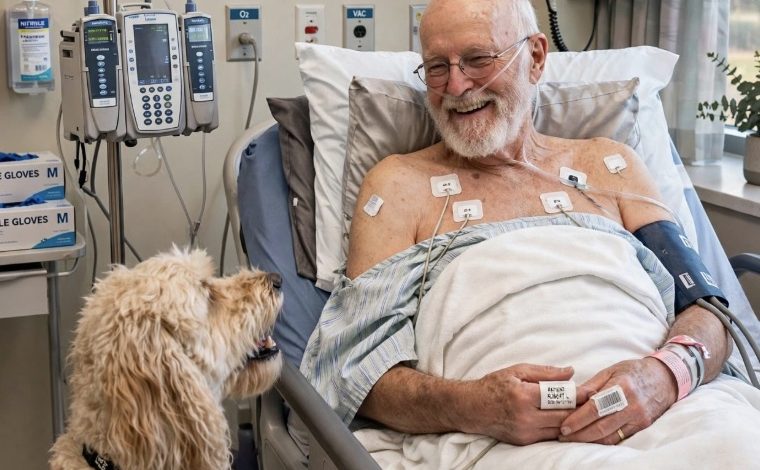
I walked in expecting nothing. He had the oxygen tube under his nose and those white sticky pads all over his chest, and his hands folded on the blanket like he was waiting for a bus. On the tray table there was a birthday envelope, still sealed, with the corner of a twelve-dollar stack poking out. Somebody wrote “GRANDPA” on the front in kid handwriting, the R backwards. Nobody had opened it.
Juniper sat down beside the bed and looked up at him. Didn’t wag. Didn’t whine. Just looked.
And he smiled. First time all week, Lorna said later.
“She’s got a welder’s patience,” he told me. His voice sounded like gravel in a coffee can. “Sits there and waits for the metal to tell her what it wants.”
We were supposed to leave after twenty minutes. Juniper wouldn’t go. I tugged the leash and she laid down flat on that cold floor, chin on her paws, and gave me a look like I was the one being rude. So I ended up on the floor next to her, because there was one chair and his old Carhartt jacket was folded on it and I wasn’t moving that. My knees are still killing me. I just noticed I’m wearing one black sock and one navy one, that’s how my week been going.
My phone was on 7 percent. Somewhere in there daycare texted that I’m $215 behind, and I just flipped the screen face down on the linoleum. It didn’t matter right then.
Around eleven his breathing changed. Slower, with longer spaces. Lorna came in, checked the monitor, squeezed my shoulder and didn’t say a word, which said everything.
Mr. Teague let his hand slide off the blanket and hang over the rail. Juniper stood up and pushed her head right under his palm. And she stayed there.
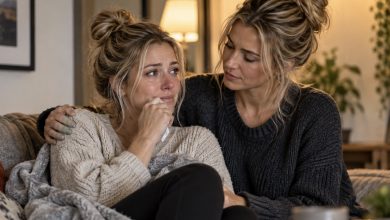
I called my sister Noreen from the garage just now and told her all of it. She was quiet for a long time, then she said, “So the dog was the only one who stayed with him.” And it brought back everything I’d been trying not to think about in that room. A son somewhere. A grandkid with a backwards R. Everybody who was supposed to be in that chair.
Instead it was a twenty-two pound dog with a crooked ear who refused to leave. She was the only one who stayed beside that old man until the very end.
She kept her head under his hand for four hours, until his fingers went still.
I almost didn’t answer. My phone was on 3 percent by then and I had no idea who in Arizona would be calling me at that hour. Then I remembered Lorna had asked for my number “just in case family wants to know who was with him.”
“Is this the lady with the dog?” A man’s voice, rough, like he’d been driving with the windows down. “This is Curtis. Curtis Teague. The hospital said… they said you were there.”
I told him yes. I told him his dad went peacefully, a little after one, and that he wasn’t alone.
There was a sound on the other end I’ll never forget. Not crying exactly. More like somebody setting down something very heavy after carrying it too long.
“My voicemail’s full,” he said finally. “Did they tell you that? It’s full because he left me a message every Sunday for eleven years. Every single Sunday. And I never listened to one of them. I just couldn’t delete them either.”
He told me the whole thing sitting in his truck outside a gas station somewhere past Kingman. When he was seventeen, he did his first real weld on a footbridge over a creek near their house in Colville. His dad looked at it and said it wouldn’t hold through one winter. They yelled. Curtis left for Phoenix a year later and the two of them turned into the kind of family that only talks at funerals. Then they stopped talking at those too.
“He’d call and I’d watch the phone ring,” Curtis said. “Then there’d be a new voicemail and I’d feel sick all day. Isn’t that crazy? Feel sick about a voicemail you won’t even play.”
I sat there in the garage with Juniper’s warm back against my leg and I almost didn’t tell him the last part. Because I wasn’t sure I heard it right.
Around midnight, when his breathing got slow, Mr. Teague opened his eyes one more time. He looked at Juniper, not at me. And he said, very clear, “Tell Curt the bridge held.”
That’s all. Then he closed his eyes.
On the phone, Curtis didn’t say anything for so long I thought the battery died. Then he laughed, this broken little laugh. “It’s still there,” he said. “That stupid footbridge. Thirty years. I drove past it with my son last summer and didn’t even stop the car.”
Then he asked me about the envelope.
It was from his boy, Tobias, nine years old. Curtis had mailed it two weeks before, because Tobias insisted. Inside was twelve dollars from his allowance jar and a card. Curtis knew what it said because Tobias read it to him out loud before sealing it.
“Grandpa, this is for gas so you can come see me.”
Lorna told me later Mr. Teague asked the nurses to leave it sealed. He said he wanted to open it when his grandson got there.
Three weeks later I got a message through the volunteer office. A man and a boy were asking for “the lady with the gray dog.”
Curtis was taller than I imagined, with his father’s hands. Exactly his father’s hands. Tobias hid behind him until Juniper trotted up and sat down at his feet the way she sat by that hospital bed, no wagging, just waiting. Then he got down on the floor with her and didn’t get back up for a while.
They had come up from Phoenix to bury Ambrose in Colville, next to his wife. On the way they stopped at the creek. Curtis and Tobias stood on the footbridge together, the one that held, and opened the envelope there. Tobias kept the twelve dollars. Curtis said that felt right, like his dad would’ve wanted the boy to use the gas money himself someday.
Before they left, Curtis pulled something out of his jacket pocket. A small tag cut from steel, smooth edges, a tiny welded bead around the border. On it he’d stamped one word: STAYED.
“I made it in my garage,” he said. “It’s not as good as he’d do. But it’ll hold.”
Juniper wears it on her vest now, right next to her volunteer badge. People ask about it on Tuesdays and Fridays. Sometimes I tell them the whole story. Sometimes I just say she’s good at waiting.
Curtis calls me sometimes on Sunday evenings. Not about anything big. Just to ask how Juniper’s doing.
I always pick up.