Thirty-One Years After I Stayed Silent, He Showed Up at the Library Garden
I recognized his name on the brass plaque before I saw his face.
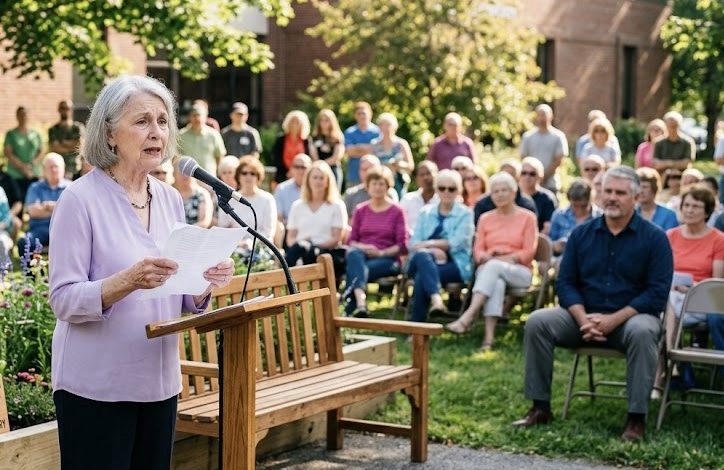
I was standing beneath a row of maple trees behind the North Ridge Public Library, holding two stapled pages that I had rewritten at least six times. My sister had talked me into wearing the lavender blouse because, according to her, my usual gray cardigan made me look like I was “waiting for the pharmacy to call.”
There were maybe sixty people gathered in folding chairs on the grass.
Children were running between the new wooden benches. Somebody from the bakery on Cedar Avenue had brought lemon bars. The Friends of the Library had set up a table with iced tea, paper cups, and a little handwritten sign that said PLEASE TAKE ONE COOKIE UNTIL EVERYONE HAS BEEN SERVED.
It was exactly the kind of event I understood.
Quiet.
Local.
Safe.
I had served on the library board for twenty-two years. Before that, I had volunteered here. Before that, I had simply been a woman who came every Tuesday with two small children and returned home with more books than I could comfortably carry.
The new reading garden was supposed to be one of the happiest things we had ever done.
Three benches. Raised flower beds. A small paved path wide enough for wheelchairs. A covered reading table for children. Native plants selected by the high school environmental club.
Most of the money had come from one private donor.
I had never asked who.
That morning, when I arrived, I finally saw the plaque attached to the stone near the entrance.
READING GARDEN MADE POSSIBLE THROUGH A GIFT FROM DANTE ALVAREZ AND FAMILY
For a few seconds, I actually wondered if there could be another one.
Another Dante Alvarez.
Another man with that name connected to North Ridge.
Then I heard laughter behind me.
I turned.
He was standing near the last row of chairs.
He was older, of course.
So was I.
The skinny seventeen-year-old I remembered had become a broad-shouldered man with silver beginning at his temples. He wore dark jeans, an open-collar blue shirt, and the kind of expression people wear when they have arrived somewhere they are not certain they should have come.
Beside him stood a woman around his age and a younger woman who looked enough like him to be his daughter.
He saw me.
There was no dramatic reaction.
No anger.
No smile either.
He simply looked at me for several long seconds and gave a small nod.
My hands started shaking hard enough that the corners of my speech made a faint clicking sound against each other.
“Marian?”
I looked over.
Devon Park, our library director, was watching me.
“You okay?”
“Yes.”
It came out too quickly.
She followed my eyes toward the back row.
“Do you know Mr. Alvarez?”
I looked down at my papers.
“I used to.”
She smiled, unaware of anything being wrong.
“He didn’t want any attention, actually. We practically had to beg him to come today. Apparently he spent a lot of afternoons in this library when he was a kid.”
I knew.
I knew exactly how many afternoons Dante Alvarez had spent there.
Because for nearly a year, I had been the person who signed his volunteer sheets.
Back then, the library looked completely different.
No computers except one boxy machine behind the main desk. Brown carpet. Metal shelves. A copy machine that jammed if you looked at it wrong.
I was thirty-seven and serving as treasurer for the Friends of the Library.
Dante was seventeen.
His mother worked evenings at St. Vincent’s Hospital, and he usually came to the library after school because their apartment was only a few blocks away. He shelved books, carried boxes, fixed loose chairs, helped older patrons use the copy machine, and occasionally stayed until closing.
He was polite without being charming.
Quiet without being shy.
And he read constantly.
Science fiction mostly.
One Friday in October, the Friends group held its annual used-book sale.
By the end of the day, we had collected a little over eight hundred dollars in cash.
I counted it myself.
I put the money inside a white bank envelope and placed it in the locked drawer beneath the circulation desk.
The next morning, the envelope was gone.
Only three people had been in the building after I counted it.
Me.
My husband, Glenn, who had come to help move two tables.
And Dante.
I can still remember standing behind the desk while our head librarian, Ruth, asked him whether he knew anything about the envelope.
“No, ma’am.”
“You were here last night.”
“Yes.”
“You were behind the desk?”
“To get the cart.”
“Did you open the drawer?”
“No.”
He looked at me after he answered.
I wish I could say I defended him.
I didn’t.
I said, “I saw him behind the desk.”
That was true.
But it wasn’t the whole truth.
And sometimes the part you leave out causes more damage than the part you say.
Dante was removed from the volunteer program.
Nobody called the police because Ruth didn’t want to ruin a teenager’s life over money we couldn’t prove he had taken.
I told myself that made things better.
It didn’t.
Rumors traveled.
They always do in small communities.
Two weeks later, Dante stopped coming to the library.
By Christmas, his mother had moved them to Spokane to live near her sister.
And six days after they left, I found the envelope.
It was inside the bottom drawer of the old metal filing cabinet in the meeting room.
Glenn had put it there.
He had forgotten.
That was all.
There was no theft.
No criminal.
No clever explanation.
My husband had been cleaning the circulation area after the sale, noticed the envelope sitting where someone might see it, and moved it somewhere safer.
Then he forgot to tell me.
When I found it, I sat alone in that little meeting room staring at eight hundred and twelve dollars.
I knew exactly what I was supposed to do.
Call Ruth.
Call Dante’s mother.
Tell everyone.
Correct the story.
Instead, I hesitated.
That hesitation became one day.
Then two.
Then a week.
I was ashamed.
But the more time that passed, the harder admitting the truth seemed.
People had already talked.
I had already allowed them to believe him guilty.
I began imagining what they would say about me.
That I had rushed to judgment.
That I had been careless.
That I had helped push an innocent boy out of a place he loved.
Every one of those things was true.
So I did something much worse than making a mistake.
I protected myself from the embarrassment of admitting it.
Glenn wanted me to call.
I told him I would.
I even wrote a letter to Dante’s mother.
Three pages.
I never mailed it.
Glenn died eleven years ago.
The letter was still in a box in my bedroom closet.
And now Dante was sitting twenty yards away from me while people congratulated him for giving money to the same library where I had allowed his name to be damaged.
“Marian?”
Devon touched my elbow.
“You’re next.”
People were clapping.
I walked toward the small microphone beside the new garden path.
Someone adjusted it lower for me.
I unfolded my speech.
“Thank you all for being here,” I began.
My voice sounded steady.
That surprised me.
I thanked the volunteers.
The high school students.
The parks department.
The businesses that had donated soil, lumber, flowers, and labor.
Then I reached the paragraph about the primary donor.
The paragraph said:
And finally, our deepest gratitude goes to Mr. Dante Alvarez and his family, whose generous gift made this garden possible.
I looked toward him.
He was watching me.
I folded the speech in half.
Then I put it down on the little stand beside the microphone.
“There is something I need to say before we open this garden.”
The conversations stopped.
Devon looked confused.
Dante didn’t move.
I held the microphone with both hands because I was afraid one hand alone would shake too much.
“Most people here know me. Some of you have known me for forty years. And because of that, this is probably something I should have said a very long time ago.”
I looked directly at Dante.
“Dante Alvarez never stole that money.”
I swallowed.
“And I knew that before he left town.”
The microphone picked up the small sound someone made in the front row.
Not quite a gasp.
More like a surprised breath.
Behind me, one of the children dropped something plastic onto the pavement, and for some reason the little clatter sounded incredibly loud.
I continued before fear could stop me.
“Thirty-one years ago, money disappeared after the Friends of the Library book sale. Dante was blamed. There wasn’t evidence. There was only suspicion. And I helped create that suspicion.”
Nobody interrupted.
“My husband had moved the envelope. He was trying to keep it safe. I found it after Dante and his mother had already moved away.”
I could see Devon staring at me now.
I didn’t look at anyone else.
“I should have called his family immediately. I should have told every person who heard the rumor. I should have apologized.”
My mouth had become dry.
“I didn’t.”
That was the hardest part.
Not explaining what happened.
Saying those two words.
I didn’t.
“I was embarrassed. I was afraid of what people would think of me. So I let a seventeen-year-old boy carry something that belonged to me.”
There was no applause.
I was grateful for that.
Applause would have made it feel like courage.
It wasn’t courage.
It was overdue.
“I am sorry, Dante.”
He looked down for a moment.
Then back at me.
“I should have told you thirty-one years ago.”
I stepped away from the microphone.
Devon came toward me, but before she reached me, Dante stood.
For one horrible second, I thought he might leave.
I wouldn’t have blamed him.
Instead, he walked slowly down the aisle between the chairs.
People moved their knees aside to let him through.
When he reached the microphone, he looked at me.
“Can I?”
I nodded.
He stood where I had been standing.
“My daughter asked me this morning why I almost didn’t come.”
A few people turned toward the young woman in the back row.
Dante smiled faintly.
“I told her I didn’t like ceremonies.”
His daughter shook her head as if she had heard that excuse before.
“That wasn’t really the reason.”
He put one hand in his pocket.
“I knew Marian would probably be here.”
Hearing my name from him after all those years did something strange to me. It brought back the old library so clearly that I could almost smell that brown carpet.
Dante continued.
“For a long time, this building was not a good memory for me.”
He didn’t soften it.
I respected him for that.
“When we moved, my mother told people it was because my aunt had found her better work. That was partly true. But she also wanted me away from here.”
He looked toward the library.
“I had spent years in that place. I knew where every shelf was. I wanted to become an architect because of books I found here.”
That was something I had never known.
“The funny thing is, I eventually did.”
Several people laughed quietly.
“My wife says it wasn’t funny because architecture school cost us a fortune.”
The woman beside his daughter laughed.
The tension loosened slightly.
Then he became serious again.
“I found out the money had been recovered about six years after we moved.”
My head came up.
I stared at him.
He saw my surprise.
“Ruth wrote my mother.”
I had never known.
“She apologized. My mother showed me the letter.”
I could barely process it.
For decades, I had imagined Dante never knowing the truth.
Maybe part of me had preferred that version because it made my unsent letter seem more important than it was.
“But,” he continued, “I also knew Marian never contacted us.”
There it was.
Simple.
Accurate.
Painful.
“I was angry about that for a long time.”
He turned toward me.
“I won’t pretend I wasn’t.”
I nodded.
He deserved that anger.
“Then life got busy. College. Work. Marriage. Kids. My mother got sick. Years passed.”
He glanced toward the garden.
“A few years ago, my daughter was doing a college project about public spaces. She asked me where I first became interested in design.”
He smiled.
“I told her about this library.”
His daughter called from the back, “After I asked him about twelve times.”
People laughed again.
“So I looked the place up,” Dante said. “I saw that the library wanted to build an accessible reading garden but didn’t have enough funding.”
He paused.
“My first reaction was definitely not to send a check.”
That got the biggest laugh yet.
Even I smiled.
“But I kept thinking about something my mother used to say. She said a place can fail you without everything about that place being bad.”
That sentence stayed with me.
Dante said he had spent wonderful afternoons in the library before the accusation.
He had discovered Ray Bradbury there.
Ursula Le Guin.
Books about bridges, buildings, train stations, and cities.
He had met an elderly volunteer named Mr. Kubacki who taught him how to repair book bindings.
Those memories were also real.
“So I decided I didn’t want the worst thing that happened here to own every good thing that happened here too.”
That was why he donated.
Not because he had forgotten.
Not because he thought what happened didn’t matter.
Because he refused to let it be the only story.
When he finished, people applauded.
This time it felt appropriate.
I remained near the microphone but didn’t go to him immediately.
I didn’t think I had earned a public hug, and I certainly wasn’t going to create one because people were watching.
After the ribbon was cut, everyone drifted toward the refreshments.
I found a quiet place behind one of the new raised beds.
A few minutes later, Dante walked over.
For a moment, neither of us spoke.
Then I said, “I wrote you a letter.”
He gave me a puzzled look.
“When?”
“Thirty-one years ago.”
“Did you send it?”
“No.”
He nodded once.
“That sounds about right.”
It hurt.
But it also made me laugh.
A small, embarrassed laugh.
“I still have it.”
“Why?”
“I don’t know.”
He looked at me carefully.
“I think you do.”
He was right.
I had kept the letter because it allowed me to pretend some better version of myself had existed.
The woman who wrote the apology.
Not the woman who failed to mail it.
“I think I kept it because I wanted proof that I felt bad.”
Dante nodded.
“Feeling bad is easier than fixing something.”
“Yes.”
We stood quietly for a while.
Then I asked him the question I had been afraid to ask.
“Did what happened here change your life?”
He thought about it before answering.
“Yes.”
No comforting lie.
“I stopped trusting adults for a while. I quit volunteering. When teachers accused kids of things, I always assumed the teacher was wrong.”
He rubbed the back of his neck.
“But I also had people who believed me. My mom. My aunt. A coach in Spokane. Later my wife.”
He glanced toward his family.
“So no, you didn’t ruin my life, if that’s what you’re asking.”
I looked down.
“But you did hurt me.”
“I know.”
“And my mother.”
“I know.”
“She never forgave you.”
That one landed harder than I expected.
Dante must have seen it on my face.
“She died four years ago,” he said.
“I’m sorry.”
“She had a good life.”
I wanted to say more.
There wasn’t anything useful to say.
So I didn’t.
For once, silence was the honest choice.
Then Dante looked toward the garden.
“My daughter designed the curved bench.”
I followed his eyes.
The younger woman was sitting on it with her mother.
“She’s an architect too?”
“Landscape design.”
He smiled.
“Apparently one architect in the family wasn’t annoying enough.”
I laughed.
He did too.
It wasn’t forgiveness.
Not yet.
Maybe not ever in the clean way people like stories to end.
But it was two people standing beside a flower bed, speaking honestly after thirty-one years of avoiding the same truth.
A week later, I mailed Dante the old letter.
I almost threw it away first.
Then I decided it belonged to him, not me.
I added one new page.
It was much shorter than the original.
I wrote:
I am not sending this because the woman who wrote it deserves credit for feeling sorry. She doesn’t.
I’m sending it because it was always yours.
You never owed me forgiveness.
I owed you the truth.
Three days later, I received an email.
Only four sentences.
He said he had read both letters.
He thanked me for finally saying it publicly.
Then he wrote something I did not expect.
The garden needs volunteers on Saturday mornings.
You already know where the library is.
So that Saturday, I put on old jeans and arrived at nine.
Dante wasn’t there.
His daughter was.
She handed me gardening gloves and pointed toward a row of young lavender plants near the path.
“Those need weeding.”
I looked at the plants.
Then at my lavender shirt from the ceremony, which I had stupidly worn again because it was comfortable.
His daughter smiled.
“Apparently you have a theme.”
I laughed harder than the joke deserved.
We spent the morning pulling weeds.
Over the next few months, Dante came by several times.
Our conversations were never dramatic.
We talked about books.
His mother.
My grandchildren.
The terrible coffee from the machine in the library lobby.
Sometimes we didn’t talk about the past at all.
That mattered to me too.
I used to think forgiveness meant reaching some perfect moment where everything hurtful was washed away.
I don’t believe that anymore.
Some things remain.
A wrong accusation remains wrong.
Thirty-one years cannot be returned.
An apology does not give a seventeen-year-old boy back the afternoons when people whispered about him.
But the truth can still be told late.
Responsibility can still be accepted late.
And sometimes, if you are fortunate, the person you hurt may allow you to stand somewhere nearby while something better grows.
The garden is beautiful now.
The flowers filled out by midsummer. Children use the covered table after school. Retired people sit on the curved bench with newspapers. On warm evenings, families bring books outside.
There is one spot near the entrance where the lavender grows especially thick.
Every time I pass it, I see the brass plaque with Dante’s name.
For years, I thought the worst thing about my mistake was that people might someday discover what I had done.
I understand now that the worst thing was how long I made another person live with the consequences because I was afraid of being embarrassed.
The truth did embarrass me.
For about five minutes.
The silence had lasted thirty-one years.
Frequently Asked Questions (FAQ)
What is this story about?
The story follows the reconciliation between Marian, a longtime library volunteer, and Dante Alvarez, a man falsely accused of theft as a teenager. Thirty-one years later, Marian publicly confesses her silence during the grand opening of a new library reading garden funded by Dante, exploring themes of accountability, guilt, and the power of late apologies.
Who actually stole the money from the library book sale?
No one stole the money. Marian’s husband, Glenn, moved the envelope containing the $812 to a safer drawer in the filing cabinet while cleaning up and forgot to tell her. Marian discovered the money shortly after Dante and his mother had already moved away.
Why didn’t Marian tell the truth as soon as she found the missing envelope?
Marian was afraid of judgment and public embarrassment. She hesitated out of shame, dreading what people in her small community would think of her quick judgment. That initial hesitation grew into days, weeks, and ultimately decades of silence.
Did Dante know he was cleared before Marian’s public confession?
Yes. Dante revealed that the former head librarian, Ruth, had written a letter to his mother six years after they moved, apologizing and explaining that the money had been recovered. However, Dante was well aware that Marian had never reached out herself.
What does the reading garden represent in the narrative?
The reading garden symbolizes healing, growth, and reclaiming a narrative. By funding the space, Dante chose not to let his worst experience at the library erase his fondest childhood memories—such as discovering his passion for architecture through the library’s books.
What is the central moral of the story?
The core message is that taking responsibility and telling the truth still matter, even when it is long overdue. While an apology cannot undo past harm or return lost time, acknowledging past mistakes releases the burden of silence and opens a path toward honest connection.