I Found My Grandmother’s Red Heels Beside Her Pearls the Morning of Her Funeral—Then I Saw What She Had Hidden Inside One of Them
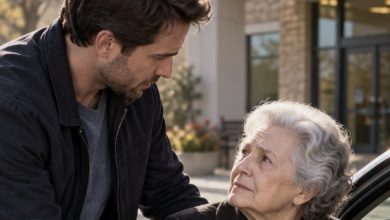
My grandmother had been gone less than twelve hours when my uncle stood in her kitchen, drinking coffee from her favorite mug, and told me there was “no reason for anybody to go through her bedroom.”
That was the first moment something felt wrong.
Not because of what he said exactly, but because of how quickly he said it.
Nobody had asked about her bedroom.
It was 7:38 on a gray Saturday morning in Cedar Ridge, Missouri. The coffee maker was still clicking behind him. My mother was standing at the counter spreading strawberry jam over a piece of toast she clearly had no intention of eating. My cousin Caleb was outside on the porch talking quietly to the funeral home staff.
And Uncle Wade was already talking about Grandma’s things.
“Her papers are organized,” he said. “I’ll handle all that after the service. No point everybody digging through drawers.”
My mother nodded without even looking up. Wade had always handled things—taxes, insurance, property paperwork, car titles, and Grandma’s prescriptions after Grandpa passed away. If there was a issue in our family, somebody usually said, “Call Wade.”
He was fifty-eight, broad-shouldered, clean-shaven, and had spent twenty-six years managing a building supply store outside Springfield. He coached Little League when we were kids, cooked burgers at the Fourth of July church picnic, and was the person who brought jumper cables when your battery died.
Nobody questioned Uncle Wade. Including me—at least not then.
My grandmother, Ruth Caldwell, had passed away peacefully the night before at eighty-three. She had been home, exactly where she wanted to be, in the little white farmhouse where she had lived since 1967. Grandpa built the back porch himself. Grandma planted tomatoes beside the garage every spring. Every Thanksgiving, there were too many people squeezed around her dining-room table, and somebody always ended up eating with a paper plate balanced on their knees.
When I was little, she made cinnamon toast before school whenever I stayed overnight. White bread, butter, sugar, and cinnamon. I can still smell it.
That morning, Mom asked me to go upstairs and find Grandma’s pearl earrings. “She always said she wanted those,” Mom whispered.
I remembered them immediately: small cream-colored pearls in a black velvet box that Grandpa had bought them for their twenty-fifth anniversary.
I went upstairs. Grandma’s bedroom still smelled faintly of lavender powder and the little rose-shaped soaps she kept in the bathroom. Her bed was neatly made.
Then I saw the shoes.
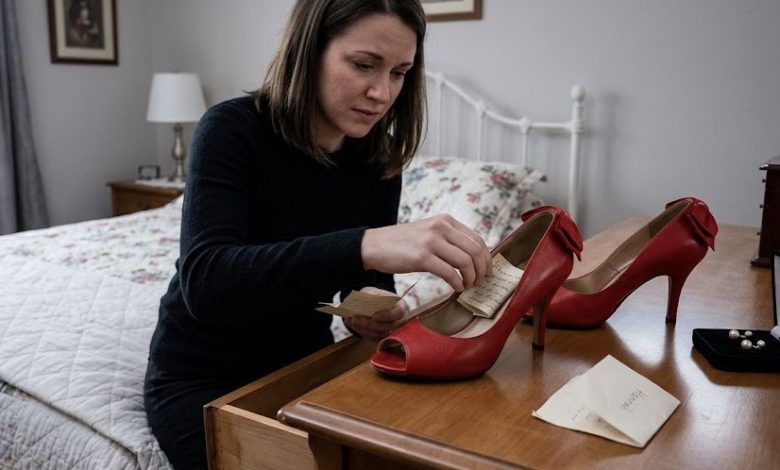
Bright red high heels. Not dark red, not burgundy, but bright red. The kind of shoes you would notice from across a room. They were sitting on the wooden dresser beside two jewelry boxes, featuring high narrow heels, open toes, and large satin bows tied around the backs.
I actually laughed to myself. I had never seen that woman wear anything higher than a two-inch church shoe. For the last fifteen years, she practically lived in white sneakers and brown loafers.
I picked up one of the red heels. The leather was soft but aged, and the bottom had scratches across it showing they had been worn. Once, maybe twice.
Then I noticed something strange: the inside lining near the heel had been lifted carefully. I ran my finger beneath it.
There was something underneath—a folded piece of paper.
My first thought was that it might be an old receipt, but when I pulled it out, my name was written on the outside in Grandma’s small, slanted handwriting: Hannah.
Inside were only two lines:
Hannah, if you are the one who finds this, do not let Wade take my bank folder.
Look under the other shoe before you ask him anything.
Downstairs, I could hear Uncle Wade laughing at something Caleb had said.
I looked at the second red shoe and lifted it. Underneath was a white envelope taped flat to the bottom. Across the front, Grandma had written:
HE HAS BEEN TAKING MONEY FROM ME FOR THREE YEARS.
I sat down on the edge of Grandma’s bed and stared at that sentence. Then I heard footsteps on the staircase. I shoved the envelope beneath my sweater just as Wade appeared in the doorway.
“Hannah? What’re you doing up here?”
“Mom wanted Grandma’s pearls.”
His eyes moved immediately toward the dresser—not toward me, but toward the dresser.
“I can get them,” he offered.
“I already found them.”
He smiled, but it felt tense. Then he noticed the red shoes. His face changed slightly.
“You found those old things?” he asked.
“You know them?”
He shrugged. “Your grandma kept everything. She bought these years ago. Your grandpa talked her into wearing them to some union banquet.” He picked one up, and for a second, I thought he was going to check underneath it. Instead, he put it back. “Complained about her feet for three days afterward.”
Wade left, and I locked the bedroom door before opening the envelope.
Inside were photocopies of bank statements with withdrawals circled in blue pen: $900, $1,200, $2,750, $600, $4,000. There were handwritten notes beside several transactions:
Wade said roof repair. No repair done.
Said Caleb needed treatment. Caleb says insurance covered it.
Asked Wade about $3,400. He became angry.
At the bottom was the total: $68,420.
Grandma was not wealthy. Grandpa had worked maintenance at a packaging plant, and Grandma had worked part-time in the elementary school cafeteria. Their house was paid for, but $68,000 was an enormous sum.
There was also a letter:
Hannah, I know you are wondering why I did not say something sooner. I am wondering that myself.
She explained that Wade began helping with her finances after Grandpa died. At first, everything was normal. Then Wade’s son, Caleb, went through a difficult period needing rehabilitation, which Grandma helped cover. But long after Caleb recovered, Wade kept taking funds. When Grandma confronted him, he told her she was getting forgetful.
He has started telling people I confuse numbers. I do not confuse numbers. I worked a cash register for twenty-two years and I can still tell you exactly what forty-seven children owe when lunch costs $1.35.
Please do not hate your uncle. But please do not protect him from the consequences of what he has done. There is a difference between forgiveness and pretending something never happened.
I called my husband, Ben, who advised, “Don’t confront anybody yet. Take pictures of everything.”
I photographed every page, put the bank statements back, kept the letter, and went downstairs.
After the funeral service that afternoon, our family gathered at the house. Once most guests had left, I took my mother to the back porch and showed her the document. When she realized the truth, she wept.
That evening, five of us sat around Grandma’s dining table: Mom, Wade, Caleb, Ben, and me. I placed copies of the statements on the table.
Wade’s face went pale. Caleb looked at his father in disbelief.
“I was going to put it back,” Wade finally whispered. “I borrowed it.”
He admitted that after initial costs for Caleb’s medical needs, his own business had struggled, and he took out loans to buy a fishing cabin at Table Rock Lake. Grandma’s funds became his regular source of financial relief.
The aftermath was difficult, but the family addressed the situation head-on with legal assistance. The fishing cabin was sold, and Wade agreed to repay the remaining balance from his inheritance share.
With the recovered funds, Mom and I established the Ruth Caldwell Practical Skills Scholarship through the local community college to help students learning trades like nursing assistance, welding, and electrical work.
As for the red heels, I kept them. A year later, a family friend named Mrs. Hensley told me their full back-story: Grandpa had bought them for Grandma in 1988 because he wanted her to have “one thing that didn’t look sensible.” She wore them once, complained, but kept them forever.
Grandma could have hidden those papers anywhere. Instead, she chose the most noticeable, least sensible thing she owned.
They sit on a shelf in my closet now—a reminder of the wisdom she left behind: There is a difference between forgiveness and pretending something never happened.
Frequently Asked Questions (FAQ)
What is the main message of the story?
The central theme highlights the importance of honesty, accountability, and the distinction between true forgiveness and ignoring wrongdoing. It demonstrates how one family confronted a painful internal issue directly rather than covering it up.
Why did Grandma hide the financial documents inside her red shoes?
The red shoes were the most eye-catching, unique item she owned—a item her uncle would never think to check. They also held sentimental value, representing a bold, memorable moment from her past with her husband.
What happened to the funds that were recovered from the estate?
The family recovered the majority of the funds through the sale of the fishing property and estate settlements. The money was then used to launch the Ruth Caldwell Practical Skills Scholarship, supporting local trade school students.
How did the family handle the situation with Uncle Wade?
Instead of covering up the issue, the family involved an attorney to audit the bank records and restructure the estate distribution, ensuring accountability while managing the financial recovery process legally and fairly.