Hidden for 27 Years Behind a Game Console Battery: The True Story of a Family’s Reconciliation
“Mom, why does Grandma keep asking me if I beat Level Seven?” my eight-year-old son, Caleb, whispered beside her hospital bed. At first, I thought the medication had confused her—until she reached beneath her blanket and handed him something I hadn’t seen since I was seventeen.
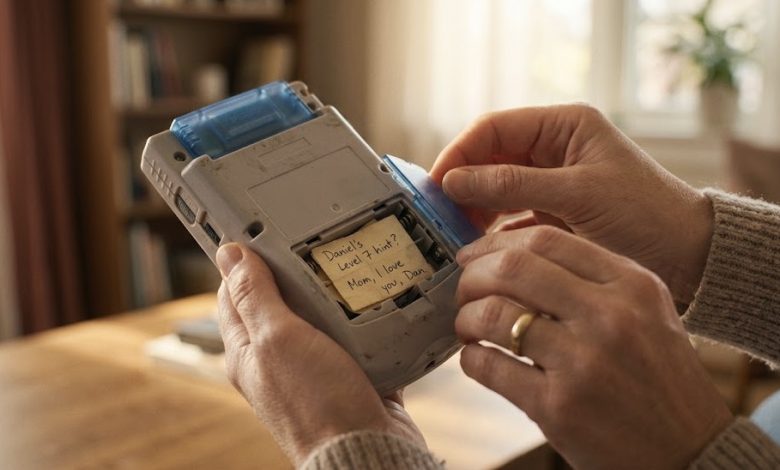
It was a chunky old handheld game console, gray around the edges with a bright blue plastic cover clipped over the back. Caleb stared at it like someone had handed him a museum artifact.
“What is this?” he asked.
My mother gave a weak smile.
“Something your uncle was very good at.”
I looked at her. Caleb had heard us mention my brother before, but not often. In our house, the name Daniel had become one of those topics everyone knew not to ask about. My mother hadn’t seen him in twenty-seven years. Neither had I.
The official family explanation was simple: Daniel had left. He was nineteen, angry at our father, restless with our little Pennsylvania town, and convinced there was a better life waiting somewhere else. One morning, he packed a duffel bag, took some cash from the kitchen drawer, and disappeared. That was the story I grew up repeating.
“Your uncle Daniel liked games?” Caleb asked.
My mother stared at the little machine. “He loved that one.”
Then she looked directly at me. “There’s something behind the batteries.”
The Note Hidden Inside the Console
Caleb immediately flipped the console over. The battery cover was stiff, held together at one corner with yellowed tape. He worked at it with his thumbnail until two old batteries rolled into his lap. Underneath them was a folded piece of paper—very small and very thin.
Written across the outside in handwriting I recognized instantly were four words: For Laura. When Mom’s ready.
For several seconds, nobody said anything. I picked up the brittle paper.
“Mom, how long has this been in there?” I asked.
“A long time,” she murmured, looking toward the window.
“Did Daniel write this?”
She nodded. “The night before he left.”
“You said he didn’t tell anybody he was leaving.”
“He didn’t tell your father.”
I opened the note. Daniel’s handwriting was unmistakable—heavy, slanted letters pressed deep into the paper:
Laura,
If Mom ever decides you should know, ask her about the night Dad came home from Harrisburg.
I didn’t leave because I wanted to.
I’m sorry.
D.
Uncovering a Decades-Old Truth
I asked Caleb to get a snack from the hallway vending machine so I could speak with my mother alone. Once the door closed, the truth finally came out.
When Daniel was nineteen, my father had taken money my brother saved for community college without asking. When Daniel confronted him, an argument turned physical. The next morning, my father gave Daniel an ultimatum: leave immediately, or he would call the police and claim Daniel attacked him.
“You let me believe he abandoned us?” I asked, my voice growing cold. “You let Dad tell everyone he stole money?”
My mother closed her eyes in shame. “I thought I was protecting you.”
The truth was even harder to hear: Daniel hadn’t just vanished. He had called home at least ten times over the next six years, asking to speak with me every time. My mother never let us talk. She kept his secret letters hidden, avoiding confrontation with my father until contact faded completely.
Before Daniel lost touch, he left a final message: “If Laura ever wants me, she can find me.”
The Search and the Emotional Reunion
That night, after taking Caleb home, I began searching for my brother. I eventually tracked down Daniel’s high school best friend, Marcus, on social media.
When I reached out to apologize for past misunderstandings and ask about Daniel, Marcus replied simply: “He owns a small property maintenance company outside Grand Rapids.” He gave me the phone number.
Sitting in my car, trembling, I dialed.
A man answered: “Lakeview Property Services.”
“Hi. I’m trying to reach Daniel Whitaker.”
“This is Dan.”
“It’s Laura.”
Silence filled the line, followed by a shaky breath. “Laurie?” he asked, using my childhood nickname. “Did Mom finally tell you?”
Two days later, Daniel drove down from Michigan. He met me in the hospital cafeteria before visiting our mother. We hugged awkwardly, tears blurring twenty-seven years of missed time.
When he walked into Mom’s room, my mother gasped.
“You came,” she whispered.
“Laura called,” Daniel replied softly. He sat beside her, not pretending everything was fixed, but refusing to let their story end in silence. They talked for nearly an hour, sharing pieces of the lives they had missed.
Healing and Moving Forward
My mother passed away nine days later. Daniel stood beside me at the funeral, ignoring the quiet whispers of extended relatives. Afterward, he came to my home, where Caleb proudly challenged him to a game on the old handheld console. Daniel beat Level Seven in three minutes flat.
It has been two years since that day. We aren’t magically perfect; you cannot compress nearly three decades of separation into a few visits. But we talk, we exchange holiday cards, and we visit each other’s families.
The blue game console now sits on a shelf in my living room, reminding me that families are complicated, but truth and connection are always worth reaching for.
Frequently Asked Questions (FAQ)
What is the central theme of this story?
The story explores themes of family secrets, forgiveness, the impact of miscommunication, and the healing power of truth across generations.
How did the sister find her missing brother after 27 years?
She discovered a hidden note inside an old handheld game console. This led her to contact her brother’s childhood best friend, who provided his current business contact information in Michigan.
Why did the father force the brother to leave?
After a heated argument over saved college money turned physical, the father threatened to call the police and accuse the nineteen-year-old son of assault unless he left the home.