A Secret from the Past: How an After-Class Conversation Changed a Family Forever
The first time Mr. Daniel Mercer mentioned my mother’s childhood nickname, I dropped my pencil. My mother had passed away eight months earlier, and I had never spoken to him about her.
“Your mom was called Annie when she was little, right?” he asked.
The pencil rolled off my American History textbook and hit the floor.
Nobody at school called my mother Annie. Her official name was Anne Porter Hayes, and to everyone in town, she was simply Anne. My dad called her “honey,” and my grandmother called her “Anne Marie” only when she was upset.
“Annie” belonged strictly to vintage family photographs and stories from a childhood my mother rarely discussed.
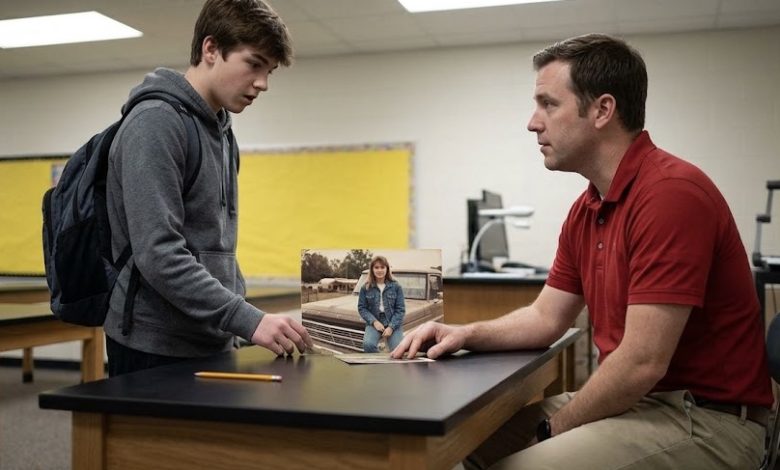
I looked up at Mr. Mercer. He was standing near the front of Room 214, resting a hand on the media cart. He was in his late thirties—short brown hair, a red polo shirt, and khakis. He looked more like a Little League coach than a high school history teacher.
He had started teaching at Wilson Creek High School just three weeks prior. From his very first day, something about him had felt unusual. It wasn’t that he was strict—he was actually one of the most patient teachers I had. It was the way he looked at me.
Sometimes I’d catch him observing me while I was taking notes. Other times, he’d pause briefly when reading my last name during roll call. Hayes. Since there were dozens of families with that last name in southern Indiana, I tried to convince myself it was just a coincidence.
Until that Tuesday afternoon.
Our class had just finished a unit on modern American history. As the bell rang, chairs scraped across the tile floor, backpacks zipped, and students rushed out the door discussing weekend plans.
I was halfway out when Mr. Mercer spoke up. “Ethan, could you stay for a moment?”
My stomach dropped. I had scored poorly on his previous quiz and assumed I was in for a lecture about my grades.
Once the last student left, however, Mr. Mercer didn’t mention the quiz. Instead, he walked to his desk, opened the top drawer, and pulled out an old, faded photograph.
He placed it face-up in front of me.
The girl in the picture looked to be about fifteen or sixteen. She had long brown hair, wore a denim jacket, and was sitting on the hood of a vintage pickup truck with a smile I recognized instantly.
It was my mother—long before she met my father, long before I was born, and long before our home on Juniper Lane.
“Where did you get this?” I asked, my voice rising. “My mom passed away in January. Why do you have her picture?”
His expression shifted from calm to quiet exhaustion. “I didn’t know she had passed away,” he admitted softly.
“How did you know her?” I demanded.
“She was sixteen in that photo,” he said gently. “It was taken in 1987.”
I took a step back. “Who are you?”
He looked straight at me and said words that split my life into before and after: “Your mother was my mother, too.”
The Unspoken Past
I stood there in disbelief. “My mom was fifty-two when she passed. You’re… what, nearly forty?”
“Thirty-eight,” he replied.
I did the math quickly. My mother would have been fifteen when he was born.
Seeing my reaction, Mr. Mercer added, “If you want answers, ask your grandmother about the St. Agnes home in Louisville.”
That name struck a chord. Years earlier, when I was around eleven, I had overheard my grandmother and mother arguing in the kitchen after a holiday dinner. Grandma had said, “We did what we thought was best at the time,” to which Mom replied, “It wasn’t your decision to make.” They had stopped talking the moment I walked into the room.
Overwhelmed, I grabbed my bag and headed straight home.
When I walked into our kitchen, my father and grandmother were sitting at the table. One look at my face was all it took for my grandmother to close her eyes in quiet resignation.
“You knew,” I said, looking between them. “You knew Mom had another son?”
My father stood up, looking visibly shaken. “Ethan, it’s complicated.”
Grandmother explained the story in quiet fragments. Back in 1987, when my mother became pregnant as a teenager, her father panicked over local gossip and societal expectations. They sent my mother away to stay with relatives near Louisville, where she stayed at a residential facility for young mothers.
When Daniel was born in March 1988, he was immediately placed for adoption. My mother returned home, and the family buried the secret. Decades later, after my mother married my dad and built our family, the topic remained unspoken out of habit and lingering shame.
“Did Dad know?” I asked.
“Yes,” my father said quietly. “She told me everything before we got engaged. I promised her I would respect her privacy until she was ready to share it.”
Rebuilding Connection
The next morning, I met Mr. Mercer in his classroom before the first period.
He explained that he had always known he was adopted and had been raised by loving parents near St. Louis. As he grew older and had children of his own, he simply wanted to learn more about his medical history and biological roots. A DNA test connected him to a distant cousin, which eventually led him to my mother.
They had actually reconnected three years before she passed away, meeting a few times in public places to talk and catch up.
Mr. Mercer reached into his desk and handed me a letter my mother had written to him during that time. Her familiar, rounded handwriting filled the page. In it, she wrote about how often she had thought about him over the years, clarifying that placing him for adoption was an agonizing decision forced upon her by the adults in her life at the time.
Reading her words brought a sense of closure that anger never could.
Over the following months, our family gradually opened up to the new dynamic. Daniel began visiting occasionally, joining us for casual family meals and holidays. He didn’t try to replace anyone or rush into an artificial relationship; instead, we built a genuine connection step by step.
Family histories aren’t just made of the happy memories shared around dinner tables. Sometimes, they are also shaped by the difficult truths people were once too afraid or burdened to share. Healing begins when those truths are finally brought into the light.
Frequently Asked Questions (FAQ)
1. Is this story based on real events?
This story is a narrative exploration of family dynamics, adoption reunions, and how historical secrets impact multi-generational families. It highlights common challenges faced by individuals navigating unexpected family discoveries through modern genealogy tools.
2. How do adult adoptions and biological reunions usually work?
Reunions between adopted adults and their biological relatives often begin through mutual consent, state registries, or commercial DNA testing platforms. Experts recommend approaching these reunions with patience, low expectations, and respect for personal boundaries to ensure a healthy transition for everyone involved.
3. What support is available for families dealing with adoption reunions?
There are numerous resources available for adoptees, birth parents, and families navigating post-reunion relationships. Organizations such as the National Council for Adoption (NCFA) and local family counseling services offer guidance, support groups, and professional counseling to help manage complex emotional transitions.
4. Why were adoption secrets common in previous decades?
In the mid-to-late 20th century, social stigma surrounding young, unmarried parents often led families to keep pregnancies private. Closed adoptions were standard practice, meaning records were sealed, and contact between biological parents and children was rarely maintained. Modern open adoptions and accessible genetic testing have significantly shifted this cultural dynamic.