The Hospital Secret: Why My Wife Made Me Promise to Keep a Stranger Away From Our Newborn Son
My son had been alive for less than a minute when my wife grabbed my wrist and made me promise not to let a woman named Rebecca anywhere near him.
At the time, I thought she was confused.
Anna had been in labor for almost seventeen hours. She was exhausted, shaking, and crying on and off.
The baby’s heart rate had suddenly dropped, and within minutes our quiet delivery room had turned into a rush of nurses, doctors, rolling equipment, and words I didn’t fully understand.
“Emergency C-section.”
That was the only part I understood.
They gave me blue scrubs, a cap, a mask, and told me where to stand.
I remember my hands shaking so badly that I couldn’t tie the back of the gown.
One of the nurses finally did it for me.
“You’re okay, Dad,” she said. “Just breathe.”
Dad.
That word almost broke me.
Anna and I had waited six years to hear someone call me that.
Six years.
Three failed IVF cycles.
Two miscarriages.
More injections than either of us could count.
One Christmas spent pretending we were happy while my brother announced that his wife was pregnant with their third child.
And one night when Anna sat on the bathroom floor holding a negative pregnancy test and told me she couldn’t do it anymore.
Eventually, our doctor suggested using a donor egg.
It took us months to accept the idea.
I had been ready before Anna was.
“You would still be his mother,” I told her one night.
“I know,” she said.
But I could tell knowing something logically and feeling it in your heart were two very different things.
Eventually she agreed.
The clinic found a donor.
At least, that was what I believed.
We were told very little about her. She was healthy, around Anna’s age, had brown hair, green eyes, no serious family medical problems, and had already passed all the required screenings.
Anna handled most of the communication.
I didn’t question it.
Maybe I should have.
But after years of doctors, tests, appointments, and disappointment, I had reached the point where I didn’t care whose cells were involved.
I just wanted a child with the woman I loved.
The transfer worked.
For the first time in years, two pink lines appeared.
I still have the photograph of Anna sitting on the bathroom counter holding that test.
She was laughing and crying at the same time.
I was kneeling in front of her.
We didn’t tell anyone for twelve weeks.
We were too scared.
Every ultrasound felt like waiting for someone to deliver bad news.
But the weeks kept passing.
Twenty weeks.
Thirty.
Thirty-five.
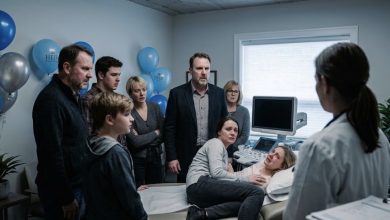
By thirty-eight weeks, our spare bedroom had become a nursery.
There was a crib beside the window, a small wooden shelf full of books, and a ridiculous stuffed giraffe my mother bought that was almost as tall as the crib.
We had chosen a name.
Miles.
Everything finally felt real.
Then, during labor, Anna started acting strange.
Not scared.
Different.
She kept checking her phone.
Every time it vibrated, she turned the screen away from me.
Once, around three in the morning, I woke from a terrible half-sleep in the chair beside her bed and saw her deleting messages.
“Who keeps texting you?” I asked.
“No one.”
“Someone is definitely texting you.”
“My sister.”
Anna didn’t have a sister.
At least, not one I knew about.
She had one older brother named Daniel.
I stared at her.
“Your sister?”
She looked at me for maybe two seconds.
Then she said, “I meant Daniel’s wife.”
I was too tired to argue.
A few hours later, everything went wrong.
Miles’ heart rate dropped.
The nurse hit a button.
Suddenly six people were in the room.
Someone gave Anna oxygen.
Someone told me to move.
The doctor said they weren’t waiting any longer.
Within minutes, I was standing in an operating room beside Anna’s head while a blue surgical sheet blocked most of my view.
That’s when she grabbed me.
Hard.
Her fingers closed around my wrist.
“David.”
I leaned closer because of the mask.
“What?”
Her eyes were red.
“If Rebecca comes here, don’t let her hold him.”
I thought I’d misheard her.
“Who?”
“Rebecca.”
“Who is Rebecca?”
“Please.”
“Anna, who is Rebecca?”
She tightened her grip.
“Promise me.”
There was something in her face I had never seen before.
Not pain.
Fear.
Real fear.
I looked toward the doctors.
Everything was happening so quickly.
“Okay,” I said. “I promise.”
Then I heard a baby cry.
There is no way to explain what that sound does to you after you’ve waited six years for it.
I started crying immediately.
I didn’t even try to stop.
Someone said, “He’s here.”
The doctor lifted this tiny, red, angry little person high enough for us to see him.
Ten fingers.
Tiny legs kicking.
Dark wet hair pressed against his head.
Anna made this sound somewhere between a laugh and a sob.
“Oh my God.”
I kissed her forehead.
“That’s him.”
They cleaned him quickly, put a little white hat on him, wrapped him in a cream-colored blanket, and handed him to me.
I had imagined that moment probably a thousand times.
In my imagination, I always knew exactly what to say.
In reality, I stared at him like an idiot.
“Hi.”
That was it.
Six years of waiting and my first words to my son were, “Hi.”
His eyes opened for maybe two seconds.
Tiny gray-blue eyes.
Then he frowned.
I laughed.
Anna reached over and rested her hand on his head.
For maybe thirty seconds, everything was perfect.
Then a nurse came toward us.
She leaned down beside Anna.
“There’s a woman at the nurses’ desk asking for you.”
Anna’s hand froze on Miles’ head.
I felt it.
The whole mood of the room changed.
“What woman?” I asked.
The nurse looked uncertain.
“She says her name is Rebecca Cross.”
Anna closed her eyes.
“No.”
The nurse looked between us.
“She says she’s family.”
“She isn’t,” Anna said quickly.
Then she looked at me.
“David, please.”
That promise.
Don’t let Rebecca hold him.
I gave Miles carefully to the nurse because the doctors needed to finish with Anna.
Then I followed another nurse into the hallway.
“Can I talk to this woman?”
“You can, but she can’t come back here without permission.”
“Good.”
I walked down the hall still wearing the blue gown, mask hanging under my chin.
I felt ridiculous and terrified at the same time.
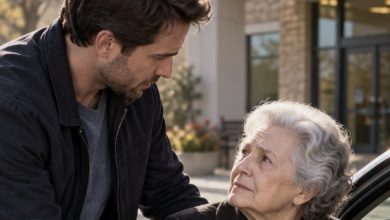
There was a woman standing near the nurses’ desk.
Maybe thirty-four or thirty-five.
Dark hair pulled into a messy ponytail.
Jeans.
Gray sweatshirt.
No makeup.
She looked like she hadn’t slept.
The second she saw me, she knew who I was.
“David?”
I stopped.
“How do you know my name?”
She swallowed.
“Is the baby okay?”
That question made something hot rise inside me.
“Who are you?”
“Rebecca.”
“I know your name. Who are you?”
She looked toward the doors behind me.
“Please. I need to talk to Anna.”
“You’re not going near her.”
Her eyes filled with tears.
“Then give her this.”
She held out a folded piece of paper.
I didn’t take it.
“What is it?”
“Something the doctor needs to know.”
“About what?”
“The baby.”
I stepped closer.
“What about my baby?”
Rebecca looked at me for a long moment.
Then she said something I will never forget.
“His heart needs to be checked.”
My stomach dropped.
“Why?”
“Please just give Anna the paper.”
“No. You’re going to tell me right now.”
She started crying.
Not dramatically.
She just covered her mouth for a second, then wiped her face with the sleeve of her sweatshirt.
“I wasn’t supposed to come here.”
“Then why are you here?”
“Because she stopped answering me.”
“Who?”
“Anna.”
I felt cold despite the hospital gown.
“You’ve been texting my wife?”
Rebecca nodded.
“For weeks.”
I thought about Anna turning her phone over.
Deleting messages.
Lying about Daniel’s wife.
“What do you want from her?”
“Nothing.”
“Then why are you here?”
“Because I found something out.”
“What?”
She looked at the doors again.
Then back at me.
“I need Anna to tell you.”
“Tell me what?”
Rebecca shook her head.
“Ask your wife who donated the egg.”
For a moment, I honestly thought I had misunderstood her.
“What?”
She pressed the folded paper into my hand.
Then she stepped backward.
I looked at the paper.
Then at her.
“No.”
Rebecca’s face crumpled.
And before I could ask another question, she said quietly:
“David… I’m Anna’s sister.”
I just stared at her.
“Anna doesn’t have a sister.”
“Yes, she does.”
“No.”
“She has me.”
Then she looked toward the room where my newborn son was being checked.
Her next words made my legs feel weak.
“And I’m the woman whose egg created your son.”
✂️ CUT HERE FOR THE FACEBOOK POST
The website/article continuation begins directly below this point.
I don’t remember walking back to Anna’s room.
I remember the hallway.
I remember the sound of my shoes on the floor.
I remember staring at the folded paper in my hand.
But I don’t remember deciding to move.
When I entered the recovery room, Anna knew immediately.
She took one look at my face.
“You talked to her.”
It wasn’t a question.
I shut the door behind me.
“You told me the donor came through the clinic.”
“She did.”
“You told me we didn’t know her.”
Anna started crying.
“David—”
“Who is Rebecca?”
She looked toward the bassinet beside her.
Miles was sleeping peacefully, completely unaware that the adults around him had just blown up their lives.
“She’s my half-sister.”
I pulled a chair beside the bed.
“You have a sister.”
“Yes.”
“For eleven years you’ve told me you had one brother.”
“I know.”
“Eleven years, Anna.”
“I know.”
“You never thought maybe this was something your husband should know?”
She wiped her eyes.
“It wasn’t that simple.”
I laughed once.
There was nothing funny about it.
“Apparently nothing tonight is simple.”
She stared at her hands.
“My father had another family before my mom.”
I said nothing.
“There was a woman named Elaine. They were together for a few years. Rebecca was their daughter.”
“So she’s older than you?”
“Three years.”
“Does Daniel know?”
“Yes.”
That hurt almost as much as the original secret.
“Your brother knows.”
“Yes.”
“Your mother?”
“Yes.”
“So I’m basically the only person who didn’t.”
Anna shook her head.
“I wasn’t trying to embarrass you.”
“This isn’t embarrassing. It’s insane.”
“Please don’t yell.”
“I’m not yelling.”
Miles moved slightly in the bassinet.
Both of us instantly looked at him.
That was the strangest part.
Even while my marriage felt like it was cracking open, some new part of my brain was constantly checking whether my son was okay.
I lowered my voice.
“Why didn’t you tell me Rebecca donated the egg?”
Anna looked away.
“Because you wouldn’t have agreed.”
That sentence hurt.
“You don’t know that.”
“I do.”
“No, Anna. You decided for me.”
She started crying harder.
I wanted to be angry.
I was angry.
But seeing her lying there after surgery, pale and exhausted, made it impossible to turn the anger into cruelty.
So I sat down.
“Start at the beginning.”
And she did.
Rebecca had grown up mostly with her mother.
Anna saw her occasionally as a child, but their father didn’t exactly encourage a relationship between his two families.
When Anna was fourteen and Rebecca was seventeen, their father left both families completely.
He moved across the country with another woman.
He barely contacted any of his children afterward.
Oddly enough, that was when the two sisters became close.
They understood each other in a way no one else did.
They both knew what it felt like to be abandoned by the same man.
For almost ten years, they were more like best friends than sisters.
Then Rebecca’s life started falling apart.
She got into a relationship with a man Anna hated.
There were bad choices.
Heavy debt.
Trouble with the law.
Rebecca disappeared for months at a time.
Eventually Anna cut contact.
“When we started IVF,” Anna said, “I hadn’t spoken to her in nearly four years.”
“So how did she become the donor?”
“When the doctor told me my eggs probably weren’t viable, I panicked.”
I remembered that appointment.
Anna had barely spoken during the drive home.
“I couldn’t stand the idea that the baby wouldn’t have any biological connection to me,” she continued.
I took a breath.
“So you called Rebecca.”
“Yes.”
“And she agreed.”
“Immediately.”
Apparently Rebecca had turned her life around and been doing well for almost three years by then.
She had a job.
An apartment.
She was doing well.
She went through months of testing.
Genetic screening.
Counseling.
Medical appointments.
The clinic approved her.
I knew we’d used an egg donor.
What I hadn’t known was that Anna had personally chosen her.
Anna had told me the donor was part of a confidential program.
I trusted her.
“Why lie?” I asked.
“Because you knew about Rebecca.”
I frowned.
“Barely.”
Years earlier, Anna had told me she had a “relative” with personal struggles.
She never said sister.
“I knew what you thought of her.”
“I didn’t know her.”
“You said you would never bring someone unstable into a child’s life.”
I stared at her.
“So you thought the solution was to make her our child’s biological aunt and hide it from me?”
Anna flinched.
When she repeated it back in her own mind, I think she realized how bad it sounded.
“She wasn’t asking to be part of our lives.”
“Until now.”
“No. That’s not why she’s here.”
I remembered the paper.
I pulled it from my pocket.
“Then why did she tell me Miles needs his heart checked?”
Anna’s face changed.
“She told you that?”
I unfolded the page.
It was a copy of a medical report.
I didn’t understand most of it.
One phrase had been circled.
Hypertrophic cardiomyopathy.
I looked at Anna.
“What is this?”
“She fainted at work three weeks ago.”
My anger disappeared for a second.
“What?”
“They thought she was dehydrated. Then something showed up on her ECG. They did more tests.”
“And?”
Anna looked toward Miles.
“She has a heart condition that can run in families.”
That was why Rebecca had been calling.
Not because she wanted our son.
Not because she wanted money.
Not because she wanted to destroy our family.
She was scared.
She had only received the final diagnosis five days earlier.
The cardiologist told her that close biological relatives might need screening.
The first person she thought of was Miles.
A child who technically wasn’t even born yet.
“She wanted us to tell the doctors,” Anna said.
“Then why didn’t you?”
“I was going to.”
“When?”
“I don’t know.”
“Anna.”
“I was scared!”
“Of what?”
She finally looked at me.
“You finding out everything exactly like this.”
I stood up.
“So instead you risked not telling the doctors something that could affect him?”
“They knew there was a family history being investigated.”
That mattered.
At least she hadn’t completely hidden the medical concern.
She had told her obstetrician that new health information had come from the egg donor, but she hadn’t told me who the donor was.
Still, I felt betrayed.
Not because Rebecca’s DNA was inside our son.
That never bothered me.
Miles was my son.
I knew that from the moment he wrapped four tiny fingers around one of mine.
What hurt was discovering that the person I trusted most had built part of our family around a lie.
A nurse entered before I could answer.
She checked Anna’s blood pressure and asked whether we wanted the pediatrician to come talk to us.
“Yes,” I said immediately.
The pediatrician came about twenty minutes later.
He explained that nothing suggested Miles was in immediate danger.
His heart sounded normal.
His oxygen levels were normal.
They would document Rebecca’s diagnosis, speak with pediatric cardiology, and decide what follow-up testing was appropriate.
For the first time since I had met Rebecca in the hallway, I could breathe.
Then Anna said something I didn’t expect.
“Can she come in?”
I looked at her.
“Rebecca?”
Anna nodded.
“I think she deserves to know he’s okay.”
I wasn’t sure how I felt about it.
Part of me wanted that woman out of the hospital.
Another part knew she had driven nearly three hours to warn us about a medical condition.
Whatever else she was, she hadn’t come to hurt our son.
So I said yes.
Rebecca walked into the room about ten minutes later.
She stopped the moment she saw Miles.
She didn’t move closer.
She didn’t ask to hold him.
She just stood near the door with both hands stuffed inside the pockets of her sweatshirt.
“Is he okay?”
“For now,” I said. “They’re going to do follow-up tests.”
Her shoulders dropped.
“Thank God.”
Anna couldn’t look at her.
Rebecca looked at my wife.
“You blocked my number.”
“I was scared.”
“You told me you’d tell him.”
“I know.”
“You promised.”
“I know.”
I stayed quiet.
Rebecca’s voice started shaking.
“I wasn’t coming to take anything from you, Anna.”
“I know.”
“No, you don’t. Because if you knew, you wouldn’t have spent nine months treating me like some criminal waiting outside your house.”
Anna started crying.
Rebecca did too.
And suddenly I realized I had walked into a story that had started decades before I ever met my wife.
Two sisters.
The same father.
The same abandonment.
Years of resentment.
Years of guilt.
One had rebuilt her life.
The other had never fully forgiven her for destroying it in the first place.
Then Rebecca looked at me.
“I need you to know something.”
I braced myself.
I had heard enough surprises for one day.
“I never wanted to be his mother.”
She nodded toward Miles.
“I knew what I was agreeing to. I knew exactly what it meant.”
“Then why do this?” I asked.
She looked at Anna.
“Because she saved my life.”
Anna immediately shook her head.
“Don’t.”
But Rebecca continued.
“Years ago, when my life was spiraling out of control, nobody knew how bad it was. Not my mom. Not my friends. Nobody.”
She took a breath.
“Anna drove four hours in the middle of the night because I called her and hung up.”
Anna turned her face away.
“She found me collapsed in my apartment.”
I looked at my wife.
She had never told me that story.
“She got me to the hospital,” Rebecca continued. “Then she paid for my first month in a recovery program because I didn’t have insurance that covered it.”
“Rebecca…”
“She visited me every weekend.”
Anna was openly crying now.
“So when she called me years later and told me she might never have a baby, there was no question.”
Rebecca looked toward the bassinet.
“She gave me another chance at life. I gave her something back.”
Nobody spoke for several seconds.
Then Miles started crying.
Tiny little newborn cries.
Anna tried to shift but winced from the incision.
Without thinking, I went to the bassinet.
I picked him up.
He settled against my chest.
Rebecca watched me.
Then she smiled.
It wasn’t jealousy.
I know jealousy when I see it.
This wasn’t that.
It was relief.
“That’s his dad,” she whispered.
Those four words destroyed whatever anger I still had toward her.
Not toward Anna.
That would take longer.
But toward Rebecca.
I walked closer.
“Do you want to see him?”
She looked at Anna first.
Anna nodded.
Rebecca approached slowly.
I moved the blanket slightly so she could see his face.
“Oh…”
She covered her mouth.
“He has your chin.”
I laughed.
“He’s been alive four hours. Nobody knows whose chin he has.”
Rebecca laughed through her tears.
“Fine. He has an excellent chin.”
That was the first moment all day that felt normal.
Almost.
We didn’t fix everything in that hospital room.
Real life doesn’t work like that.
Anna and I argued a lot during the next few months.
Quiet arguments, mostly.
Late at night.
When Miles was sleeping.
The issue wasn’t Rebecca.
It was trust.
I told Anna that I could forgive fear.
I could forgive bad decisions.
What I couldn’t accept was being protected from the truth because she had decided I couldn’t handle it.
She listened.
Sometimes she defended herself.
Sometimes she cried.
Sometimes I did.
We eventually went to counseling.
Best decision we could have made.
Anna admitted something there that I hadn’t understood before.
She had spent most of the pregnancy terrified that I wouldn’t feel connected to Miles because he wasn’t genetically hers.
She thought if I knew Rebecca was the donor, I would constantly see Rebecca when I looked at him.
Instead, the opposite happened.
I looked at Miles and saw Miles.
That’s all.
He had my weird second toe.
He had Anna’s habit of sleeping with one hand beside his face, even though there was no genetic reason for that.
He calmed down when Anna sang badly.
He sneezed three times almost every morning.
He hated baths for two months and then suddenly decided baths were the greatest thing ever invented.
Biology explained pieces of him.
It didn’t explain our family.
Rebecca’s heart diagnosis also turned out to be important, but not catastrophic.
Miles saw a pediatric cardiologist.
Then another specialist.
His early tests were normal.
Because of the family history, he’ll continue to be monitored as he grows.
Rebecca gets regular treatment too.
She’s doing well.
For the first six months after Miles was born, she didn’t visit unless we invited her.
I think she was terrified of crossing a line.
Eventually I told her she could stop acting like a visitor from another planet.
She’s his aunt.
That’s what we call her.
Aunt Rebecca.
Nothing more complicated is necessary right now.
When Miles is old enough, he’ll know the truth about how he was conceived.
We’ve already decided that.
No secrets.
I insisted on that part.
Anna agreed.
The strangest thing happened on Miles’ first birthday.
We had a small party in our backyard.
My parents came.
Daniel and his family came.
Rebecca came with her mother.
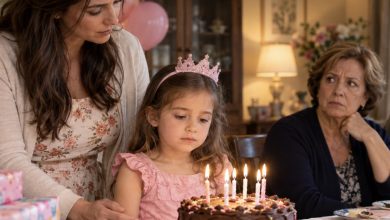
There were balloons tied to the fence, half-melted ice cream on the table, and wrapping paper everywhere.
At some point, I walked into the kitchen and found Anna and Rebecca standing together near the sink.
They were laughing.
Not politely.
Really laughing.
The kind where you can’t breathe.
For a second I just stood there watching them.
They looked alike when they laughed.
I had never noticed that before.
Anna saw me.
“What?”
“Nothing.”
“Why are you staring at us?”
“I just realized something.”
Rebecca raised an eyebrow.
“What?”
I smiled.
“My son is going to have two women teaching him terrible jokes.”
Anna threw a napkin at me.
Rebecca laughed even harder.
Later that evening, after everyone left, I carried Miles upstairs.
He was exhausted.
His head rested against my shoulder while I walked toward his room.
The stuffed giraffe my mother bought was still standing beside the crib.
Miles pointed at it.
“Raff.”
“Yeah,” I whispered. “Giraffe.”
I laid him down.
Anna stood beside me.
For a while, neither of us said anything.
Then she reached for my hand.
“Do you ever think about that day?”
“The hospital?”
She nodded.
“All the time.”
“I thought I’d lost you.”
“I know.”
“And then I thought some random woman was coming to steal our baby.”
Anna laughed softly.
“I’m sorry.”
“I know.”
There was a pause.
Then she asked something she had asked me several times during that first year.
“Do you regret any of it?”
I looked down at Miles.
His eyes were already closed.
One little hand rested beside his head.
The same position Anna slept in.
I thought about fertility clinics.
Needles.
Miscarriages.
Secrets.
Rebecca in that hospital hallway.
That folded medical report.
The fights.
Counseling.
Fear.
Forgiveness.
And the little boy sleeping three feet away from us.
“No,” I said.
Anna looked surprised.
“Not even the bad parts?”
“I wish you’d told me the truth.”
“I know.”
“I wish I’d known about Rebecca from the beginning.”
“I know.”
“And I wish our son hadn’t entered the world in the middle of the weirdest family secret imaginable.”
She smiled.
“Fair.”
“But regret him?”
I shook my head.
“Never.”
Anna rested her head against my shoulder.
And that’s the thing nobody tells you when you’re desperate to start a family.
You imagine the moment your baby arrives as the ending.
You think once that child is placed in your arms, the hard part is over.
It isn’t.
That’s the beginning.
Families aren’t created in one perfect hospital photograph.
They’re created afterward.
During the sleepless nights.
During the arguments.
During the apologies you don’t want to make.
During the conversations you’ve been avoiding for years.
During doctor appointments.
First birthdays.
Mistakes.
Second chances.
And moments when someone you once saw as a threat becomes the aunt sitting on your living room floor building a tower of blocks with your son.
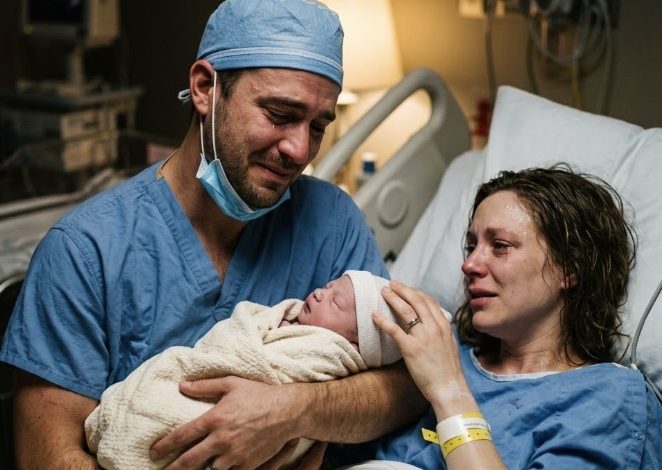
I still have the photograph taken shortly after Miles was born.
I’m wearing blue surgical clothes and a mask.
My eyes are red.
Miles is wrapped so tightly in his blanket that only his tiny face is showing.
Anna is lying beside us with her hand resting carefully on his head.
When people see it, they usually say the same thing.
“What a beautiful moment.”
And they’re right.
It was.
They just don’t know that somewhere outside that room stood a woman whose name I had learned only minutes earlier.
A woman I had been told to keep away from my son.
A woman I thought might destroy my family.
Instead, she arrived carrying the truth we desperately needed to hear.
And sometimes I look at that photograph and think about how close I came to refusing to listen to her.
Because the biggest surprise of that day wasn’t discovering whose DNA my son carried.
It was learning something much harder.
The person standing outside the door isn’t always the danger.
Sometimes the real danger is the secret you’ve already let inside.
Lessons on Trust, Family, and Secrets from the Past
The story of David, Anna, and Rebecca offers a profound perspective on how unaddressed fear and trauma can distort decision-making within a marriage. Although Anna’s intentions stemmed from a desire to protect and a fear of rejection, her silence nearly destroyed the foundational trust between her and her husband.
1. Fear of the Truth Is Often More Dangerous Than the Truth Itself
Anna’s biggest mistake was not her choice of donor, but isolating her husband from the decision-making process. In moments of extreme vulnerability, people often hide details to shield their loved ones. However, on an emotional level, a secret creates a far deeper divide than the original issue ever could.
2. Biology vs. Parenthood
One of the most powerful moments in the narrative is David’s realization that the bond between a parent and child does not rely exclusively on DNA. Paternal love is built through daily presence, care, sleepless nights, and unconditional commitment—not solely through a genetic footprint.
3. Healing Family Relationships
Forgiveness does not mean forgetting past mistakes; it means allowing space to rebuild on a stronger foundation. Couple’s therapy and open, transparent communication allowed them to move past the initial shock and turn a major crisis into a turning point for personal maturity.
Frequently Asked Questions (FAQ)
Why did Anna hide the fact that the donor was her half-sister?
Anna feared David would reject the donor option if he knew the egg came from someone with a complex past. She was also afraid that her husband wouldn’t feel emotionally connected to a child who carried the genetics of someone he held reservations about.
How did the family medical history drive Rebecca to come to the hospital?
A recent diagnosis of hypertrophic cardiomyopathy prompted Rebecca to act immediately. Although she had been asked to keep her distance, her top priority was the baby’s health, ensuring the medical team had critical genetic information to properly monitor newborn Miles.
How can a couple rebuild trust after a major secret is revealed?
Rebuilding trust requires time, absolute transparency, and professional guidance through marriage counseling. Both partners must take accountability for their actions, acknowledge the emotional impact, and establish clear boundaries for future communication.