Everyone Was Laughing at the Hat I Wore at My Wedding—Until the Venue Manager Pulled Me Aside
The photograph everyone loves most from my wedding was taken during the one moment when I had absolutely no idea what had happened inside that building a few hours earlier.
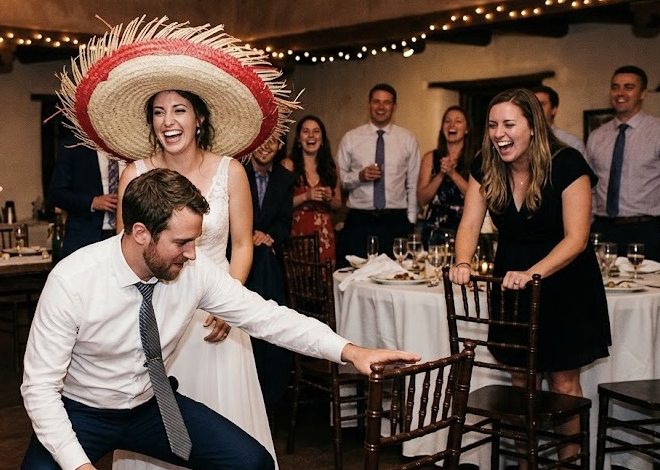
In the picture, I’m wearing my wedding dress and an enormous straw hat with red trim that looks like something somebody bought at a roadside souvenir shop after three margaritas.
My husband, Caleb, is in front of me doing some kind of dance that I still cannot identify.
His knees are bent.
One arm is stretched toward a chair.
His tie is crooked.
My cousin Tori is somewhere outside the frame screaming, “Lower! Lower!” at him like she’s coaching an Olympic event.
Behind us, several guests are laughing so hard that one woman is holding onto the back of a chair.
I love that picture now.
For a long time, I couldn’t look at it.
Our wedding was in an old adobe event hall outside Santa Fe, New Mexico. Nothing fancy. White tablecloths, dark wooden chairs, strings of warm lights around the courtyard, and enough food to keep both of our families from complaining for at least two hours.
Caleb and I had been together for six years.
We weren’t young newlyweds either. I was thirty-four, and he was thirty-six. We had already survived two apartments, one broken water heater, my nursing-school schedule, his attempt to start a landscaping business, and a six-month period when his mother seemed personally offended that we had bought a gray couch.
The wedding wasn’t supposed to change our lives.
It was supposed to make official the life we already had.
There was only one thing hanging over the day.
My father.
Frank Sutter.
I hadn’t seen him in almost four years.
That sentence makes the situation sound simpler than it was.
He hadn’t completely abandoned me when I was a kid. He wasn’t one of those fathers who disappeared one Tuesday and was never heard from again.
Frank was worse in a quieter way.
He came and went.
When I was eight, he coached my softball team.
When I was nine, he forgot my birthday because he had taken a construction job in Colorado and mixed up the dates.
When I was eleven, he drove eleven hours through a snowstorm because I had broken my wrist.
When I was thirteen, he promised to come to my school play and never showed up.
That was my childhood with my father.
Wonderful memories sitting right next to terrible ones.
After my parents divorced, he moved around even more.
Nevada.
Colorado.
Northern Arizona.
Back to New Mexico.
Then Arizona again.
He called.
Then he didn’t.
He sent a Christmas card.
Then nothing for eight months.
I got tired of trying to decide which version of him was real.
By my twenties, our relationship had become a series of awkward lunches whenever he happened to be nearby.
We’d talk about weather, work, gas prices, football—anything except why we could go months without speaking.
The last time I had seen him was after my nursing-school graduation.
He arrived two hours after the ceremony.
I had already changed clothes.
My classmates were gone.
My mother had taken the decorations down from the restaurant table.
Frank came through the door carrying a bouquet of grocery-store flowers and saying his truck had overheated outside Gallup.
Maybe it had.
That was the problem.
With my father, there was always a reason.
Sometimes the reason was even true.
I was simply exhausted from deciding whether to believe it.
We argued in the parking lot.
I remember saying, “You always have an explanation.”
He looked at me and said, “I know.”
That answer made me angrier than an excuse would have.
I left.
He didn’t follow me.
Four years passed.
When Caleb proposed, I spent almost three weeks deciding whether to invite my father.
In the end, I mailed him an invitation.
I didn’t call.
I didn’t write a personal note.
I put the invitation inside the same cream envelope everyone else received and sent it to the address on his last Christmas card.
Flagstaff, Arizona.
The invitation never came back.
Neither did an RSVP.
I told myself that was my answer.
My mother, Elaine, certainly treated it that way.
“Don’t let him ruin this for you,” she told me once while we were folding little paper place cards at my kitchen table.
“He hasn’t ruined anything.”
“You keep checking your phone.”
“I check my phone all the time.”
She raised one eyebrow.
Mothers have an annoying way of doing that.
Caleb handled it differently.
He never told me what I should feel about Frank.
A week before the wedding, he asked, “Do you want me to save him a chair?”
I was standing in our bedroom holding two pairs of earrings against my neck.
“No.”
“You sure?”
“No.”
He waited.
I sighed.
“Yes.”
He smiled.
“So we save the chair.”
“I hate you.”
“I know.”
We put Frank’s name on the seating chart.
Table six.
Seat closest to the wall.
Wedding day came.
The chair stayed empty.
I noticed during dinner.
Then again during the speeches.
Then when the cake was cut.
I hated myself every time I looked.
Around nine, I finally decided I was done letting an empty chair participate in my wedding.
Tori helped.
Tori is my cousin, but she has behaved like my annoying younger sister since approximately 1999.
At some point she discovered a basket of cheap props that the venue kept for parties.
Plastic sunglasses.
A feather boa.
Two fake mustaches.
A sparkly crown with three missing stones.
And the hat.
It was a pale straw hat with red fabric around the edge.
Tori put it on her own head first.
“No,” I said.
“Yes.”
“No.”
“You have been classy for six straight hours. Nobody should have to live like that.”
Caleb heard her.
“What are we doing?”
“Saving your wife from becoming boring.”
“I support this.”
“You are both terrible.”
Tori took the hat off and pushed it toward me.
“Put it on.”
“My hair took ninety minutes.”
“Your hair will survive.”
The DJ had just switched from an old slow song to something loud and ridiculous that half the room apparently knew.
So I put it on.
People cheered.
Caleb bowed like an idiot.
I grabbed his hand.
And for maybe five minutes, I forgot the empty chair.
I forgot my father.
I forgot whether everybody was enjoying themselves.
I forgot whether the cake had been served on time.
I forgot that the florist had brought peach roses instead of pale pink ones.
I was just dancing with my husband.
That was when the photograph was taken.
Caleb was crouched down doing his weird dance.
I was laughing.
The hat was crooked.
Someone behind us had a drink raised in the air.
It looked like the happiest, stupidest wedding photograph ever taken.
Then I saw Nadine.
She was the venue manager.
She had been wonderful all day—calm, organized, the kind of woman who could solve a catering emergency while carrying six champagne glasses.
Now she was standing at the edge of the dance floor staring at the hat.
Not smiling.
At first I thought something had happened.
I walked over.
“What?”
Nadine pointed toward my head.
“Where did you get that?”
I laughed.
“The basket.”
“What basket?”
“The prop basket near the photo wall.”
She looked toward it.
Then back at me.
Her face changed.
Not dramatically.
Just enough that I noticed.
“Nadine?”
She touched my arm.
“Can I talk to you somewhere quieter?”
My first thought was that somebody had gotten sick.
My second was that there was some kind of problem with the bill.
I followed her into the hallway near the kitchen.
The music became muffled behind the door.
She looked at the hat again.
Then she said, “I was wondering where that went.”
“What do you mean?”
She hesitated.
“Lydia, that wasn’t one of our props.”
I stared at her.
“Then whose is it?”
She lowered her voice.
“Your father brought it.”
For a second, I thought she had confused me with another bride.
“What?”
Nadine looked toward the reception room as if she wanted to make sure nobody had followed us.
“Your father was here this morning.”
I took the hat off.
“What do you mean he was here?”
“He came a little before noon.”
“Our ceremony was at four.”
“I know.”
“Did you talk to him?”
“For a few minutes.”
I suddenly became aware that I was still holding the stupid hat in both hands.
The red trim was slightly frayed near the back.
There was a little dark stain inside the crown.
It didn’t look new.
“What did he say?”
Nadine took a second before answering.
“He asked whether you were here yet.”
“And?”
“I told him you were getting ready.”
“Why didn’t you tell me?”
“He asked me not to.”
That made absolutely no sense.
“He drove five hundred miles to my wedding and asked you not to tell me?”
“I didn’t know he was your father at first.”
She rubbed her forehead.
“He came through the side entrance because the front doors were still locked. He was carrying that hat and a garment bag. He asked if this was the Sutter-Rourke wedding.”
I almost laughed at how absurd that sounded.
“He had a garment bag?”
“Yes.”
“My father owns one suit.”
“Maybe that was it.”
Despite everything, that sounded exactly right.
Nadine continued.
“He told me his name. I realized who he was because I had seen the seating chart.”
“Okay.”
“He was nervous.”
I looked at her.
“My father?”
“Yes.”
Frank could talk to strangers in grocery-store lines for forty minutes.
Nervous wasn’t a word I associated with him.
“He kept asking whether guests had arrived yet,” Nadine said. “Then he asked whether there was somewhere he could wait without you seeing him.”
“Why?”
“I asked him that.”
“And what did he say?”
“He said he wasn’t sure he was staying.”
I stared at the floor.
Of course.
Of course Frank had managed to almost attend my wedding.
Even his appearances came with an exit plan.
I laughed once, but there was nothing funny in it.
“That sounds like him.”
“There’s more.”
Apparently those are three words nobody wants to hear while standing in a hallway at their own wedding.
Nadine told me Frank had waited outside near the courtyard for almost twenty minutes.
Then my mother saw him.
I looked up immediately.
“My mom?”
Nadine nodded.
“What happened?”
“I wasn’t close enough to hear everything.”
“But?”
“They argued.”
That explained why my mother had disappeared for a while that afternoon.
She had told me she was dealing with the florist.
“What did you hear?”
“Your mother told him today wasn’t the day to make himself feel better.”
I closed my eyes.
That sounded exactly like her.
“And my dad?”
“He said he wasn’t trying to.”
“What else?”
“She told him you had spent years learning not to expect him.”
That sounded exactly like her too.
I leaned against the wall.
I wasn’t angry yet.
Mostly I was trying to fit this new version of my wedding day into the one I had been living for the past seven hours.
“What happened then?”
“He left.”
“Just left?”
“He gave me the hat first.”
Nadine nodded toward it.
“He said if you wanted it, you could have it. If you didn’t, throw it away.”
I looked inside.
There was nothing written there.
No note.
No dramatic message.
Just an old hat.
And suddenly I knew exactly what it was.
I had seen it in photographs.
When I was six, my parents had taken me to a little roadside market during a trip near the Arizona border.
My father bought me a hat that looked almost exactly like this one.
I had insisted that he buy himself one too.
We wore them in the car.
My mother took a picture.
For years that photograph had been stuck to our refrigerator with a magnet shaped like a chili pepper.
I hadn’t thought about it in decades.
“He kept it?”
Nadine obviously didn’t know what I meant.
I sat down on a chair in the hallway.
That was when Caleb found us.
“There you are.”
Then he saw my face.
“What happened?”
I told him.
Not elegantly.
I probably repeated myself three times.
Caleb listened.
Then he asked the obvious question.
“Where is he now?”
“I don’t know.”
Nadine did.
At least partly.
Frank had apparently asked her where the closest inexpensive motel was.
She had mentioned the Desert Pine on Cerrillos Road.
“Call him,” Caleb said.
“I don’t have his number anymore.”
“Tori might.”
She didn’t.
Neither did my mother.
Or at least she claimed she didn’t.
I found her in the courtyard.
“Mom, did Dad come here today?”
Her expression answered before she did.
“Yes.”
“You didn’t tell me.”
“I was going to.”
“When?”
“Not today.”
“It is my wedding.”
“Exactly.”
I could feel several years of old arguments trying to enter one conversation at once.
“You sent him away.”
“I did not send him away.”
“Nadine said—”
“I told him that if he came here, he needed to be absolutely certain he was staying. I was not going to let him walk into that room, hug you, make some speech, and disappear again.”
“That wasn’t your decision.”
“I know.”
She said it quickly.
That stopped me.
My mother rarely surrendered a point that fast.
She looked tired suddenly.
“I know, Lydia.”
“Then why?”
“Because I watched you wait for him too many times.”
Her voice got quieter.
“I was protecting the little girl you used to be. I probably forgot you’re not her anymore.”
I didn’t know what to say to that.
Because I understood her.
And I was still angry.
Both things could be true.
“Where did he go?”
“I don’t know.”
Caleb had followed me outside.
He stood next to me and said, “Let’s check the motel.”
My mother looked at my wedding dress.
“You’re going now?”
I looked down at myself.
“Yes.”
Tori appeared behind Caleb.
Apparently news traveled quickly.
“You cannot leave without me.”
“Yes, I can.”
“But you’re wearing a wedding dress.”
“I’m aware.”
“Do you want shoes?”
That was actually a good question.
Twenty minutes later, my husband was driving us down Cerrillos Road while I sat in the passenger seat wearing my wedding dress, sneakers, and Frank’s ridiculous old hat.
We looked insane.
The motel clerk said nobody named Frank Sutter had checked in.
I felt stupid.
That was when Caleb pointed toward the diner next door.
“Would your dad eat pie instead of dealing with an emotional situation?”
“Yes.”
“Then I think I understand him.”
Frank was sitting in a booth near the window.
Coffee in front of him.
Half a slice of apple pie.
His jacket folded beside him.
Same gray hair.
Same weathered face.
Same habit of rubbing his thumb against the side of the coffee cup.
He looked up.
Saw me.
Then saw the dress.
Then the hat.
For once in his life, my father had nothing to say.
I slid into the booth across from him.
Caleb stayed near the entrance.
Frank stared at me.
“You look beautiful.”
“Thanks.”
Silence.
“You got the hat.”
“Apparently.”
Another silence.
I had imagined this conversation in a hundred different forms over the years.
Angry speeches.
Apologies.
Accusations.
None of them seemed useful anymore.
So I asked him one question.
“Why didn’t you come inside?”
He looked at his coffee.
“Your mother was right.”
“That wasn’t my question.”
He rubbed his face.
“I thought maybe the invitation was just you being polite.”
“I saved you a seat.”
His eyes lifted.
“You did?”
“Yes.”
He looked genuinely surprised.
That annoyed me more than I expected.
“You could have called.”
“I know.”
“You could have asked.”
“I know.”
“You could have walked ten feet into the building.”
“I know.”
“Stop saying you know.”
He nodded.
“Okay.”
We sat there.
Finally he said, “I was ashamed.”
That wasn’t what I expected.
“Of what?”
“Of how much time had passed.”
I didn’t answer.
“The longer I waited to call you,” he said, “the harder it got. Then a month became six months. Six months became two years. After a while, I figured you were better off without me showing up whenever I felt guilty.”
“That was convenient.”
“Yes.”
At least he didn’t argue.
He pushed the pie plate away.
“I’ve spent a lot of years convincing myself that staying away was respecting your life.”
“It wasn’t.”
“I know.”
I gave him a look.
“Sorry.”
For the first time that night, I almost smiled.
Almost.
Then Frank nodded toward the hat.
“You made me buy that thing in Tucson.”
“I was six.”
“You cried because mine didn’t match yours.”
“That sounds like me.”
“You wore yours until you threw up in it outside Las Cruces.”
I stared at him.
“I did not.”
“You absolutely did.”
I started laughing.
I didn’t want to.
It just happened.
He laughed too.
And there we were.
Bride.
Absent father.
Cheap diner.
Cold coffee.
A ridiculous straw hat between us.
No movie speech came after that.
I didn’t forgive twenty years in one booth.
He didn’t suddenly become the father I had needed.
I simply said, “Come back with us.”
He looked toward Caleb.
“Is that okay with him?”
“It’s my wedding too,” Caleb called from across the room. “But she outranks me today.”
Frank smiled.
Then looked at me again.
“You sure?”
“No.”
That surprised him.
I continued.
“But come anyway.”
He did.
When we returned, my mother saw him enter.
Nobody spoke for several seconds.
Then she moved one chair away from hers at the table.
Not beside her.
Not far away either.
That was enough.
Frank didn’t make a speech.
He didn’t ask for a father-daughter dance.
He didn’t pretend nothing had happened.
He sat down.
He ate cold dinner.
He talked quietly to my aunt.
Later, while Caleb and I were dancing again, I looked toward the edge of the room.
Frank was standing there watching us.
Tori grabbed the straw hat.
“Round two!”
I put it back on.
Caleb groaned.
“No.”
“Oh, absolutely.”
He started doing the stupid crouching dance again.
Everyone laughed.
This time my father laughed too.
Somebody took another photograph.
In that one, you can see Frank in the background.
Just barely.
He isn’t crying.
He isn’t making some big emotional gesture.
He’s simply there.
That mattered more.
Frank and I didn’t become magically close after the wedding.
For the first few months, we talked maybe twice a month.
Sometimes the conversations were awkward.
Once we argued and didn’t speak for three weeks.
The difference was that one of us finally called again.
He visited the following Christmas.
He arrived late.
Naturally.
But he arrived.
My mother still doesn’t completely trust him.
Neither do I.
Trust isn’t a switch.
It’s more like putting coins into a jar one at a time.
Some days he adds one.
Some days I do.
Neither of us gets to pretend the jar was always full.
The straw hat now hangs on a hook in our laundry room.
Caleb has tried to throw it away twice because he says it sheds straw everywhere.
I threatened his life both times.
Every anniversary, Tori sends us the wedding photograph.
The one where Caleb looks ridiculous.
The one where everyone is laughing.
The one taken just before I learned my father had been standing outside my wedding while I was inside believing he hadn’t bothered to come.
For years, I thought people either showed up for you or they didn’t.
I still believe showing up matters.
Maybe more than anything.
But I learned something else that night.
Sometimes two people can stand surprisingly close to each other while both are convinced the other one doesn’t want them there.
And sometimes somebody has to be the first person to cross the room.
Frequently Asked Questions (FAQ)
1. Where and when did the story take place?
The story takes place at an old adobe event hall outside Santa Fe, New Mexico, during the wedding of Lydia (34) and Caleb (36).
2. Why was there tension between Lydia and her father, Frank Sutter?
Frank had a history of being an unreliable, inconsistent father—showing up for some life events while completely missing others. Prior to the wedding, Lydia had not spoken to or seen him in four years following an argument at her nursing school graduation.
3. Did Frank receive an invitation to the wedding?
Yes. Lydia sent him a standard wedding invitation to his last known address in Flagstaff, Arizona, but he never sent back an RSVP or called. However, Caleb convinced Lydia to reserve a seat for Frank at Table 6 just in case.
4. What is the story behind the giant straw hat in the wedding photo?
The Memory: When Lydia was six years old, she insisted that her father buy a matching straw hat with red trim at a roadside market during a family trip.
The Wedding Day: Frank drove 500 miles to the venue early in the day, holding a garment bag and that exact same hat. Unsure of whether he would be welcomed, he left the hat with the venue manager, Nadine, to pass along to Lydia before leaving.
The Photo: Unaware of where it came from, Lydia’s cousin Tori pulled the hat from a prop basket and put it on Lydia. Shortly after, a photo was taken of Lydia in the hat while laughing at Caleb’s silly dance.
5. Why didn’t Frank come inside the venue for the ceremony?
Frank was overwhelmed by shame regarding his four-year absence and was terrified that showing up would ruin Lydia’s day or that she only invited him out of politeness. While waiting outside the venue, he was confronted by Lydia’s mother, Elaine, who warned him not to reappear only to make himself feel better. Dissuaded and hesitant, Frank left for a nearby motel.
6. How did Lydia find her father on her wedding night?
After the venue manager revealed the hat’s origins and Lydia learned her mother had confronted Frank, Lydia, Caleb, and Tori drove down Cerrillos Road to track him down. Knowing Frank’s habits, Caleb suggested checking a diner next to a local motel, where they found Frank eating a slice of apple pie.
7. Did Lydia forgive her father immediately?
No. They had an honest conversation in the diner booth about his absence and his shame. Lydia acknowledged that while it didn’t instantly repair twenty years of broken trust, she invited him back to the reception.
8. How did things turn out between Lydia, her family, and Frank?
The Reception: Frank returned, sat at a table near Elaine, ate dinner, and stayed for the rest of the evening. He is even visible in the background of a second photo taken later that night.
Long-term Relationship: Frank and Lydia stay in regular contact, though their relationship requires continuous effort. Trust is described as “putting coins into a jar one at a time.” Frank visited the following Christmas—arriving late, but ultimately showing up.
The Hat: The straw hat now hangs on a hook in Lydia and Caleb’s laundry room.