# My Son’s Fiancée Asked Me Not to Wear Blue to Their Wedding — Then I Saw What Her Mother Was Wearing
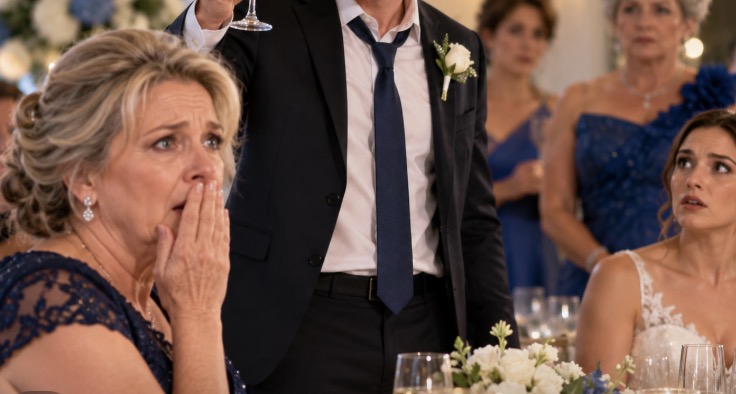
When my son Daniel told me he was getting married, I cried before he even finished the sentence.
Not because I was sad.
I was genuinely happy for him.
Daniel had always been the thoughtful one in our family. Even as a little boy, he noticed when someone was uncomfortable, remembered birthdays without being reminded, and somehow knew when I needed help carrying groceries before I ever asked.
So when he met Claire and started talking about her with the kind of calm certainty I had never heard in his voice before, I knew she was important.
“She makes everything feel easier,” he once told me.
That sentence stayed with me.
I wanted to like her.
And in the beginning, I did.
Claire was polite, intelligent, organized, and clearly devoted to Daniel. She worked in marketing, loved cooking, and had a habit of making lists for almost everything.
Restaurant options.
Vacation schedules.
Christmas gifts.
Wedding ideas.
Especially wedding ideas.
Once they got engaged, Claire approached the wedding like she was planning an international event.
She had folders.
Color palettes.
Spreadsheets.
Fabric samples.
A wedding website.
And what seemed like hundreds of tiny decisions that apparently had to be made months in advance.
Daniel mostly smiled and went along with it.
“If Claire is happy, I’m happy,” he would say.
I understood.
It was their wedding, after all.
I promised myself I would not become one of those mothers who tried to take control.
I would answer questions when asked, offer help when needed, and otherwise stay out of the way.
For the most part, I kept that promise.
Then, about three months before the wedding, Claire called me.
“I wanted to ask you something about your dress,” she said.
I was standing in my kitchen washing strawberries.
“Of course.”
“Have you bought one yet?”
“Not yet.”
There was a short pause.
Then she said, “Could you please not wear blue?”
I stopped washing the strawberries.
“Blue?”
“Yes. Any shade of blue, really.”
I glanced down at the blue sweater I happened to be wearing.
“Is there a reason?”
Claire laughed lightly.
“It’s just part of the color scheme. The bridesmaids are wearing dusty blue, and there will be a lot of blue in the decorations. I don’t want the family outfits blending into the wedding party.”
That sounded reasonable enough.
At least, I tried to tell myself it did.
“Of course,” I said. “No blue.”
“Thank you. I knew you’d understand.”
And that was that.
Or so I thought.
The truth was, I had been considering a navy dress.
Nothing dramatic. Just something elegant and simple.
But I crossed blue off my list.
A week later, I bought a soft green dress instead.
It had three-quarter sleeves, a modest neckline, and a long flowing skirt.
When I tried it on, my sister told me it was perfect.
“You look elegant without looking like you’re trying to be twenty-five,” she joked.
I laughed.
“That’s exactly the goal.”
I sent Claire a photograph.
She replied almost immediately.
“Beautiful!”
So I thought the issue was settled.
As the wedding approached, I tried to make myself useful without becoming intrusive.
I helped Daniel organize old family photographs for a memory table.
I ordered personalized handkerchiefs for him and his best man.
I helped address a few envelopes when Claire fell behind on invitations.
And I kept reminding myself that weddings make people stressed.
Small things feel enormous when you are planning a day you have imagined for years.
That explanation became useful because Claire had started acting differently.
She became more controlling.
Not rude, exactly.
Just particular.
Extremely particular.
Daniel’s sister, my daughter Emma, was asked to change her shoes because Claire thought they were “too shiny.”
Daniel’s uncle was politely discouraged from wearing his favorite patterned tie.
Even Daniel had to change the style of watch he planned to wear because Claire thought his usual one looked “too casual.”
I noticed all of it.
But I said nothing.
It wasn’t my wedding.
The rehearsal dinner took place the evening before the ceremony at a small restaurant near the hotel.
Claire seemed exhausted.
Daniel looked nervous but happy.
Her parents, Robert and Monica, arrived about twenty minutes late.
I had met them twice before.
Robert was friendly and quiet.
Monica was different.
She was confident, stylish, and the kind of woman who entered a room as though she expected everyone to notice.
That evening she wore an expensive-looking cream suit and enormous gold earrings.
She kissed Claire on both cheeks, hugged Daniel, and then looked me up and down.
“That color is nice on you,” she said.
I was wearing burgundy.
“Thank you.”
“I suppose tomorrow will be green?”
I was surprised she knew.
“Yes.”
She smiled.
“Interesting.”
There was something odd in her expression.
I could not place it.
The dinner continued.
Speeches were given.
People laughed.
Daniel squeezed my hand when no one was watching.
“Tomorrow,” he whispered.
“Tomorrow,” I repeated.
That night, I slept badly.
Not because anything was wrong.
I think mothers simply do not sleep normally the night before their children get married.
I kept remembering Daniel as a little boy.
His first day of school.
His first bicycle.
His first broken heart.
His college graduation.
And now he was about to start his own family.
By morning, my nerves had turned into excitement.
I got dressed slowly.
I had my hair styled.
Put on simple earrings.
Checked my dress twice.
Green.
Definitely green.
No accidental blue anywhere.
My sister picked me up, and we drove to the venue together.
The wedding was being held at an old country estate that had been converted into an event space.
White flowers lined the entrance.
The ceremony chairs faced a garden surrounded by tall trees.
Staff members moved quickly through the reception area carrying candles, table settings, and trays of glasses.
It was beautiful.
Claire had done an incredible job.
Then I walked into the bridal preparation room to say hello.
Claire was standing near a mirror in her wedding gown.
For a moment, every strange feeling I had disappeared.
She looked stunning.
Her dress was simple but elegant, with delicate lace at the sleeves.
“You look beautiful,” I told her.
She smiled.
“Thank you.”
We hugged.
I was about to leave when the door opened behind me.
Someone said, “Claire, where do you want these flowers?”
I turned.
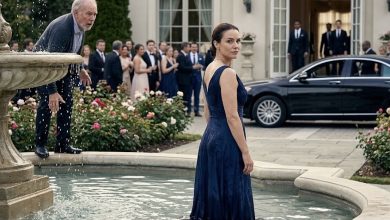
And there stood Monica.
Claire’s mother.
Wearing blue.
Not just blue.
The exact shade of blue I had specifically been told not to wear.
Dusty blue.
Her floor-length dress matched the bridesmaids almost perfectly.
For several seconds, I simply stared.
Monica noticed.
“Oh,” she said casually. “Hello.”
My eyes moved from her dress to Claire.
Claire looked uncomfortable.
I waited.
Surely someone was going to explain.
No one did.
Finally, I said, “That’s a beautiful color.”
Monica smiled.
“Thank you. Claire chose it.”
That was the moment something inside me dropped.
Claire chose it.
I looked at Claire.
“You chose your mother’s dress?”
Her face turned pink.
“Yes.”
I tried to keep my voice calm.
“I thought family members weren’t supposed to wear blue.”
Silence.
One bridesmaid suddenly became extremely interested in a bouquet.
Another stared at her phone.
Claire took a breath.
“It’s slightly different.”
It was not slightly different.
It was almost identical.
Monica lifted her chin.
“I’m the mother of the bride.”
The sentence was simple.
But the meaning behind it was clear.
Different rules applied to her.
For a few seconds, I considered saying everything that was running through my mind.
I could have reminded Claire about the phone call.
I could have pointed out the obvious double standard.
I could have asked why the mother of the bride was allowed to coordinate with the wedding party while the mother of the groom was specifically prohibited from doing the same.
But then I looked through the open doorway.
Daniel was standing across the courtyard.
He was laughing with his best man.
He looked happier than I had seen him in years.
And suddenly I knew exactly what I wanted to do.
Nothing.
At least not then.
I smiled.
“Well, you look lovely.”
Monica seemed surprised.
“So do you.”
I turned toward Claire.
“Enjoy your morning. I’ll see you outside.”
Then I walked away.
My sister followed me into the hallway.
“Are you seriously going to ignore that?”
“For today, yes.”
“That was deliberate.”
“Maybe.”
“You know it was.”
I did.
But I also knew something else.
If I created a scene, Daniel would remember it forever.
Every photograph.
Every anniversary.
Every time someone told the story of his wedding.
Somewhere in the story would be the argument between his mother and his wife.
I refused to give that moment to anyone.
So I went outside.
I greeted guests.
I helped my elderly aunt find her seat.
I hugged cousins I had not seen in years.
And when Daniel walked toward me before the ceremony, I smiled so sincerely that the hurt almost disappeared.
“You look amazing, Mom.”
“So do you.”
He adjusted his tie.
“Are you okay?”
That surprised me.
“Of course. Why?”
He studied my face.
“No reason.”
Then the music began.
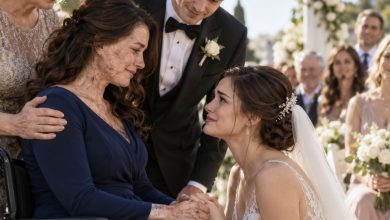
The ceremony was beautiful.
Daniel cried when Claire walked down the aisle.
Claire cried during her vows.
I cried through most of both.
For twenty minutes, dresses and colors and petty decisions became completely irrelevant.
Two people I loved were promising to build a life together.
That was what mattered.
During the reception, however, something unexpected happened.
People started commenting on the photographs.
Not negatively.
Just curiously.
A family friend approached me during dinner.
“I thought Claire asked you not to wear blue.”
My eyebrows rose.
“How did you know?”
“She mentioned it at the bridal shower.”
That surprised me.
Later, another guest made a similar comment.
Then Emma came over.
“Mom, did Claire tell Aunt Susan you weren’t allowed to wear blue?”
“I have no idea.”
“She told several people.”
Suddenly the situation felt different.
Until that moment, I had assumed the request was simply an awkward wedding decision.
Now I realized it had been discussed.
Possibly planned.
Still, I kept quiet.
The reception ended after midnight.
Two days later, Daniel came to my house.
Alone.
The moment I opened the door, I knew something was wrong.
“Coffee?” I asked.
“Please.”
We sat at the kitchen table.
He stared into his cup for almost a minute before speaking.
“Why didn’t you tell me?”
“Tell you what?”
“About the dress.”
I knew immediately.
“Daniel, it wasn’t important.”
“It was important enough that Claire told you not to wear blue.”
I folded my hands.
“This is not how you should spend the first week of your marriage.”
He sighed.
“I asked Claire about it.”
I said nothing.
“She told me her mom wanted blue because she wanted to coordinate with the bridesmaids.”
“I see.”
“And apparently Claire thought if both mothers wore blue, it would look strange.”
There it was.
Not a wedding rule.
Not a design issue.
Not a misunderstanding.
Just a choice.
One mother had been included.
The other had not.
Daniel looked angry.
“I’m sorry.”
“You have nothing to apologize for.”
“I should have known.”
“No, you shouldn’t.”
He looked at me.
“Why didn’t you say anything at the wedding?”
I smiled.
“Because you were getting married.”
“That doesn’t mean you had to accept being treated badly.”
“No. But there’s a difference between accepting something and choosing when to respond to it.”
He was quiet.
I continued.
“If I had argued with Claire in that room, what would have happened?”
He shrugged.
“She would have gotten upset.”
“Exactly. You would have heard about it. Her mother would have gotten involved. Your sister would have defended me. Someone would have cried. Everyone would have remembered the argument.”
He looked down.
“And instead?”
“Instead, everyone remembers your wedding.”
For the first time since arriving, he smiled slightly.
Then he said something I did not expect.
“Claire wants to apologize.”
I leaned back.
“She doesn’t have to.”
“She does.”
That evening, Claire called.
Her voice sounded different.
Less polished.
Less confident.
“I owe you an apology,” she said.
I listened.
“The dress thing was unfair.”
I appreciated the honesty.
She continued.
“My mom had opinions about everything. She wanted to be involved in the wedding party. She wanted a special dress. She kept saying the mother of the bride should stand out.”
I could imagine Monica saying exactly that.
Claire sighed.
“I didn’t know how to tell her no.”
“So you told me no instead.”
There was a pause.
“Yes.”
At least she did not make excuses.
“I thought you’d be easier about it.”
That sentence stung more than I expected.
“Because I usually am?”
“Yes.”
We were both silent.
Then I said, “Claire, being easygoing doesn’t mean someone won’t notice when they are treated unfairly.”
“I know.”
“And kindness shouldn’t become a reason to give someone less consideration.”
“I know that now.”
I believed her.
Not completely.
But enough.
Then she said something that surprised me.
“My mother asked why you didn’t say anything.”
“What did you tell her?”
“That you were protecting the wedding.”
I smiled.
“That sounds dramatic.”
“She said she would have said something.”
“I’m sure she would have.”
Claire laughed nervously.
Then something shifted.
The tension softened.
Before we ended the call, she apologized again.
And this time I told her I accepted.
Not because the dress no longer mattered.
It did.
Small moments sometimes reveal large truths about how people see one another.
But they can also become opportunities.
Over the next year, Claire changed.
Not completely.
People rarely transform overnight.
But she started noticing things she previously ignored.
At Thanksgiving, when Monica tried to change dinner plans at the last minute, Claire said no.
At Christmas, when her mother criticized Daniel for spending Christmas morning with our family, Claire defended him.
And when my daughter Emma got engaged the following spring, Claire offered advice without trying to control anything.
Then, about eighteen months after Daniel’s wedding, Claire and I went shopping together.
She was looking for a dress for Emma’s engagement party.
We walked past a rack filled with formal dresses.
She stopped.
Pulled one out.
And held it against me.
It was navy blue.
For a second, neither of us spoke.
Then she smiled.
“I think you should try this one.”
I laughed.
“Are you sure?”
She covered her face.
“I knew you were going to say that.”
“You walked right into it.”
“I deserved it.”
I tried on the dress.
It fit perfectly.
When I stepped out of the fitting room, Claire smiled.
“That’s definitely the one.”
I looked at myself in the mirror.
The whole situation felt strangely complete.
A dress had never really been the issue.
The issue was whether kindness would be mistaken for weakness.
Whether silence would be mistaken for ignorance.
Whether keeping the peace meant allowing someone else to decide that your feelings mattered less.
I learned something from my son’s wedding.
You do not have to react to every insult immediately.
You do not have to turn every unfair moment into a confrontation.
Sometimes strength is walking away.
Sometimes strength is speaking later.
And sometimes the most powerful thing you can do is refuse to let one uncomfortable moment become the memory everyone carries forever.
I wore that navy dress to Emma’s engagement party.
Claire complimented me three times.
And yes, Monica was there too.
When she saw me, her eyes moved toward the dress.
For one tiny second, I wondered whether she remembered the wedding.
Then she smiled.
“Blue suits you.”
I smiled back.
“I’ve always thought so.”