The Truth That Met Us in the Park
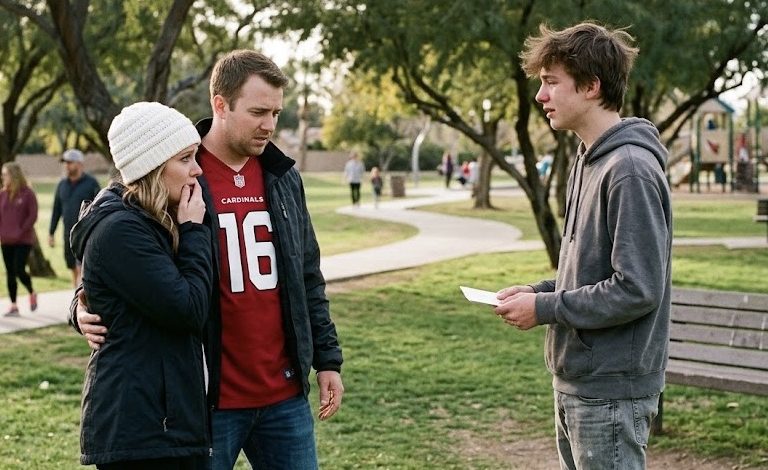
Thirty seconds after I took a picture with my husband, a teenage boy walked across the park, stared at him like he had seen a ghost, and said, “My mom died Thursday, and she told me you’re my father.”
I wish I could say I immediately knew there had been some mistake. I didn’t—because of the way my husband’s face changed.
Grant had been smiling a second earlier, standing beside me in his red Cardinals jersey with the big grin he always wore on football Sundays. I had my white knit cap pulled low against the chilly January air in Tempe, Arizona, where we had stopped before driving over to meet his brother-in-law for the game.
Taking a picture had been my idea. Grant hated selfies, but I coaxed him into it. He laughed, leaned in, and I snapped the photo. Grant looked completely happy in it. Completely normal. And, as it turned out, completely capable of carrying a deep secret I had somehow missed for fourteen years.
The boy who approached us couldn’t have been older than sixteen. He was tall and skinny, dressed in faded jeans and a gray hoodie, rubbing his thumb over the edge of a small white envelope.
“Grant Mercer?” he asked.
Grant stopped smiling. Something inside him simply shut down.
“Yes?” Grant replied.
The boy swallowed. “My name is Caleb Hart.”
Grant didn’t move. Caleb looked at me, then back at Grant. “My mom was Marissa Hart.”
That was when Grant took a step backward. It was only a few inches, but wives notice things like that.
“My mom died Thursday,” Caleb said. “Cancer. She gave me this before she died.” He held up the envelope. “She said if anything happened to her, I had to find you.”
I turned to Grant. “Who is Marissa?”
He didn’t answer. Caleb spoke up instead. “She told me Grant was my father.”
For a long moment, nobody spoke. Background noise filled the air: kids throwing a football, a barking dog, the scent of charcoal grilling nearby. A completely normal Sunday, except my husband of fourteen years was standing between me and a boy who had just called him his father.
I let out a short, nervous laugh. “There has to be some confusion,” I said.
Caleb stared at Grant. Grant stared at the ground before finally looking at me. “Natalie…”
“Tell him,” I insisted.
Grant rubbed his hands over his face, looking back and forth between us. “He isn’t making it up,” he said quietly. “On paper, I’m his father.”
I don’t remember sitting down. I only remember suddenly sitting on a wooden bench, hands pressed between my knees to keep them from shaking. Grant sat beside me, while Caleb remained standing.
Fourteen years ran through my mind. Fourteen Christmas mornings, mortgage payments, family reunions, two miscarriages, funerals, and countless everyday routines. I knew every detail about Grant’s daily habits, yet I didn’t know he had a son.
“Start talking,” I said.
Grant nodded slowly. “It isn’t what you think.”
“Then tell me what I’m supposed to think.”
Caleb finally sat on the far end of the bench as Grant began to explain.
“Marissa wasn’t my girlfriend,” Grant said. “She dated my younger brother, Owen.”
I knew Owen’s name, though Grant rarely spoke about him. Owen had died at twenty-eight after struggling with addiction.
“Marissa got pregnant when Owen was twenty-one,” Grant continued. “Owen was in bad shape and couldn’t be relied on. During her pregnancy, Marissa found out Caleb had a heart condition.”
Caleb nodded, touching his chest. “I was born with a hole in my heart. Had surgery when I was eight months old.”
“Marissa was scared,” Grant explained. “Her family had turned away from her, and Owen was gone. So I helped her.”
“How?” I asked.
“I married her,” Grant said quietly. “It was a courthouse marriage. I had a job with good health insurance, and she needed stability. We never lived together as husband and wife, and I was never involved with her romantically.”
“Then why does Caleb think you’re his father?” I asked.
Grant looked at the boy. “Because legally, for a while, that’s what I became.”
Caleb chimed in, “My mom never lied about Owen being my biological dad. But she said there’s a difference between the guy who makes you and the guy who shows up. For my first three years, Grant helped take care of me.”
Grant explained that when Owen later got clean, they ended the legal arrangement so Owen could try to be a father. But Owen eventually relapsed and passed away years later.
“How much did you know about Grant?” I asked Caleb.
“A lot,” Caleb replied. “He sent birthday cards every year. And Christmas gifts.”
I turned to Grant, feeling a cold wave of realization. “You’ve stayed in contact with him?”
“Yes,” Grant admitted.
“How often?”
“A few times a year over the last decade.”
It hit me then: Grant had not simply hidden a detail from his past; he had maintained an ongoing connection in secret throughout our entire marriage.
I stepped away from the bench, overwhelmed. But looking back at Caleb, standing there holding his envelope, I remembered he had just lost his mother three days ago. My anger was with Grant, not this young man.
I walked back over. “I’m sorry, Caleb. You shouldn’t have to deal with this right now.”
Caleb handed Grant the envelope. “Mom wanted you to have this.”
Grant opened the letter. It contained four handwritten pages from Marissa. She wasn’t asking for money or trying to disrupt our lives. She was facing the end of her life and worrying about her son’s future. Caleb had very little remaining family. Marissa’s letter held one central plea: Please don’t let him feel like everybody leaves.
Reading those words shifted something inside me. For years, Grant and I had tried to build a family, enduring painful losses before giving up on the idea. Now, a sixteen-year-old boy was standing in front of us with nowhere stable to go.
We skipped the football game and went to a local diner instead. Over coffee and pancakes, we talked for hours.
I learned that Caleb liked baseball, struggled with chemistry, played guitar, and had a quick sense of humor. What struck me most was his laugh—he shared the exact same inflection and timing as Grant. Even though Grant was his uncle rather than his biological father, family traits had clearly carried through.
The weeks that followed were challenging. There were legal documents, school transitions, and difficult discussions about the future. Grant and I faced tough conversations about honesty and trust.
When I asked Grant why he had kept the truth hidden for so long, he was honest. “The first time I didn’t tell you, I was scared,” he admitted. “The second time, I was ashamed I hadn’t told you the first time. After that, every year made the lie bigger.”
It wasn’t an easy answer to accept, but it was real. Forgiveness doesn’t happen overnight, but we agreed to start rebuilding our relationship through open communication and counseling.
Caleb eventually came to stay in our guest room to finish his high school years locally. Gradually, our household adjusted to the new dynamic. Extra shoes lined the hallway, the grocery lists grew longer, and the house felt livelier.
By Thanksgiving, our home was full of family and noise. After dinner, Caleb pulled out his phone to take a group picture outside.
Grant wore his football jersey, and I put on my white knit cap—the same outfit from the day we met Caleb in the park.
As we lined up for the photo, I thought about that original picture in Tempe. I used to view it as the moment our old life ended. But standing there with Grant and Caleb, I saw it differently: it was the moment the full truth finally came to light, allowing us to build something genuinely honest together.
Caleb squeezed between us, holding up the phone camera. “Everybody smile,” he said.
Grant put one arm around Caleb and reached the other over my shoulder. I moved closer as the timer ticked down, and the flash went off.
That new photograph sits framed in our hallway today. It shows three people who took a long, unexpected path to become a family—built not on secrets, but on showing up when it mattered most.
Frequently Asked Questions (FAQ)
What is the main message of this story?
The story emphasizes the power of honesty, forgiveness, and unconditional family support. It shows how truth, even when painful at first, can heal long-standing secrets and lead to stronger, healthier relationships.
Why did Grant keep his legal marriage and nephew a secret?
Grant initially kept his secret out of fear and confusion during a difficult period in his past. Over time, shame about not telling the truth earlier caused the lie to grow larger, making it increasingly difficult for him to bring it up.
Was Grant biologically Caleb’s father?
No, Grant was Caleb’s uncle. Caleb’s biological father was Grant’s late brother, Owen. Grant had married Caleb’s mother temporarily in a legal arrangement solely to provide medical insurance and stability during a health crisis.
How did the family resolve their trust issues?
The couple addressed their challenges through honest conversations, professional marriage counseling, and transparent communication. Over time, mutual commitment and caring for Caleb helped rebuild their bond.