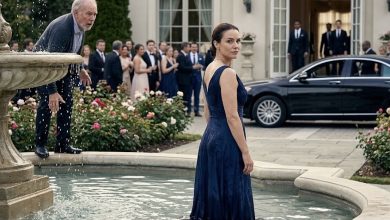
I never imagined I would get married in a hospital.
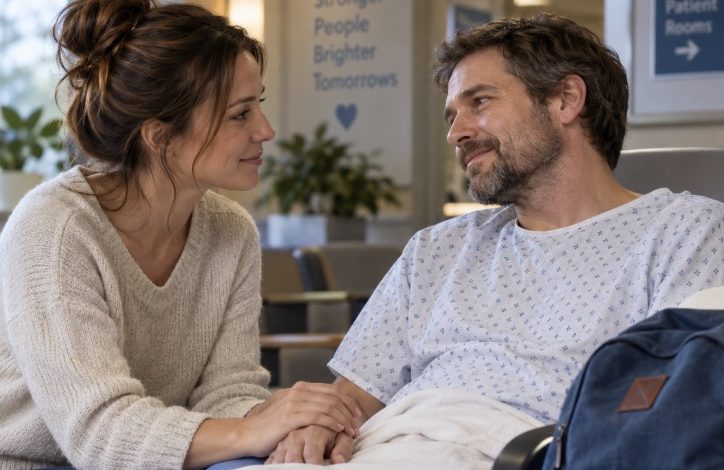
I certainly never imagined the groom would be a man whose last name I had learned only a few hours earlier.
But sometimes life puts you in a place you never planned to be, sitting beside someone you were never supposed to meet, and asks you to make a choice before you have enough time to understand what that choice might mean.
That was how I met Daniel.
It happened on a cold Tuesday evening in November.
I had gone to St. Joseph’s Hospital because my younger sister, Emily, was having emergency surgery after a minor accident at work. The doctors had assured us that she would probably be fine, but I was still nervous.
Hospitals had always made me uncomfortable.
The bright lights, the smell of disinfectant, the quiet footsteps in the hallways—it all made time seem slower.
I had been sitting in the waiting room for almost three hours when I noticed the man across from me.
He looked to be in his early forties, maybe a few years older than me. He wore jeans, an old gray sweater, and a faded blue backpack rested beside his chair.
At first, I assumed he was waiting for someone too.
But something about him seemed different.
He wasn’t checking his phone.
He wasn’t looking toward the hallway every time a nurse appeared.
Instead, he simply sat there staring at the floor.
Eventually, our eyes met.
He gave me a small smile.
“You’ve been here a while,” he said.
“So have you.”
He nodded.
“Unfortunately, I know this place pretty well.”
There was something in the way he said it that made me stop complaining about the uncomfortable chair.
We started talking.
His name was Daniel Hayes.
He told me he had been a high school history teacher for almost fifteen years. He loved old movies, terrible coffee, hiking, and collecting postcards from places he had never visited.
I laughed when he admitted that last part.
“You collect postcards from places you haven’t been?”
“Exactly.”
“Isn’t that backward?”
“Maybe. But it gives me somewhere to dream about.”
We talked for nearly forty minutes before I finally asked who he was waiting for.
His expression changed.
“No one.”
I thought I had misunderstood.
“You’re not here with someone?”
He shook his head.
“I’m the patient.”
That was when he explained.
Daniel had been seriously ill for several months. He had received treatment, but his condition had recently become much worse.
He spoke calmly, almost as though he were describing someone else’s life.
The doctors had asked him to come back that evening after his latest test results.
The news had not been good.
“How bad?” I asked carefully.
He looked toward the window.
“Bad enough that I probably shouldn’t be making plans for next Christmas.”
I didn’t know what to say.
“I’m sorry.”
“Don’t be. I’ve had a good life.”
Then he smiled again.
“Shorter than expected, apparently, but good.”
A nurse called his name.
Before he stood, Daniel picked up the blue backpack.
“Good luck with your sister.”
“Good luck with everything.”
He disappeared through the double doors.
I assumed that was the end of it.
It wasn’t.
About twenty minutes later, the doctor came out to tell me Emily’s surgery had gone well. She would remain overnight for observation, but there was no reason to expect any complications.
The relief was so strong that I nearly cried.
I walked toward the vending machines to get some water.
That was when I saw Daniel again.
He was standing alone beside a window.
This time, he wasn’t smiling.
I almost kept walking.
Instead, I stopped beside him.
“Everything okay?”
He laughed quietly.
“No.”
There are moments when people don’t want advice.
They don’t want encouraging speeches.
They just don’t want to be alone.
So I stayed.
For a while, neither of us said anything.
Then Daniel told me something I would never forget.
“My biggest fear isn’t dying.”
I looked at him.
“It’s disappearing without anyone noticing.”
He had grown up in foster care.
He had never married.
He didn’t have children.
The few relatives he knew were people he hadn’t spoken with in years.
He had friends, former coworkers, and students who occasionally contacted him, but no one he considered family.
“No one should leave this world thinking they didn’t matter,” I said.
Daniel looked at me.
“That sounds like something a greeting card company would print.”
I laughed.
“Maybe. But I mean it.”
“I know.”
We sat together until almost midnight.
Before I left, I gave him my phone number.
Not because I expected anything dramatic to happen.
I simply didn’t want him sitting alone the next day.
The next morning, he texted me.
Coffee?
I met him in the hospital cafeteria.
That became our routine.
For the next four days, I visited Daniel whenever I could.
We drank bad coffee and talked about everything.
He told me about his students.
I told him about my divorce.
He told me his dream had been to travel across Europe with nothing but a backpack.
I told him my biggest adventure lately had been replacing my washing machine without flooding the kitchen.
He laughed harder than the joke deserved.
Then, on Saturday afternoon, he said something completely unexpected.
“Would you marry me?”
I almost dropped my coffee.
“What?”
He laughed.
“I know how ridiculous that sounds.”
“Ridiculous is a very gentle word for it.”
“Just hear me out.”
Daniel wasn’t asking for romance.
He wasn’t pretending we were in love.
His request came from something much simpler.
He wanted, for however much time he had left, to know what it felt like to belong to someone.
To have a family.
Even temporarily.
“I don’t want my final paperwork to say ‘no next of kin,’” he explained.
My first reaction was to say no.
Of course it was.
People don’t marry strangers because of conversations in hospital cafeterias.
But then I thought about the first night I had seen him sitting alone.
I thought about his fear of disappearing.
And I asked myself a strange question.
If helping another person feel less alone cost me almost nothing, why was I so afraid to do it?
“Are there legal complications?” I asked.
Daniel laughed.
“That isn’t exactly the romantic answer I was hoping for.”
“I’m serious.”
“So am I.”
We spoke to a hospital social worker and later to an attorney Daniel already knew.
Everything was explained clearly.
I wasn’t taking responsibility for his medical debts.
Daniel wasn’t asking me for money.
There were no secret obligations hidden behind the request.
He simply wanted someone to call family.
Two days later, we got married in a small room near the hospital chapel.
A nurse named Teresa brought flowers from the gift shop.
Another nurse found a small cake.
Emily attended wearing hospital slippers because she hadn’t completely recovered yet.
Daniel wore a clean white shirt that one of his friends brought from his apartment.
I wore the same blue dress I had worn to work that morning.
There were no rings.
No photographer.
No carefully written vows.
When the hospital chaplain asked whether I accepted Daniel as my husband, I looked at him.
He looked happier than I had ever seen him.
“I do.”
Daniel smiled.
“So do I.”
We were married for seven days.
Those seven days were some of the strangest and most meaningful days of my life.
Daniel’s condition continued to worsen, but he insisted that every morning should begin with coffee.
We watched old movies on his laptop.
We argued about whether pineapple belonged on pizza.
He made me promise that someday I would visit Italy because he had always wanted to see Florence.
He even convinced me to bring him a stack of postcards.
One afternoon, he wrote something on the back of each one.
He refused to let me read them.
“They’re for later,” he said.
“Later when?”
“You’ll know.”
On our sixth day of marriage, Daniel asked me to bring him his backpack.
The faded blue one he had carried when we first met.
I handed it to him.
He opened it, looked inside, then closed it again.
“What’s in there?” I asked.
“Mostly pieces of my life.”
“That sounds mysterious.”
“I’m trying to become more interesting before it’s too late.”
I smiled.
The next morning, Daniel was very tired.
We barely talked.
I sat beside his bed and held his hand.
At one point, he opened his eyes.
“Claire?”
“I’m here.”
“Thank you for saying yes.”
I squeezed his hand.
“Thank you for asking.”
He smiled.
That was our last conversation.
Daniel passed away peacefully later that evening.
For several days afterward, everything felt unreal.
It seemed impossible that someone I had known for such a short time could leave such an enormous empty space behind.
I returned to my apartment.
I went back to work.
I visited Emily.
I tried to return to normal.
But normal had changed.
About ten days later, a man called me.
His name was Robert Mason.
He was Daniel’s attorney.
He asked if I could come to his office.
When I arrived, Robert was waiting with a cardboard box on his desk.
And beside it was Daniel’s blue backpack.
I recognized it immediately.
Robert pushed it gently toward me.
“He wanted you to have this.”
My throat tightened.
“Why?”
Robert hesitated.
“Because he wanted you to know the truth.”
For a moment, my mind went in every possible direction.
Had Daniel lied about something?
Had he hidden something from me?
Robert opened a folder.
“Daniel prepared instructions several months ago. Long before he met you.”
That confused me even more.
Inside the backpack were dozens of envelopes.
Every envelope had a name written on it.
Some belonged to former students.
Others belonged to teachers, neighbors, old friends, and people Daniel had met throughout his life.
There were nearly sixty letters.
“He wrote them after learning his illness was serious,” Robert explained. “He wanted certain people to know how much they had mattered to him.”
Then Robert handed me another envelope.
My name was written on the front.
Claire.
I stared at it.
“He wrote this during your marriage,” Robert said.
My hands shook as I opened it.
Daniel’s handwriting was messy but familiar.
Claire,
If you’re reading this, then Robert has probably made everything unnecessarily serious.
He does that.
I laughed through my tears.
The letter continued.
Daniel explained that the backpack had been his way of carrying the people he loved with him.
Every letter contained a memory.
A thank-you.
An apology.
Or something he had been too embarrassed to say in person.
Then I reached the part that changed everything.
You thought you married me because I didn’t want to die alone.
That was true.
But it wasn’t the whole truth.
You reminded me, during my final week, that my life had never actually been lonely.
I had students who remembered me.
Friends who checked on me.
People who laughed at my jokes.
People whose lives crossed mine and became slightly different because I had been there.
I just couldn’t see it anymore.
You helped me see it.
Underneath the letters was a small notebook.
Inside were pages filled with names.
Next to each name Daniel had written a short story about that person.
One former student had become a nurse because Daniel encouraged her after she failed an exam.
Another student had gone to college because Daniel helped him complete an application.
A neighbor remembered Daniel bringing groceries during a snowstorm.
A coworker remembered him quietly paying for a student’s field trip.
Daniel hadn’t lived a lonely life.
He had lived a life full of people.
He just hadn’t understood how much he mattered to them.
At the bottom of the backpack, I found the postcards.
The same ones he had written in the hospital.
Florence.
Paris.
Prague.
Vienna.
Barcelona.
On each postcard, Daniel had written one sentence.
Go somewhere you’ve never been.
Tell people when they matter.
Don’t wait for permission to live.
Call your sister more often.
Buy the expensive coffee once in a while.
And on the final postcard, beneath a picture of a quiet street in Florence, he had written:
Being alone and being unloved are not the same thing. It took me far too long to learn that.
I sat in Robert’s office crying.
Then he handed me one final document.
Daniel had left instructions for a small portion of his savings.
Not to me personally.
He wanted the money used to establish a scholarship at the high school where he had taught.
The scholarship would help students who had grown up in foster care.
“He wanted you to choose the first recipient,” Robert said.
“Why me?”
Robert smiled.
“His instructions say, ‘Claire understands what it means to give someone a chance.’”
That spring, I attended the scholarship ceremony.
Daniel’s former students filled the auditorium.
Some were adults now.
Teachers told stories about him.
People laughed.
People cried.
A young woman named Maya received the first Daniel Hayes Scholarship.
She had spent most of her childhood moving between foster homes.
Her dream was to become a teacher.
After the ceremony, I stood outside holding Daniel’s backpack.
I finally understood why he had wanted me to see what was inside.
It wasn’t hiding money.
There was no shocking secret identity.
No hidden fortune.
The truth was far more important.
Daniel believed he would leave the world unnoticed.
He was wrong.
Dozens of people carried pieces of him in their lives.
And now I did too.
Six months later, I booked a flight to Italy.
I traveled alone.
On my second morning in Florence, I found a tiny café near the river and ordered coffee that cost far more than any reasonable person should spend on coffee.
Daniel would have approved.
Then I walked through the city carrying his blue backpack.
Inside were only three things.
My passport.
Daniel’s final postcard.
And a new notebook.
On the first page, I had written a sentence of my own:
People don’t always enter our lives for a long time.
Sometimes they arrive for a week.
Sometimes for a day.
Sometimes only long enough to teach us something we were supposed to understand.
Daniel entered my life as a stranger in a hospital waiting room.
Seven days later, I was his wife.
And although our marriage lasted only one week, what he left behind changed the way I looked at every relationship afterward.
I stopped assuming people knew I appreciated them.
I started saying it.
I stopped postponing small adventures.
I started taking them.
And I stopped believing that the length of a relationship was the only measure of its importance.
Some people stay for decades and leave barely a trace.
Others pass through our lives quickly and somehow change the direction of everything.
Daniel was one of those people.
And whenever someone asks about the old blue backpack I sometimes carry when I travel, I smile.
Because somewhere inside it is the reason I finally understood the truth Daniel had spent his final days trying to learn himself:
A meaningful life isn’t measured only by how long we stay.
Sometimes it’s measured by what remains in the people we leave behind.