AITA for telling my wife I miss when she used to wear thongs instead of granny panties every day?
Welcome back, readers, to another dive into the tangled web of relationships! Today's story touches on a sensitive topic that many couples navigate: the evolution of intimacy and personal style within a long-term partnership. It’s natural for routines and preferences to shift over time, but how we communicate our feelings about these changes can make all the difference between fostering closeness and sparking a major conflict.
This AITA post brings to light a seemingly small comment that escalated quickly. Our original poster (OP) found himself in hot water after expressing a particular desire to his wife. It's a classic case of intent vs. impact, and it raises questions about vulnerability, body image, and the delicate art of maintaining attraction and appreciation in a committed relationship. Let's get into the details!

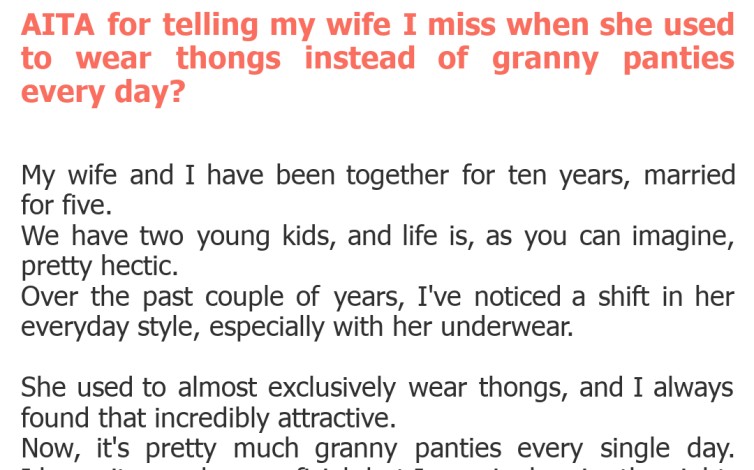
"AITA for telling my wife I miss when she used to wear thongs instead of granny panties every day?"
My wife and I have been together for ten years, married for five. We have two young kids, and life is, as you can imagine, pretty hectic. Over the past couple of years, I've noticed a shift in her everyday style, especially with her underwear. She used to almost exclusively wear thongs, and I always found that incredibly attractive. Now, it's pretty much granny panties every single day. I know it sounds superficial, but I genuinely miss the sight, and it felt like a small, tangible reflection of how things have changed between us, sometimes feeling less spontaneous or sensual.
I’ve brought it up gently before, hinting around it, but she didn’t really pick up on it. So, a few nights ago, while we were just relaxing in bed, I decided to be direct. I told her, “I really miss when you used to wear thongs instead of granny panties every day. It was hot, and I loved it.” The words were out, and the immediate atmosphere in the room changed completely. She just stared at me, her face falling, before a sudden look of hurt washed over her features. I knew instantly I'd made a mistake, but it was too late.
She immediately got defensive, asking if I thought she wasn't attractive anymore or if I was saying she needed to change her underwear for me. I tried to explain that wasn't it at all; I was just trying to express something I found appealing and that I missed that particular aspect of our intimacy. I even said I understood comfort often takes precedence, especially with two kids, but I wanted her to know how I felt.
Her response was that I was effectively telling her her body wasn't good enough in her current choice of underwear and that she felt judged and unappreciated. She said I was focusing on something so trivial when she's busy managing a household and raising our children. She felt like I was policing her comfort and making her feel self-conscious in her own home. The conversation quickly devolved into a full-blown argument, and she ended up sleeping in the guest room.
Since then, things have been incredibly tense. She's withdrawn, and I feel terrible, but also a bit misunderstood. My intention truly wasn't to shame her or dictate her clothing choices. I just wanted to voice a part of my attraction and a feeling of nostalgia for how things used to be. I thought being honest would be better than letting it fester. Now I'm wondering if I completely messed up by saying anything at all. AITA?
This situation is a classic example of how even well-intentioned words can land completely wrong in a relationship. On one hand, the original poster (OP) was attempting to communicate a feeling of desire and nostalgia for a specific aspect of his wife's previous style. It's understandable that in a long-term relationship, partners might miss elements that once contributed to their perceived attraction or intimacy. He felt he was being honest.
However, the impact of his words on his wife was clearly devastating. For many women, especially after childbirth, body image can be a very sensitive area. Being told that a partner misses a previous style of clothing, particularly underwear, can easily be interpreted as a criticism of her current body or her choices, making her feel unappreciated and judged for prioritizing comfort or personal preference.
The issue here isn't necessarily the desire itself, but the framing and delivery. Suggesting that one misses a past physical attribute or clothing choice often implies that the current state is somehow less desirable. This can erode a partner's self-esteem and create a feeling of being scrutinized rather than cherished for who they are in the present moment. It shifts the focus from mutual desire to perceived inadequacy.
Instead of highlighting what's "missing," a more constructive approach might have been to focus on expressing positive desire in the present. Compliments on her current appearance, initiating intimacy in ways that make her feel desired, or even a playful suggestion to try something new, all without the implicit comparison to the past, could have yielded a far better outcome and strengthened their bond rather than straining it.
The underwear debate: Is honesty always the best policy?
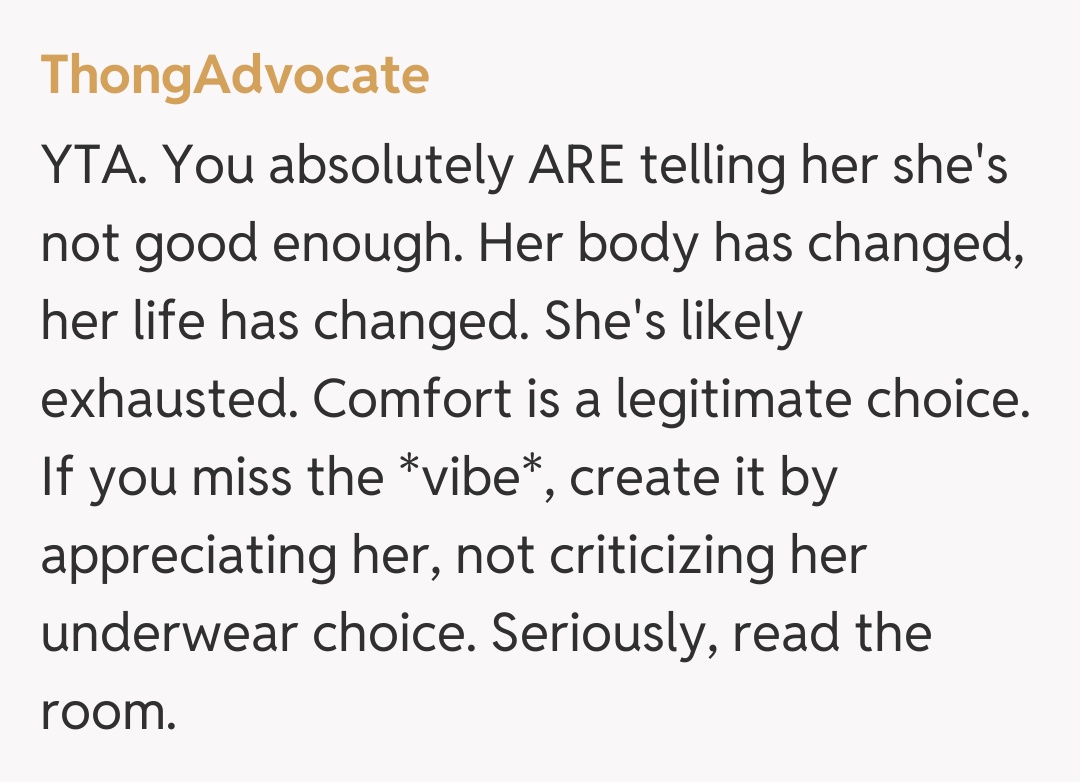
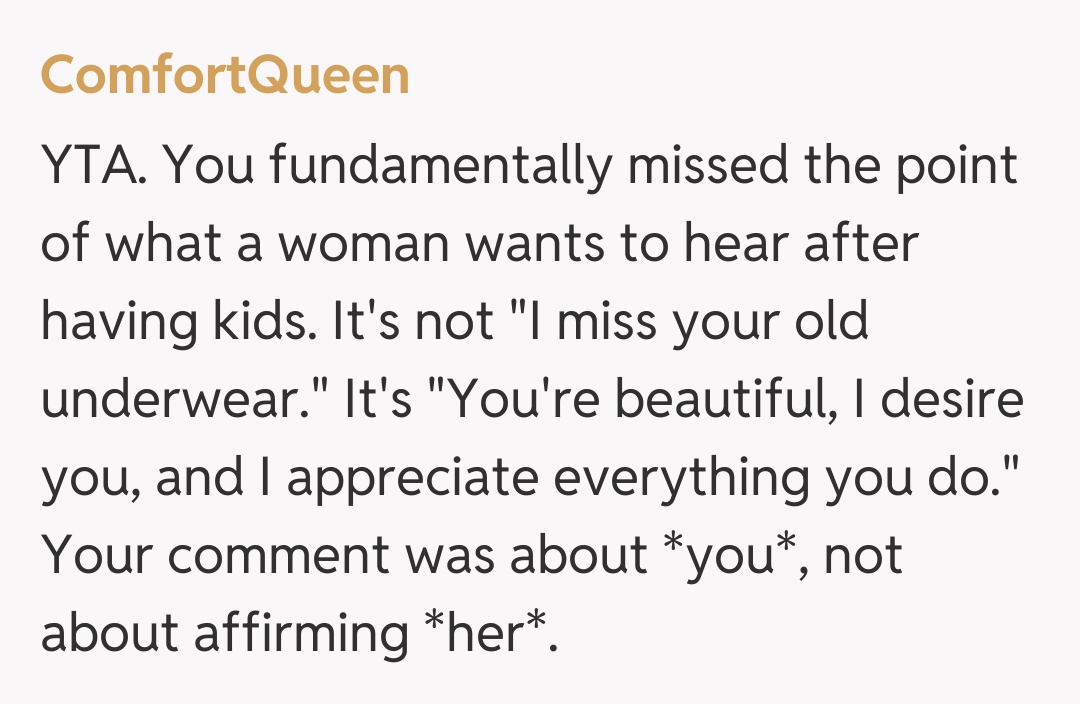
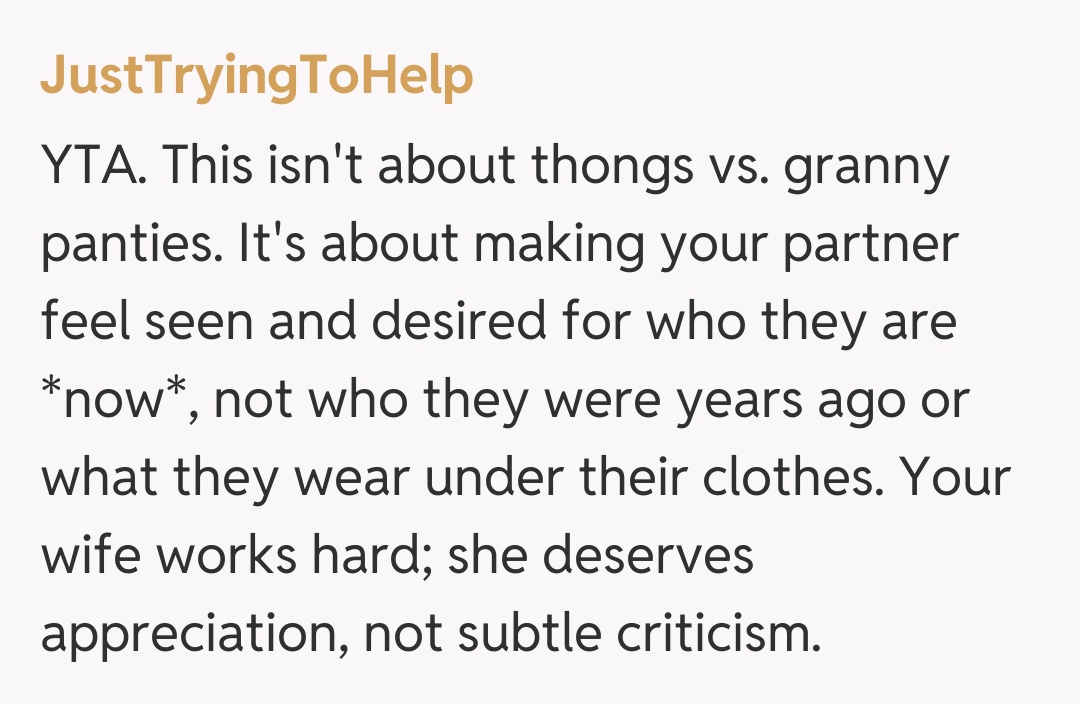
The comments section exploded with a range of opinions, but a clear majority leaned towards the "YTA" verdict for our original poster. Many readers empathized deeply with the wife, highlighting how such a comment, regardless of intent, can deeply wound a partner's self-esteem. Users pointed out that after having children, a woman's body changes, and comfort often becomes a priority, making the comment particularly insensitive.
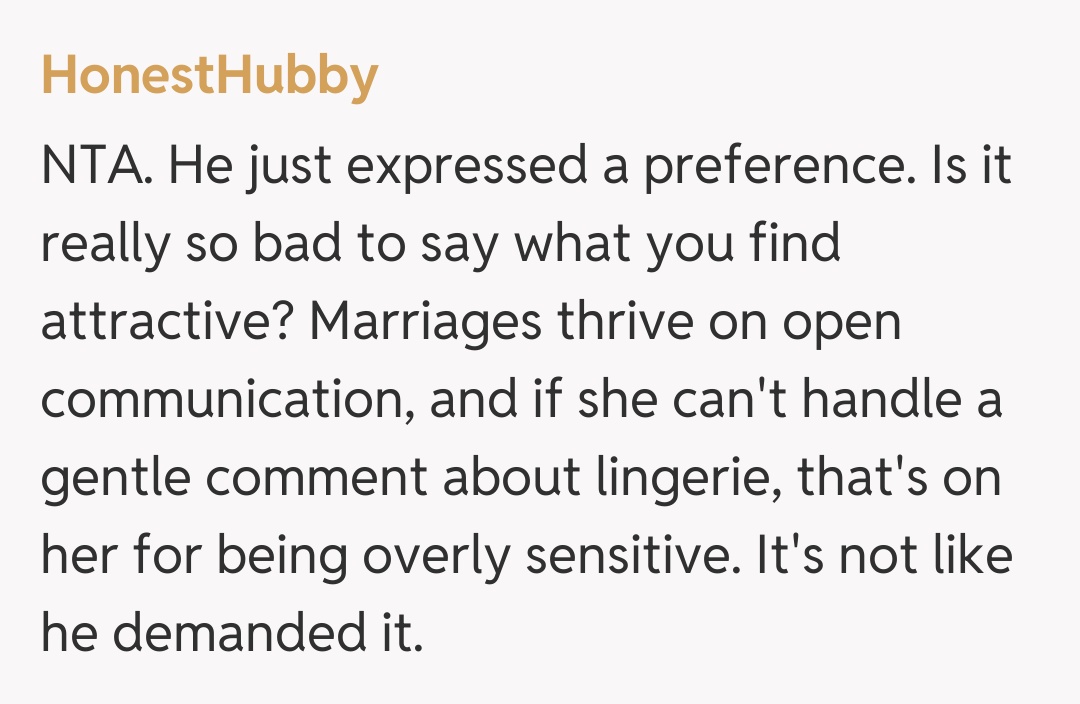
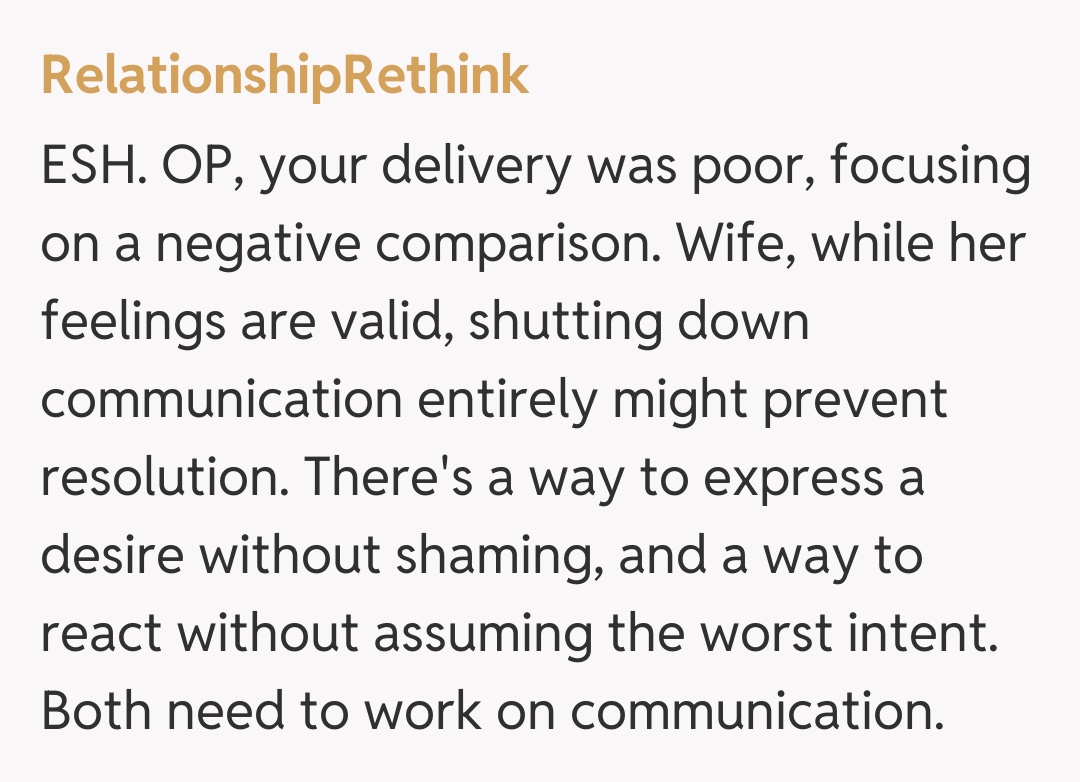
However, a vocal minority argued for "NTA" or "ESH," suggesting that honest communication, even about sensitive topics, is crucial in a marriage. They felt the wife might have overreacted and that the husband was simply trying to express his attraction. This perspective often focused on the idea that partners should be able to share their desires without fear of being labeled as shaming. It shows the complex balance between honesty and empathy.
This AITA post serves as a powerful reminder that while honesty is often lauded in relationships, empathy and careful communication are equally, if not more, important. What one partner intends as an innocent expression of desire can be perceived as a deep personal attack by the other, especially when insecurities about body image or life changes are at play. Ultimately, the goal in intimate relationships should always be to uplift and connect, and that requires thinking not just about what we want to say, but how our words will truly land.