AITA for telling my girlfriend her chronic illness is the main reason I’m staying because “if you were healthy you’d leave me for someone better and I know it”?
Oh, relationships. They're a delicate dance of honesty, vulnerability, and sometimes, a whole lot of unspoken baggage. Today, we're diving into a story that tackles one of the most painful truths a partner can utter, especially when a chronic illness is involved. It's a statement that cuts deep, revealing insecurities that might have been festering beneath the surface for far too long. Get ready for a discussion that will undoubtedly spark strong opinions and debates about what constitutes 'truthful' versus 'cruel' communication within a partnership.
This particular post really struck a nerve with our community, and it's not hard to see why. The original poster (OP) dropped a bombshell on their partner, using their chronic illness as a justification for their own insecurities. It's a complex web of emotions, ranging from self-pity to what some might call emotional manipulation. We're here to dissect it all, understanding the angles from both sides, and ultimately, trying to figure out where the line is drawn when expressing difficult feelings in a relationship.

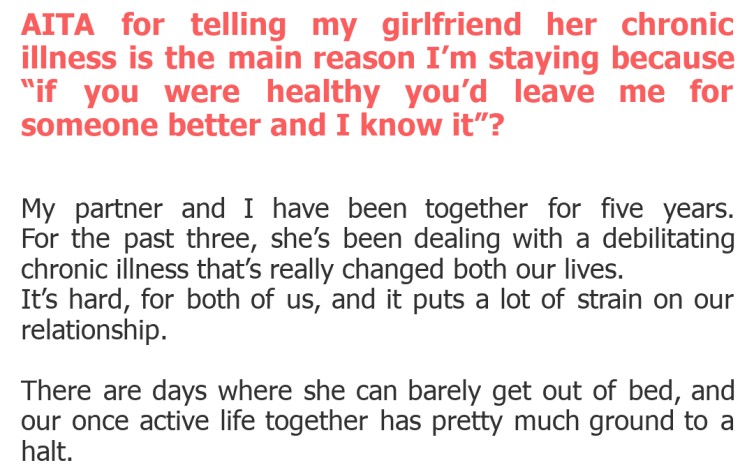
"AITA for telling my girlfriend her chronic illness is the main reason I’m staying because “if you were healthy you’d leave me for someone better and I know it”?"
My partner and I have been together for five years. For the past three, she’s been dealing with a debilitating chronic illness that’s really changed both our lives. It’s hard, for both of us, and it puts a lot of strain on our relationship. There are days where she can barely get out of bed, and our once active life together has pretty much ground to a halt. I try my best to be supportive, to be her rock, but sometimes I feel completely overwhelmed and resentful. We've had a few arguments recently, mainly born out of frustration from both sides about her limitations and my increasing responsibilities. I feel like I'm constantly sacrificing things, and while I love her, it's exhausting.
Last night, we had another one of those arguments. It started over something small – her not being able to join me for an event I really wanted to attend. The tension escalated quickly. She accused me of being insensitive, and I, in a moment of pure frustration and probably self-pity, blurted out something truly awful. I told her, word for word, “Look, the main reason I’m still here is because of your illness. If you were healthy, you’d leave me for someone better, and I know it.” The moment the words left my mouth, I instantly regretted them. The look on her face… it was a mixture of shock, hurt, and utter devastation. She just stared at me, then walked away into the bedroom and locked the door.
I tried to apologize immediately, knocking on the door, explaining that I didn’t mean it, that it was just my own insecurities speaking. But she wouldn't open up or respond. I know what I said was terrible. I have always struggled with low self-esteem, and I genuinely believe that she is too good for me, even more so when she was healthy. The illness, in my warped mind, made her 'accessible' to me, and I convinced myself that if she ever fully recovered, she would realize she could do better and leave. It’s a terrible thought, and I hate that I said it out loud.
I’ve spent the night on the couch, unable to sleep, replaying her devastated expression. I know I messed up, but I'm trying to figure out how badly. Was it an unforgivable offense born of my own deep-seated issues, or just a cruel, honest moment of insecurity that can be worked through? I love her, despite my stupid brain sometimes telling me otherwise. I need to know, AITA?
This AITA post presents a truly difficult scenario, highlighting the immense strain chronic illness can place on a relationship. The original poster's words, while undeniably hurtful, seem to stem from a place of profound insecurity rather than outright malice. His confession reveals a deep-seated belief that he is not good enough for his partner, and that her illness is, in a twisted way, keeping her with him. This kind of self-deprecating thought process can be incredibly damaging, not just to the individual but to the relationship itself.
However, understanding the source of the words doesn't negate their impact. Telling someone you are only with them because they are ill is a devastating blow. It strips away their sense of desirability and makes them feel like a burden, rather than a cherished partner. For someone already struggling with a chronic condition, which often brings its own feelings of vulnerability and loss, such a statement can be incredibly isolating and deeply traumatizing. It transforms love into pity, eroding trust and self-worth.
The question then becomes about the line between brutal honesty and cruel insensitivity. While open communication is vital in any relationship, there are ways to express insecurity and frustration without weaponizing a partner's vulnerability. The OP could have communicated his feelings of inadequacy, the strain of caregiving, and his fears of being left, in a constructive manner. Instead, his outburst turned his internal struggles into an attack on his partner's intrinsic value and agency.
Moving forward, the relationship faces a significant challenge. The partner's trust has been severely broken, and rebuilding it will require immense effort, genuine remorse, and perhaps professional help for both individuals. The OP needs to address his self-esteem issues, and they both need to explore healthier communication strategies. Whether this relationship can recover depends on the depth of the wound and their mutual commitment to healing, which now includes confronting these deep-seated insecurities head-on.
The internet weighs in: Is 'brutal honesty' just plain brutal?
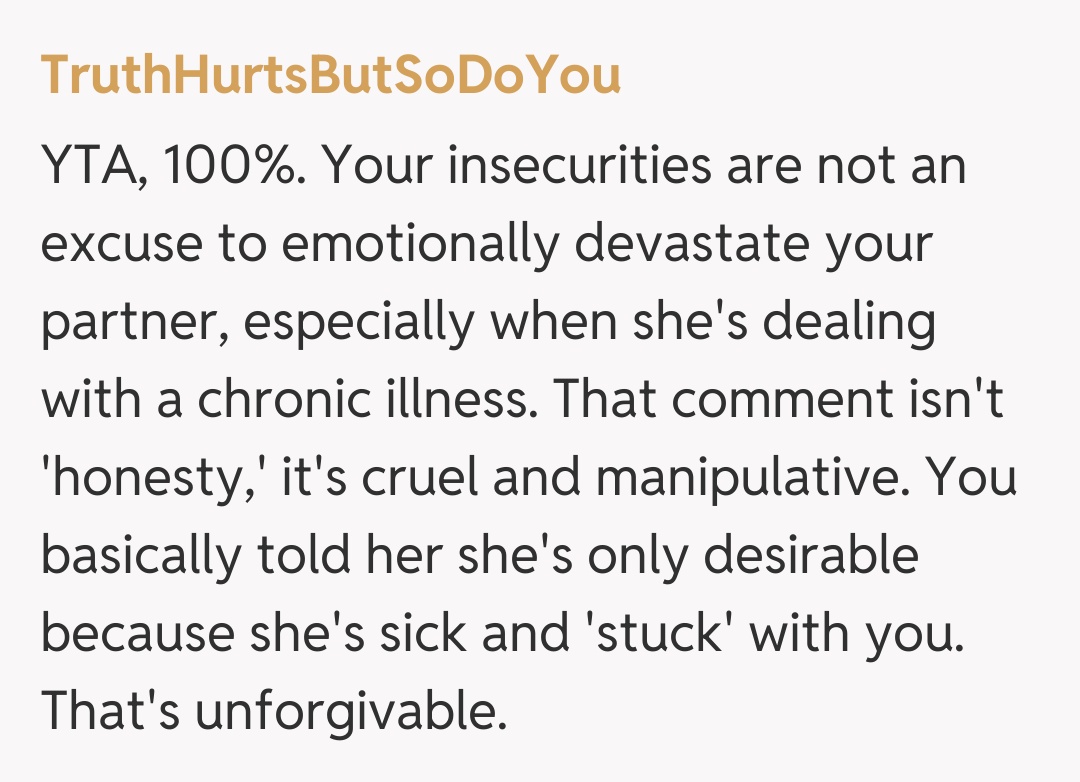
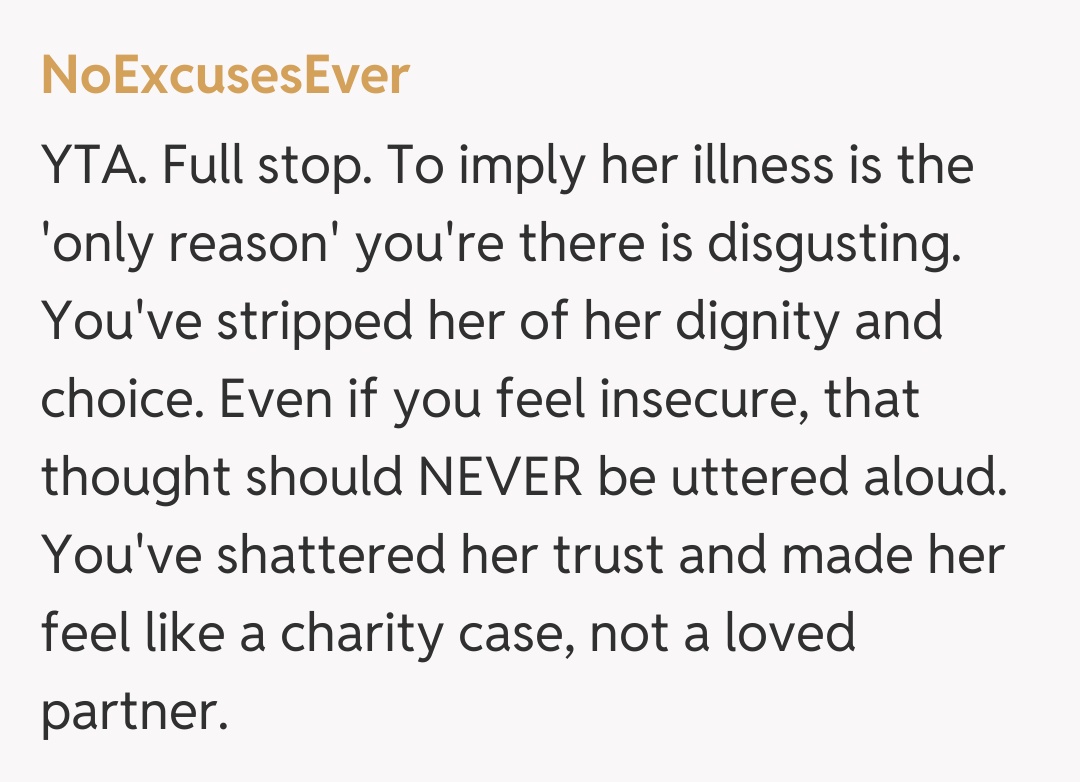
The comments section for this one blew up, as expected! The overwhelming sentiment leaned heavily towards 'You're the A**hole,' and it's easy to see why. Many users highlighted the cruel nature of the statement, emphasizing that while OP's insecurities might be real, weaponizing his partner's illness was an unforgivable act. People pointed out how this remark would make his partner feel like a burden and erase any agency she might have in the relationship, reducing her value to her health status.
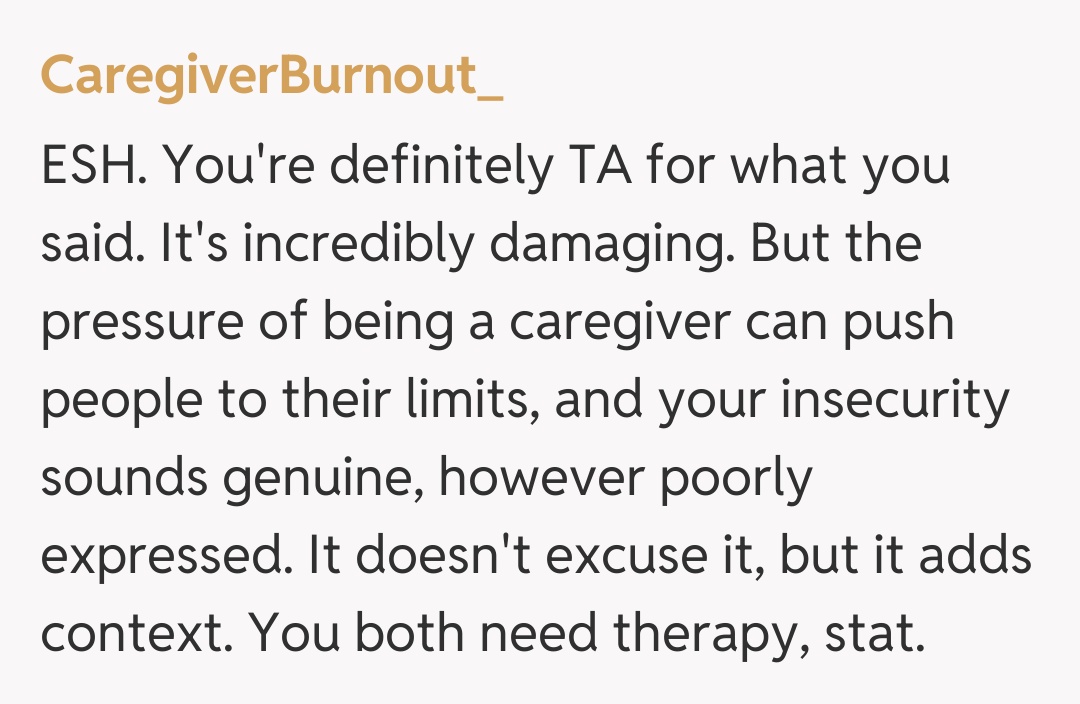
However, there were also a few who acknowledged the underlying pain of the OP, suggesting that his insecurity and the immense pressure of being a caregiver might have pushed him to a breaking point. While not excusing his words, these commenters empathized with the difficulty of living with a partner's chronic illness and the toll it takes. Ultimately, the consensus reinforced that regardless of internal struggles, projecting such hurtful thoughts onto a vulnerable partner is a massive betrayal of trust.
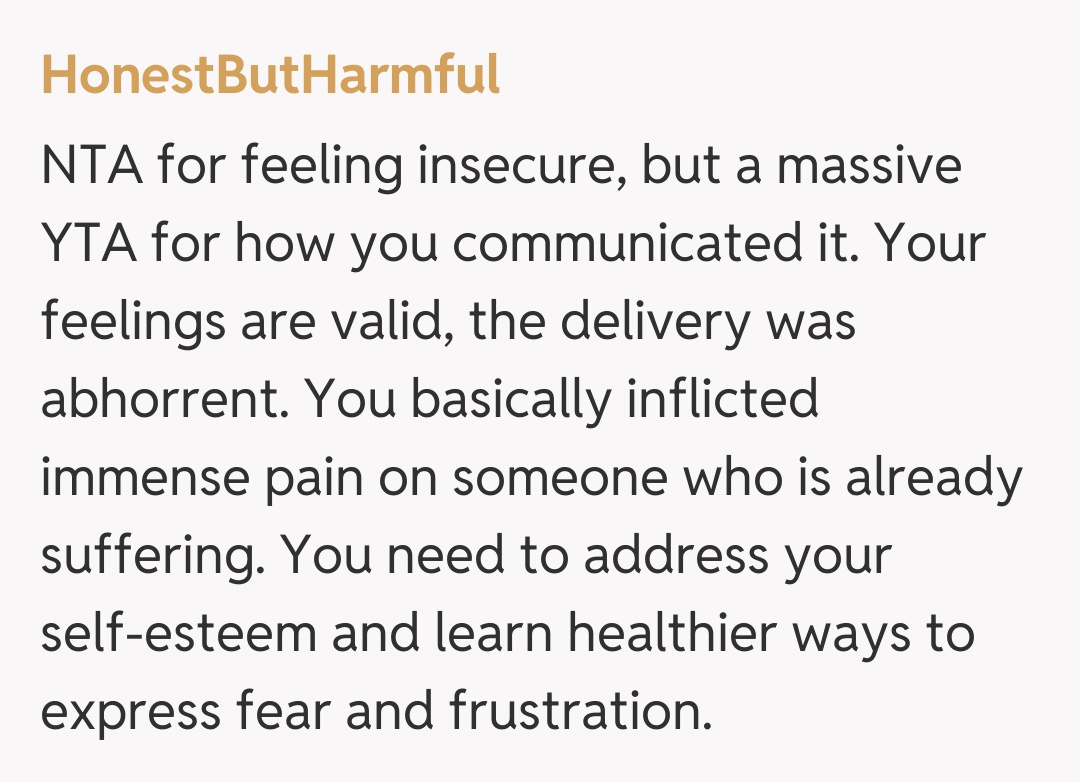
This AITA post serves as a stark reminder of the power of words and the importance of empathy, especially when navigating the complexities of chronic illness in a relationship. While the OP's insecurities are valid feelings to address, the way they were expressed inflicted immense hurt. It underscores that truth without kindness can be a weapon. For any relationship to survive such a blow, both partners need deep reflection, honest communication (delivered with care), and potentially professional guidance to rebuild the trust and emotional safety that has been so severely fractured. The road ahead will be long, but healing is possible with genuine effort and understanding.