AITA for Telling My Wife Her “Traditional Values” Are Just an Excuse to Be Lazy and Entitled?
Welcome back to AITA Tales, where modern relationships meet age-old dilemmas! Today's story plunges us into the complex world of 'traditional values' and how they clash with contemporary expectations. Many couples navigate the delicate balance of household duties and financial contributions, but what happens when one partner feels the other is using ideology to shirk responsibility? Our submitter certainly has strong feelings on the matter.\nThis particular tale highlights a common frustration: the perceived weaponization of cultural norms to justify an unequal division of labor. Is it ever okay to call out a partner so directly, even if you feel unheard and overburdened? The line between expressing valid frustration and being overly harsh can be incredibly thin, and our community will undoubtedly have much to say about this dynamic.

"AITA for Telling My Wife Her "Traditional Values" Are Just an Excuse to Be Lazy and Entitled?"
My wife and I have been married for five years, and for most of that time, we've had a recurring argument about household chores and responsibilities. When we first got together, she expressed a desire for a 'traditional' marriage, where I'd be the primary provider and she'd manage the home. I agreed, thinking it meant an equitable division of labor based on those roles. I work a demanding 50-60 hour week at a fairly high-stress job to ensure we're comfortable, and I genuinely believed she'd take care of things on the home front.
However, 'managing the home' in her definition seems to involve a lot of relaxing and very little actual management. I come home to a house that's often untidy, dishes piled high, laundry overflowing, and dinner rarely started. When I bring it up, she defends herself by saying her 'role' is to create a 'homely atmosphere' and that she's a 'stay-at-home wife,' not a maid.' She believes that because I earn the money, all other domestic tasks are somehow beneath her, or that I should simply hire help for everything, which we can't really afford without cutting into our savings significantly.
This has been going on for years, slowly building up my resentment. I've tried talking to her calmly, suggesting we divide tasks, or even just asking her to pull her weight more. Each time, it devolves into a lecture about my lack of appreciation for her 'sacrifices' and her adherence to 'traditional values.' Last night, I walked in after a particularly grueling day to find the living room a mess, the sink full of breakfast dishes from that morning, and my wife watching TV, complaining she was 'too tired' to do anything.
I snapped. I told her, straight up, that her 'traditional values' were just an excuse to be lazy and entitled. I said a traditional homemaker actually *runs* the household, cooks, cleans, and maintains the home, not just occupies it. I pointed out that I work all day to support her choice to stay home, and she can't even hold up her end of the 'traditional bargain.'
She completely blew up, called me disrespectful and misogynistic, and said I was attacking her core beliefs. She's now refusing to speak to me, sleeping in the guest room, and says I've ruined our marriage. I feel terrible for yelling, but I also feel like I finally said what needed to be said after years of being ignored. AITA?
This story hits on a common nerve in modern relationships: the interpretation of 'traditional roles.' The submitter's frustration is palpable. If one partner agrees to be the primary breadwinner while the other manages the home, there's an implicit understanding of what 'managing the home' entails. When expectations don't align, and one person feels they are carrying a disproportionate burden, resentment is a natural outcome.\nThe wife's perspective, while potentially flawed in execution, is rooted in her interpretation of these 'traditional values.' She might genuinely believe her role is less about manual labor and more about providing a certain emotional or aesthetic presence. However, if that interpretation leads to an unlivable home environment and an overworked spouse, it's a disconnect that needs addressing, not just defending.\nHowever, the language used by the submitter was undeniably harsh. Calling someone's values 'an excuse to be lazy and entitled' is a direct attack that often escalates conflict rather than resolves it. While his frustration is understandable after years of perceived neglect, the delivery might have done more harm than good to the possibility of constructive dialogue.\nUltimately, this situation highlights a severe communication breakdown. Both partners entered the marriage with different ideas of their roles, and those differences were never fully reconciled. When one person feels continually unheard and disrespected, and the other feels their entire identity is being attacked, a stalemate is inevitable unless both are willing to genuinely re-evaluate their expectations and contributions.
The Verdict Is In: Was He Out of Line, or Just Out of Patience?
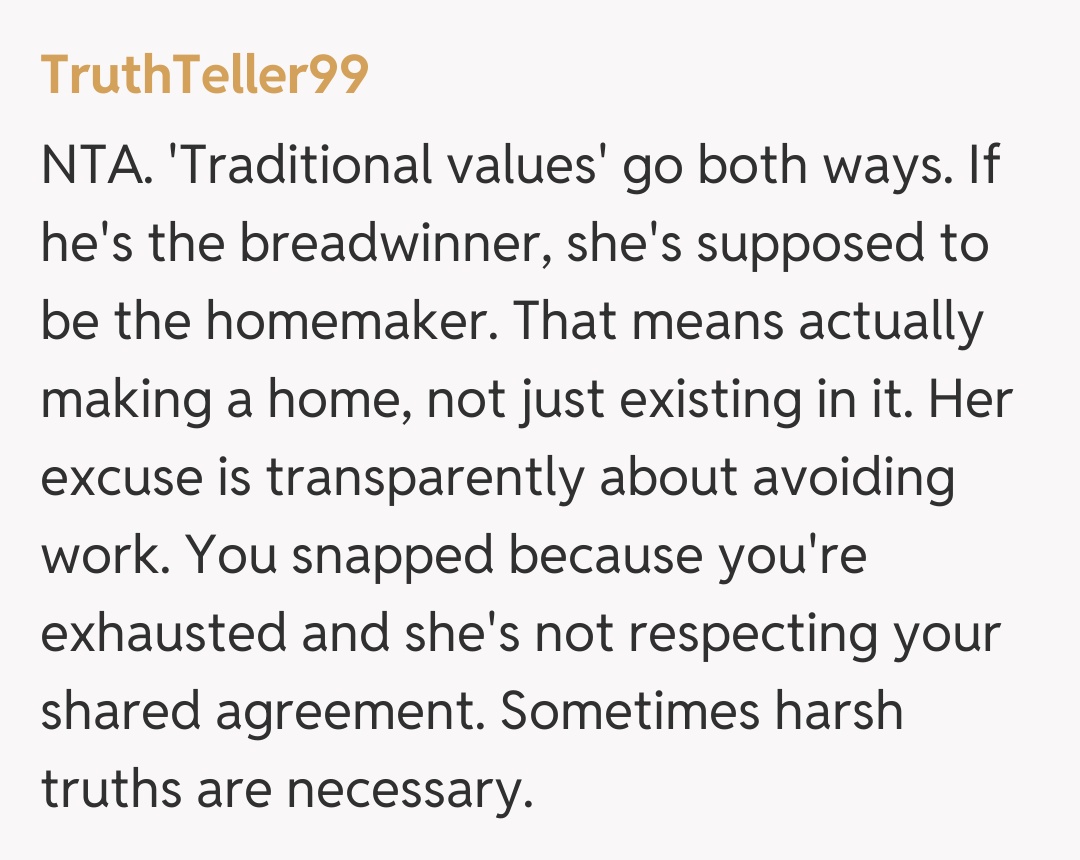
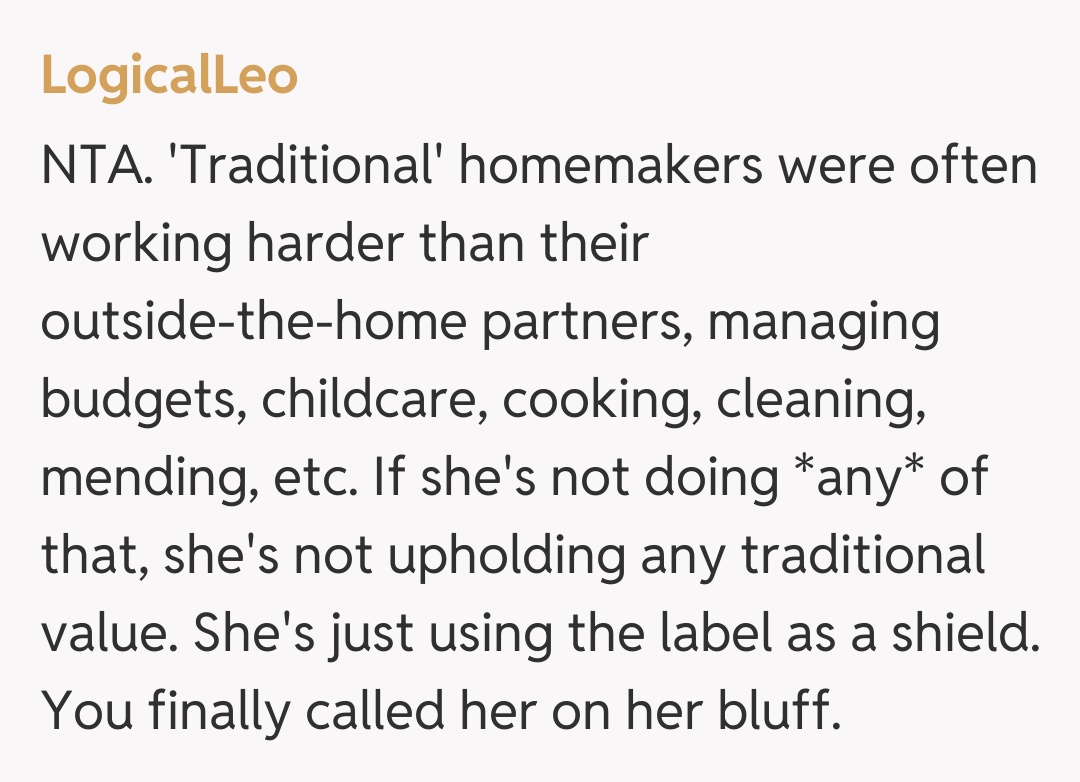
The comment section for this post was absolutely buzzing! Many users landed squarely on 'NTA,' sympathizing with the husband's years of unaddressed frustration. They pointed out that 'traditional values' usually imply *both* partners contributing significantly to the household, even if in different spheres, and his wife wasn't holding up her end of the bargain.
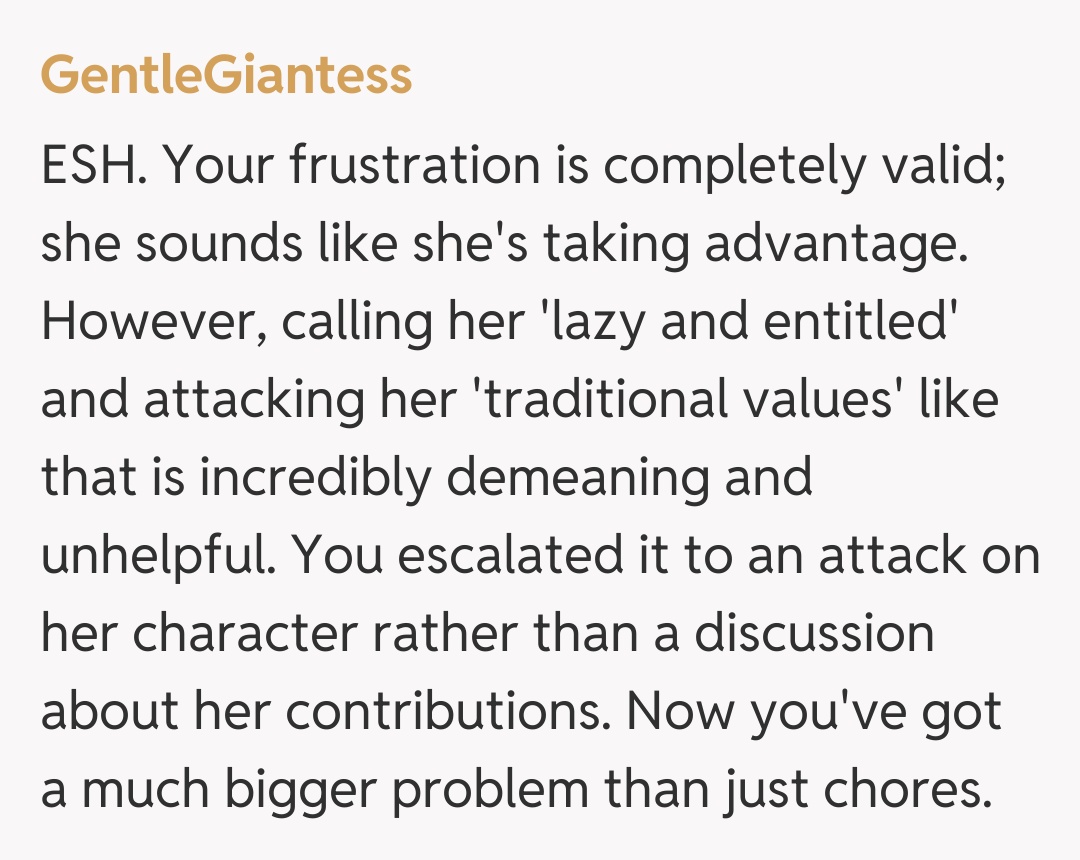
Conversely, a strong contingent felt 'ESH' (Everyone Sucks Here). While acknowledging the wife's apparent lack of effort, they criticized the husband's use of such inflammatory language. They argued that while his feelings were valid, his delivery was destructive and unlikely to resolve the underlying issues, instead creating deeper rifts. There were very few 'YTA' votes, as most could see his point of view, even if disagreeing with his choice of words.
This post clearly struck a chord, highlighting the ongoing tension between declared values and daily realities in a partnership. While the submitter's frustration is understandable, the impact of his words on his wife, regardless of their truth, can't be ignored. This isn't just about chores; it's about unmet expectations, communication breakdowns, and perhaps differing fundamental ideas of what a marriage truly entails. Hopefully, they can move past the immediate anger to find a common ground, perhaps with professional help, to redefine their roles and responsibilities in a way that truly works for both of them.