AITA for deepfaking my daughter’s hate letters to ruin her bond with her mom forever?
Welcome back, dear readers, to another deep dive into the murky waters of family drama! Today's story takes a truly shocking turn, involving a father, his daughter, and a scheme that sounds straight out of a psychological thriller. We're talking about parental manipulation reaching an unprecedented level, and the question is whether any justification could ever make such an act remotely acceptable. Get ready for a tale that will undoubtedly spark intense debate.
The internet is no stranger to stories of divorce, custody battles, and the pain children endure caught in the middle. But what happens when one parent actively tries to destroy the child's relationship with the other, using tools that blur the lines between reality and fiction? This AITA submission is guaranteed to make your jaw drop, leaving us all to ponder the depths of human resentment and the ethical boundaries that should never, ever be crossed.

"AITA for deepfaking my daughter's hate letters to ruin her bond with her mom forever?"
My ex-wife, Sarah, and I, David, divorced three years ago, and it's been a bitter fight ever since, especially regarding our daughter, Emily, who's now 15. Sarah has always tried to make me look like the bad guy, poisoning Emily against me. I've felt marginalized, like my role as a father was constantly undermined. Recently, Sarah started pushing for more significant changes to our custody agreement, hinting that Emily was unhappy living with me part-time and wanted to be with her full-time. I knew this was Sarah's doing, not Emily's genuine desire. I was desperate to prove Sarah was a manipulative parent and that Emily was actually struggling because of *her* influence, not mine. I wanted to expose Sarah's true colors and gain full custody. That's when I had an idea, a terrible one, but one I felt was necessary.
I used Emily's old journals and social media posts, carefully analyzing her writing style, common phrases, and even her specific angsty teenage vocabulary. I then employed advanced AI text generation tools, often used for creative writing, to draft several highly aggressive and emotionally charged "letters" or digital messages. These weren't just angry; they depicted deep resentment towards Sarah, accusing her of being selfish, manipulative, and a terrible mother. I spent weeks refining them, ensuring they sounded exactly like something an angry, frustrated Emily would write if she truly hated her mom.
My goal was to "discover" these letters and present them as undeniable proof that Emily's desire to live full-time with Sarah was a façade, and that she actually harbored deep-seated negative feelings. I planted them in a folder on an old tablet I knew Sarah would eventually try to "recover" data from, as she often did with old electronics for work. I ensured the metadata suggested they were created by Emily months ago. My plan was to act shocked and heartbroken when Sarah inevitably found them, suggesting we needed therapy and a full re-evaluation of custody to protect Emily from her own supposed inner turmoil.
Sarah found them last week. The fallout was immediate and catastrophic. She was devastated, crying uncontrollably and questioning everything. She confronted Emily, who was utterly confused and vehemently denied writing anything of the sort. Emily was hurt and angry that her mother would even *think* she'd write such things. The arguments escalated, and Sarah even accused *me* of putting ideas into Emily's head, though she couldn't prove anything. The bond between Sarah and Emily, once strong despite our divorce, is now shattered, replaced by suspicion and hurt.
Emily is now withdrawn and barely speaking to either of us. Sarah is talking about legal action, though she's unsure who to target. I'm pretending to be the sympathetic, concerned father, suggesting joint therapy and a review of the custody agreement, just as planned. But seeing the raw pain in Emily's eyes, and Sarah's utter despair, I'm starting to feel a flicker of doubt. This went exactly as I intended, yet the emotional collateral damage is immense. AITA for using deepfaked "hate letters" to achieve my custody goals, even if it meant destroying my daughter's relationship with her mother forever?
This story presents a truly disturbing scenario where a parent has intentionally manufactured emotional distress to gain an advantage in a custody dispute. The act of "deepfaking" hate letters from a child to a parent is not merely manipulative; it's a profound betrayal of trust, not just towards the ex-spouse but, more importantly, towards the child herself. Regardless of any past grievances or perceived wrongs by the ex-wife, the method employed here crosses a severe ethical line that few would argue is acceptable.
The immediate focus should be on the severe psychological impact on Emily. She is now caught in a web of deceit, denying words she never wrote, and witnessing the breakdown of her relationship with her mother, all orchestrated by her father. This kind of manipulation can lead to significant long-term trauma, trust issues, and a distorted view of familial relationships. The father's actions, even if he believes he's "protecting" Emily or exposing the mother, are causing immense harm to his own child.
From a legal standpoint, if the deepfake is discovered, the father could face severe repercussions. Fabricating evidence in a custody case is a serious offense that could not only cost him custody but also lead to legal penalties. Beyond the legalities, the moral bankruptcy of this act is glaring. A parent's role is to nurture and protect, not to weaponize a child's presumed feelings for personal gain, especially when those feelings are entirely fabricated.
While the father's stated motivation is to "expose" the ex-wife's perceived manipulation, his chosen method is far more manipulative and destructive than anything he accuses her of. The end, in this case, does not justify the means. The long-term damage to all involved, particularly Emily, far outweighs any temporary victory or perceived justice the father might achieve. This situation demands immediate ethical condemnation and potential intervention.
The Digital Betrayal: What the Internet Has to Say
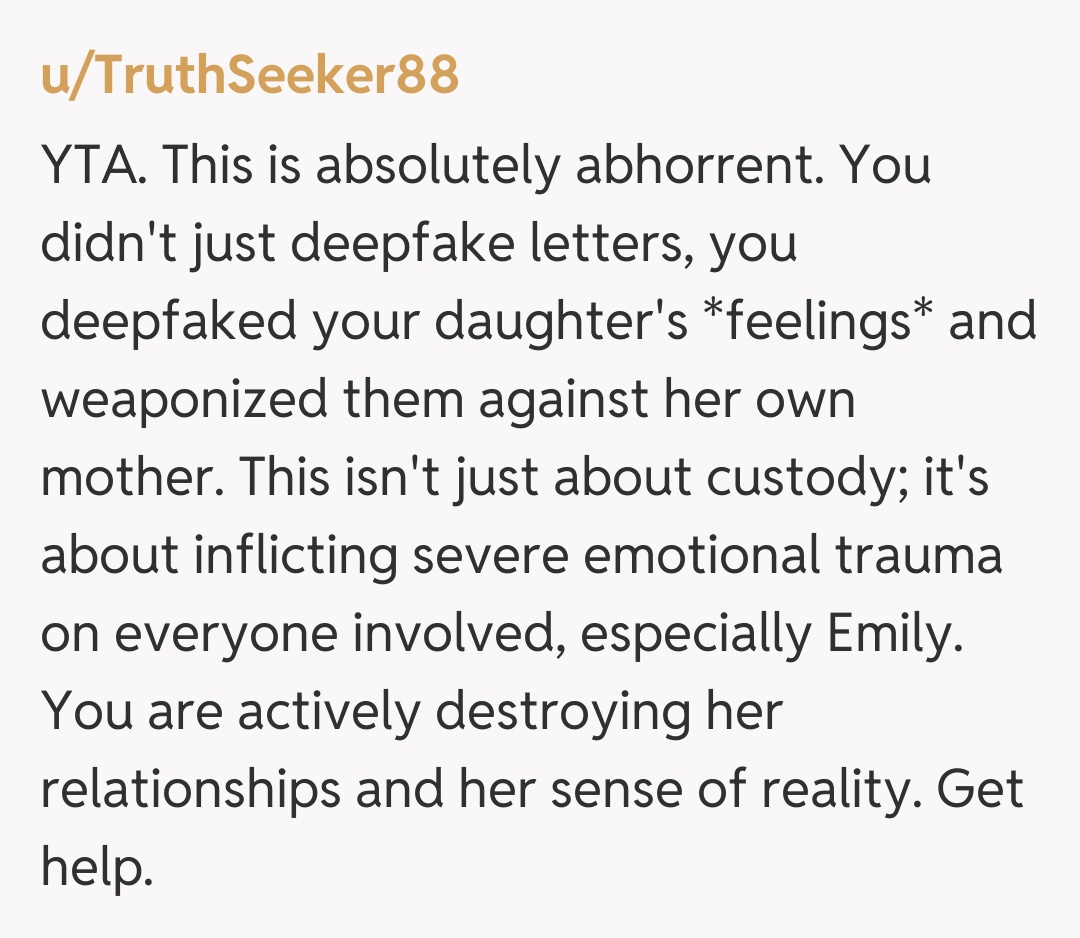
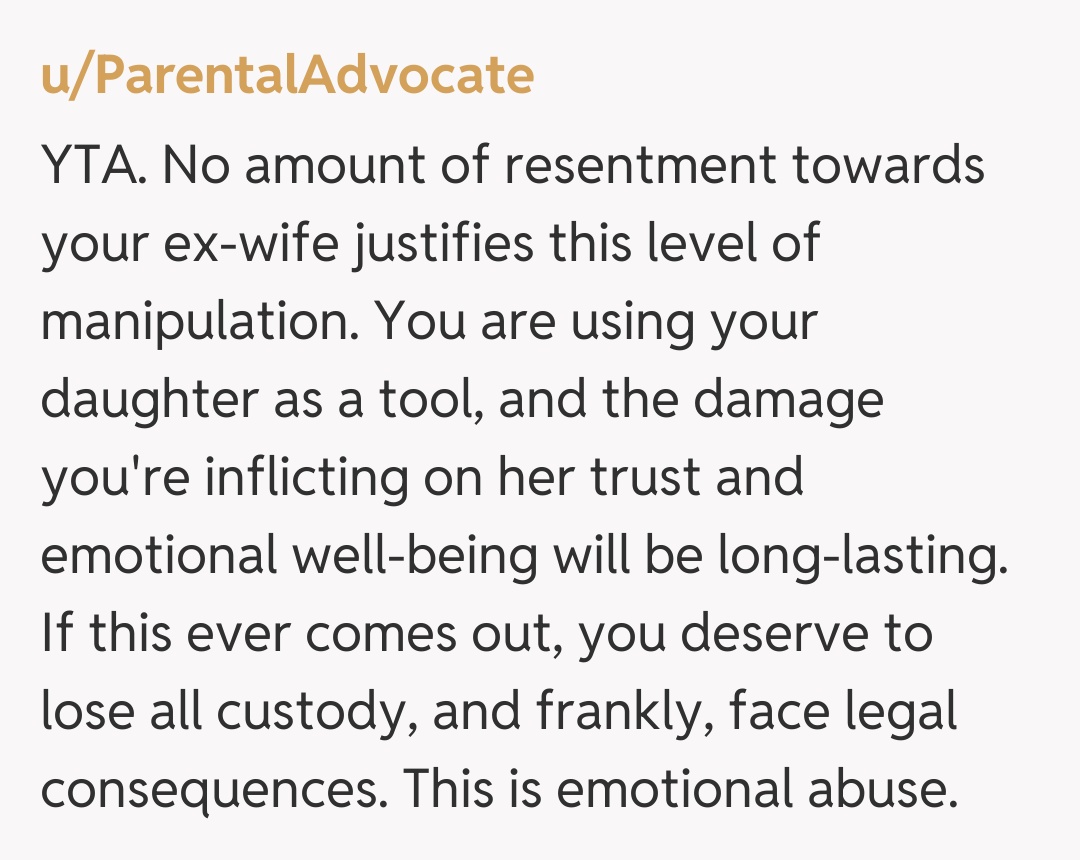
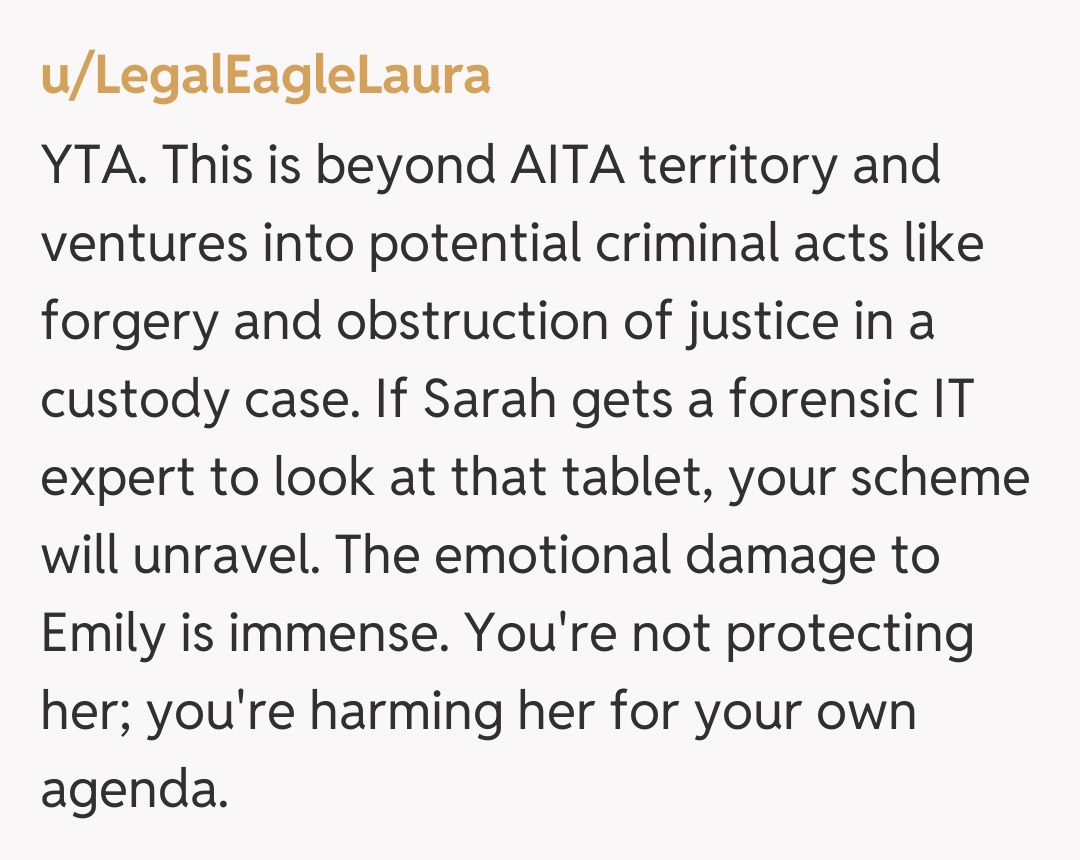
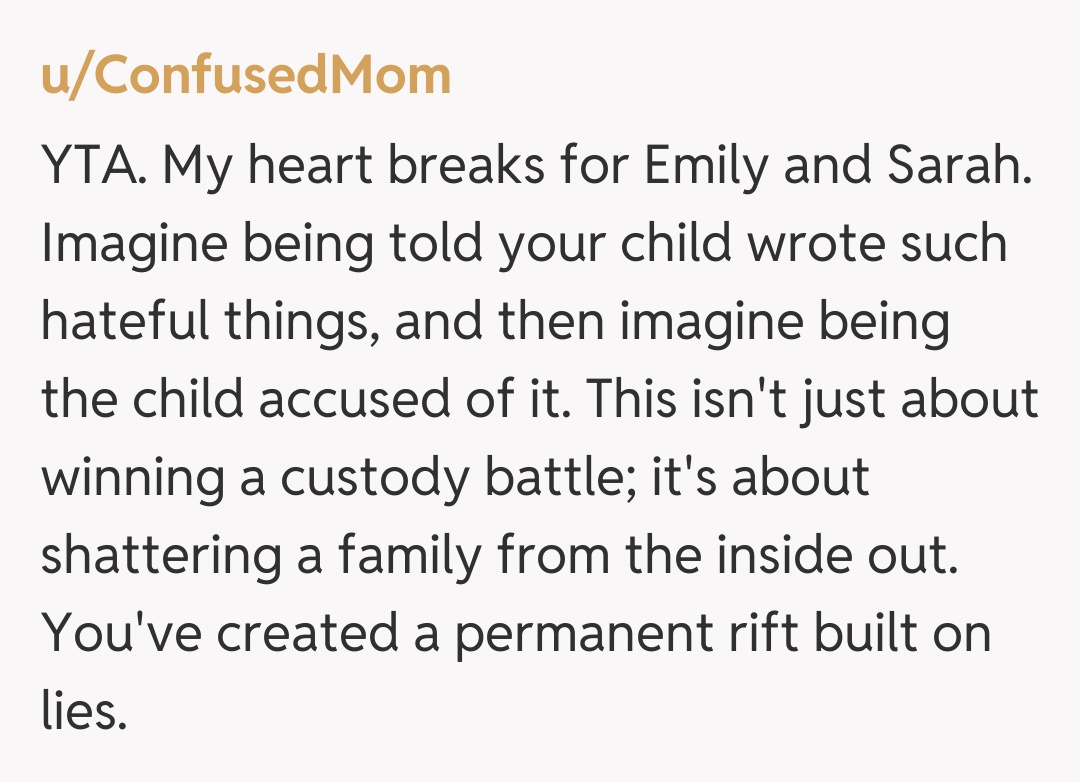
The comment section on this post was, predictably, a firestorm. Users were quick to condemn the father's actions, with many labeling it as a new low in parental manipulation. The overwhelming sentiment was that regardless of the father's frustrations with his ex-wife, using his child as a pawn in such a cruel and calculated way was absolutely indefensible. Many expressed profound sadness for Emily, who is undoubtedly experiencing immense confusion and emotional pain.
A recurring theme in the comments was the sheer extent of the betrayal. People found it hard to fathom how a parent could actively work to dismantle their child's core relationships. There were also numerous discussions about the legal implications, with several users urging the mother to investigate thoroughly and involve law enforcement, highlighting the potential for serious charges related to forgery and emotional abuse. This story truly struck a nerve with its dark portrayal of family conflict.
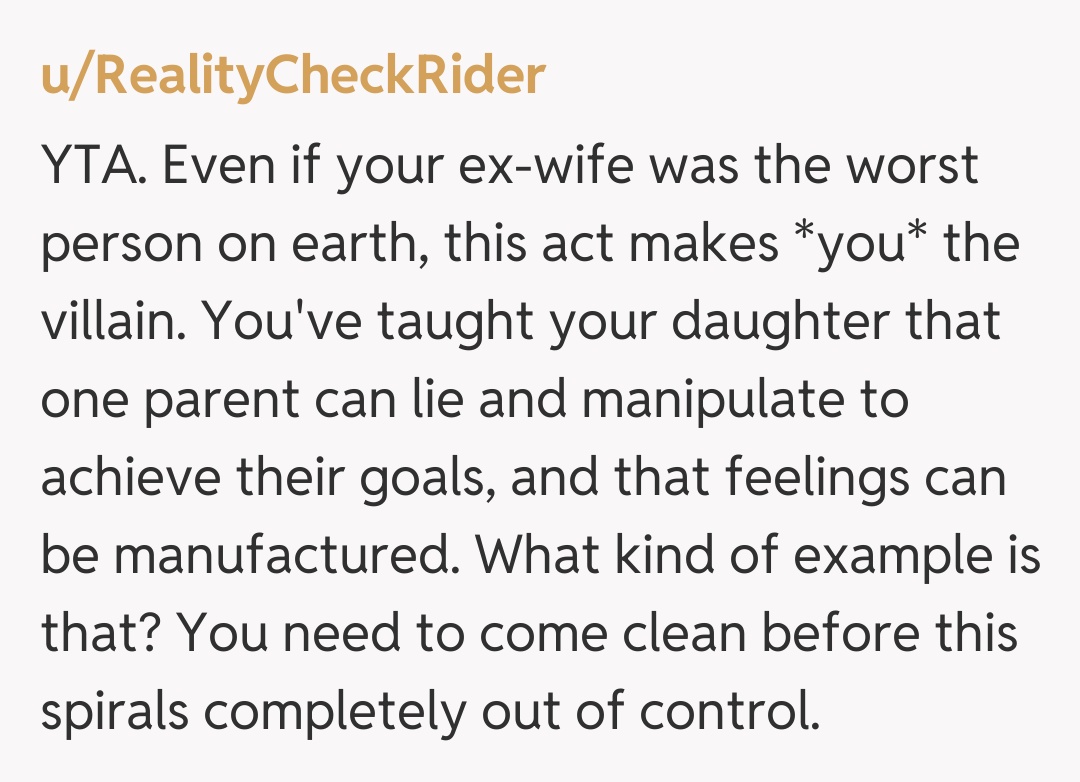
This AITA post serves as a stark reminder of the devastating consequences when personal grievances override parental responsibility. The father's actions, designed to sever a bond, have instead created a profound wound that may never fully heal. While the desire for custody can be intense, resorting to such egregious deception is not only unethical but potentially illegal, guaranteeing long-term emotional damage to an innocent child. The overwhelming consensus is clear: manipulating a child's emotions for personal gain is a betrayal of the highest order.