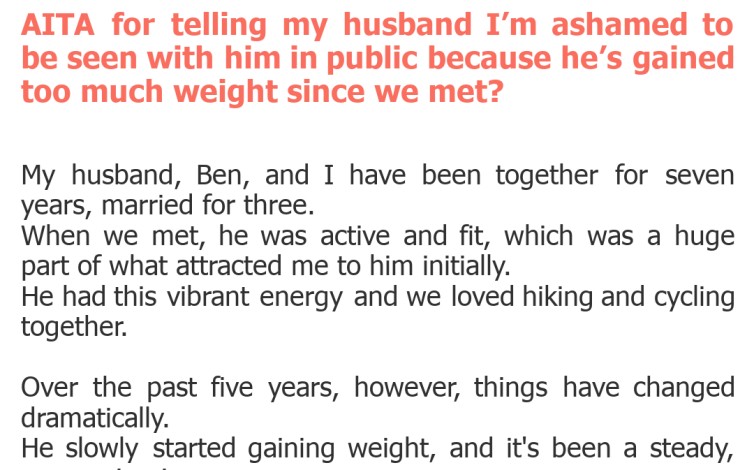
AITA for telling my husband I’m ashamed to be seen with him in public because he’s gained too much weight since we met?
Oh, relationships! They are a complex tapestry woven with threads of love, compromise, and sometimes, uncomfortable truths. Today, we're diving into a particularly thorny issue that many couples silently grapple with: changes in physical appearance, specifically weight gain. It's a sensitive subject, often intertwined with self-esteem, attraction, and perceived expectations within a partnership. The question of how to address it without causing irreparable damage is a tightrope walk for even the most empathetic among us. \n Our story today features a wife who reached her breaking point, articulating a sentiment that, while perhaps felt by others, is rarely voiced so directly. She confessed to her husband that she felt ashamed to be seen with him in public due to his significant weight gain. Naturally, this has sparked a furious debate online. Was she simply being honest, or was her delivery cruel and destructive? Let's unpack this emotional dilemma and see where the court of public opinion lands.

"AITA for telling my husband I’m ashamed to be seen with him in public because he’s gained too much weight since we met?"
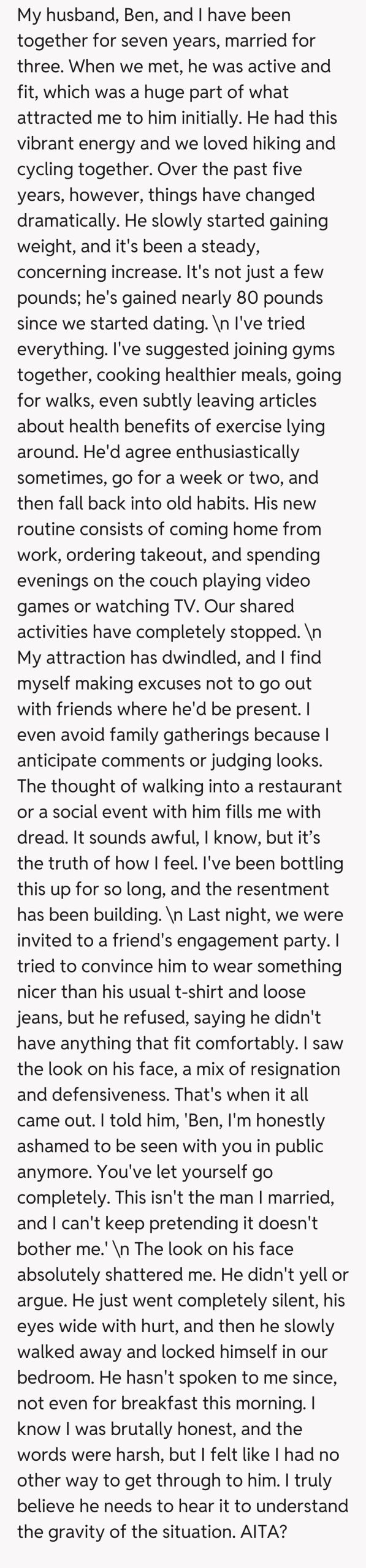
This post highlights a very raw and painful aspect of long-term relationships: how we navigate significant changes in our partners, especially physical ones. It's undeniable that attraction plays a role in romantic relationships, and it's not uncommon for a partner's changing appearance to impact that. The OP, Elena, clearly feels a profound disconnect and disappointment, believing her husband, Ben, has neglected himself and, by extension, their shared life and her feelings. Her frustration is palpable, stemming from years of perceived inaction. \n However, the way Elena chose to express her feelings is where the significant conflict lies. Telling someone you are 'ashamed' to be seen with them due to their weight is incredibly damaging. It strikes at the core of their self-worth and can inflict a deep, lasting wound, regardless of the underlying intentions. While Elena may have felt desperate to communicate the severity of her feelings, her language moved beyond concern for health or even attraction, venturing into public humiliation and judgment. \n It's crucial to differentiate between expressing a loss of attraction or concern for health and actively shaming a partner. A conversation focused on 'I miss our active life together' or 'I'm worried about your health and how it affects our future' has a vastly different impact than 'I'm ashamed of you.' The latter implies that Ben's worth is tied to his appearance and that he is a source of embarrassment, which is a devastating message for anyone to receive from their spouse. \n This situation underscores the critical need for open, honest, yet compassionate communication in relationships. If Elena felt her needs weren't being met or her concerns ignored, there were likely healthier, more constructive paths to explore, perhaps even involving couples counseling, before resorting to such a cutting remark. The challenge now is to repair the profound emotional damage and find a way forward, if one exists, that addresses both of their needs without further harm.
The Internet Weighs In: Truth or Cruelty?
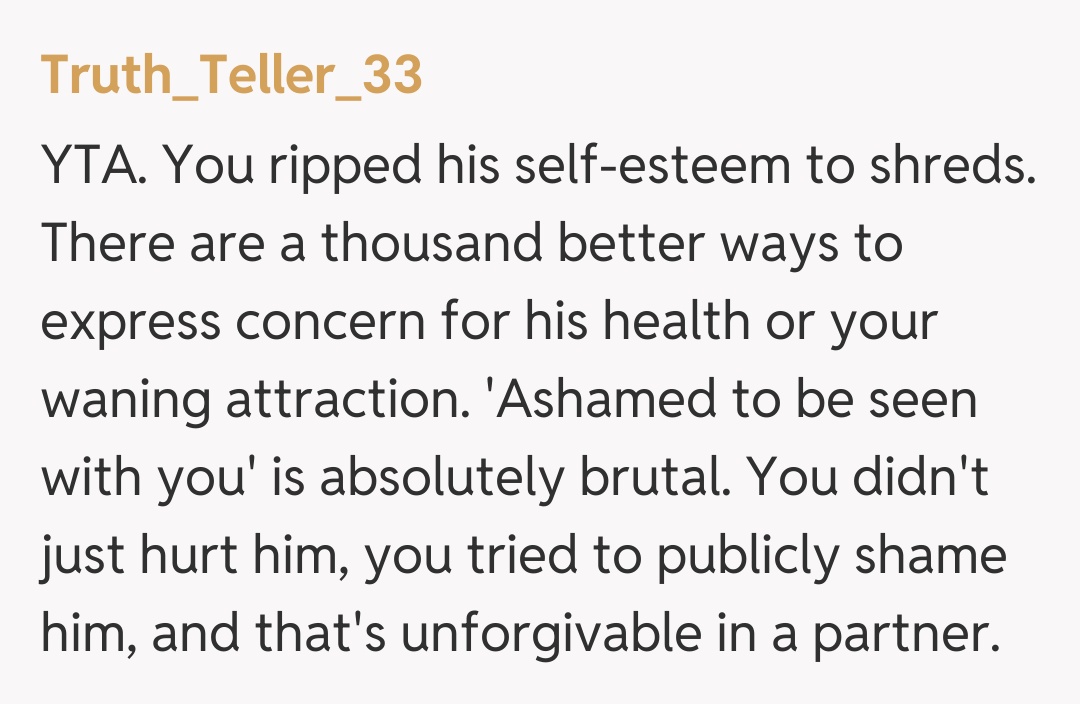
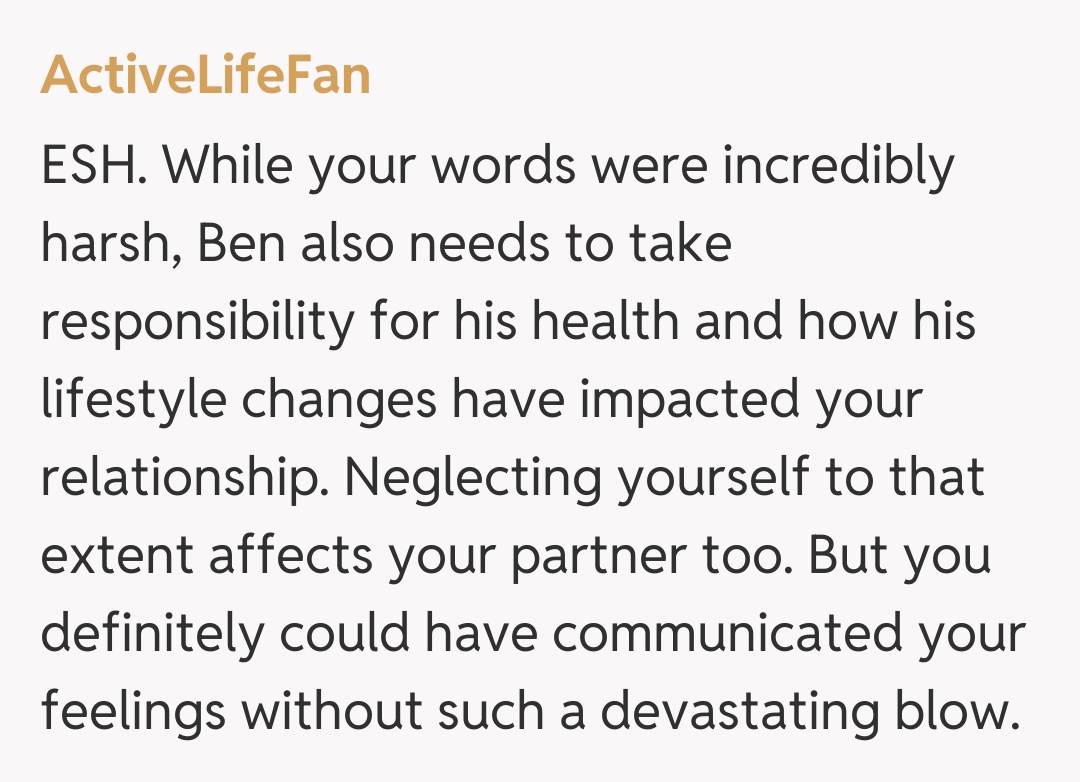
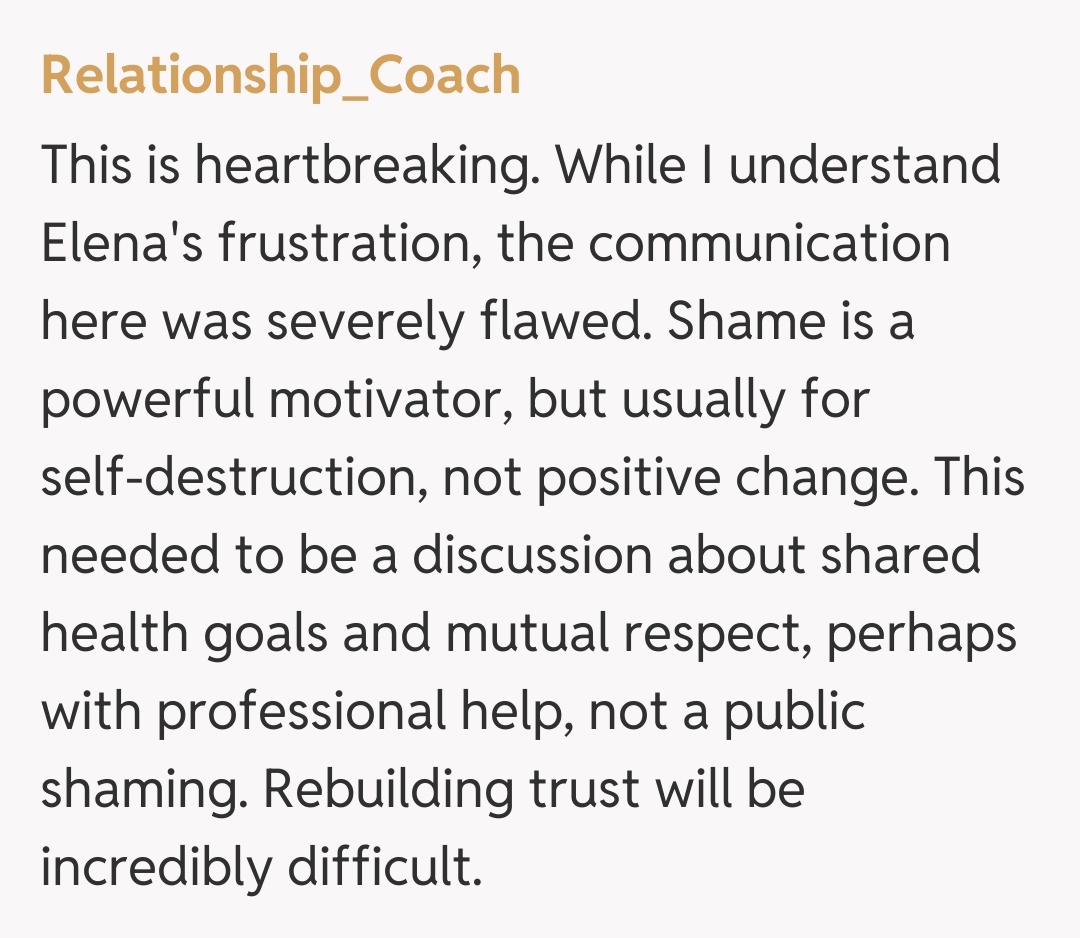
The comments section for this story was, predictably, a battleground. The overwhelming sentiment leaned towards YTA for the wife, Elena. Many users condemned her choice of words as incredibly cruel and damaging, emphasizing that shaming a partner, regardless of how frustrated one feels, is never acceptable. They pointed out that while her feelings of lost attraction might be valid, the delivery was unforgivable, likely causing deep emotional scars for Ben. \n A smaller, but vocal, contingent argued for NTA or ESH, suggesting that while the words were harsh, Ben's inaction and perceived disregard for his health and Elena's feelings also contributed significantly to the breakdown. These commenters felt that Elena's desperation might have pushed her to extremes, highlighting that a partner's continued neglect of their physical well-being can indeed strain a relationship to its breaking point. However, even these users often conceded that the 'ashamed' comment crossed a line.


This difficult story serves as a stark reminder of the delicate balance required in communication, especially when addressing sensitive topics with loved ones. While feelings of frustration, disappointment, and even a waning attraction are valid, the method of expressing them can either build bridges or burn them down. Ultimately, the impact of words like 'ashamed' can deeply wound a partner, potentially beyond repair. It highlights the importance of empathy, seeking constructive solutions, and understanding that our partners' struggles, physical or otherwise, often require support and open dialogue rather than shaming, even when our own patience is wearing thin.