Five Years After Our Divorce, I Discovered the Truth Behind the “$300” Card My Ex-Husband Left Me
Five years after our divorce, I finally used the “three-hundred-dollar” bank card my husband handed me in court. I expected disappointment. What I found instead was nearly one million dollars. Confused, shaken, and burning with questions, I went looking for him. I did not find Patrick. His sister opened the door instead, holding a small wooden box that changed everything I thought I knew.
I am sixty-five years old now, and when I look back over my life, almost every important memory is tied to the man I once called my husband. Thirty-seven years is not a short chapter. It is a lifetime built from habits, arguments, shared responsibilities, quiet compromises, and sacrifices that never appear in photographs. I believed—foolishly, stubbornly—that no matter how hard things became, we would face them together. That belief was my anchor. It was also what made the end feel unbearable.
Everything fell apart on a dull, overcast morning inside a family courthouse in Cleveland.
The divorce moved quickly, almost coldly, as if the system had seen too many broken marriages to slow down for one more. Papers were slid across desks. Pens scratched names onto official lines. No one asked how long we had loved each other or how much history we were signing away. When it was over, my ex-husband, Patrick Miller, reached into his jacket pocket and took out a simple bank card. No envelope. No explanation. Just plastic.
He placed it in my hand as if he were handing me a receipt.
“This should cover you for a little while,” he said calmly. “There are three hundred dollars on it.”
The number hurt more than shouting ever could. Thirty-seven years reduced to an amount that could barely keep the lights on. I remember staring at the card, then at his face, waiting for something—regret, sadness, hesitation. There was nothing. He turned away and walked down the courthouse steps without looking back. The sound of his shoes echoed in my ears long after he was gone.
I kept the card. Not because I wanted the money. I kept it because throwing it away felt like admitting I truly meant nothing to him.
After that day, life became smaller. Narrower. Focused on survival.
I rented a tiny, damp room behind an aging grocery store on the edge of the city. The walls smelled of mold, and the radiator clanged all night like it was arguing with itself. I worked wherever I could find someone willing to pay cash. I scrubbed office floors before sunrise, watched parked cars during weekend events, and collected bottles when money ran thin.
Pride disappeared quickly. Hunger does that to a person.
Some weeks, eating once a day felt normal. Some nights, I lay awake listening to my stomach ache, my thoughts circling anger, shame, and confusion. Still, the bank card stayed untouched at the bottom of a drawer. Using it felt wrong. Poisoned. As if swiping it meant agreeing that I was worth only three hundred dollars after a lifetime of marriage.
Years passed. My body aged faster than I expected.
My joints stiffened. My back protested every movement. Simple tasks took effort. Some mornings, standing up felt like climbing a steep hill with no top in sight. My children visited when they could, bringing groceries, leaving small amounts of money tucked into my hand, promising to come back soon.
I never told them how weak I felt.
How dizzy I became when I stood too fast.
How often the room spun.
They had families, jobs, worries of their own. I refused to become another burden in their lives.
Then one afternoon, my body finally refused to cooperate.
I collapsed just outside my door. The world narrowed into noise and darkness.
When I woke, harsh fluorescent lights buzzed above me in a hospital room. A young doctor stood nearby, his expression serious but not unkind.
“You’re severely malnourished,” he said. “Your body doesn’t have what it needs. You need treatment, and you need it now.”
For the first time in five years, I thought about the bank card without bitterness. Survival mattered more than pride. Three hundred dollars could buy food. It could buy time.
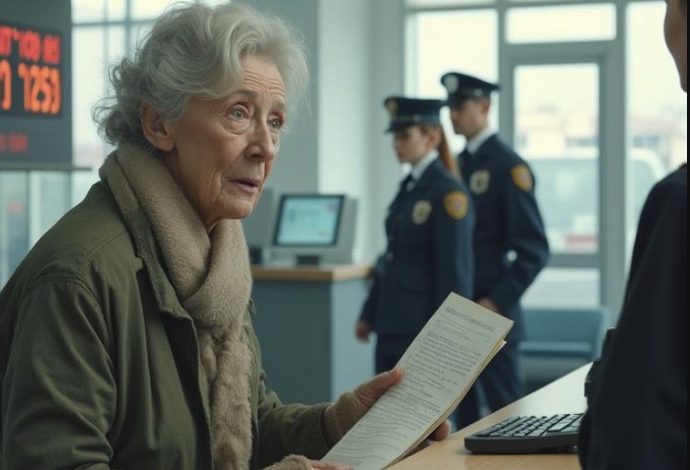
The next morning, I walked into a downtown bank branch.
My hands trembled as I slid the card across the counter to a teller who looked young enough to be my granddaughter.
“I’d like to withdraw the full balance,” I said quietly.
She typed for a long moment. Her expression changed. Professional calm shifted into something else—surprise mixed with confusion.
“Ma’am,” she said gently, “the balance on this account is not three hundred dollars.”
My heart slammed against my chest.
“Then how much is it?” I asked.
She printed out a statement and turned it toward me.
$987,000.
Nearly one million dollars.
My knees weakened instantly. I grabbed the edge of the counter to keep from falling.
“Who… who put this here?” I whispered.
She tilted her screen slightly so I could see it. Rows of deposits filled the page. The same amount. Every month. Over and over again. The same name attached to each transfer.
Patrick Miller.
I left the bank in a fog. The city around me felt distant, muted, like I was moving through water. That night, sleep refused to come. Memories rearranged themselves in my mind against my will. The quiet dinners. The way Patrick had grown distant, not cruel but withdrawn. The sadness I had mistaken for indifference. The way he avoided my eyes during our last months together.
By morning, I knew I needed answers.
I drove to a small town in western Pennsylvania, to the house of his older sister, Eleanor Grace. When she opened the door and saw me, her face fell apart.
“I was wondering when you would come,” she said softly.
“Where is Patrick?” I asked. “I need to talk to him.”
She did not answer right away. She stepped back into the house and returned holding a small wooden box. Her hands shook as she offered it to me.
“He passed away,” she said. “It’s been five years.”
The words hit me like a physical blow.
“That’s not possible,” I said. “We divorced five years ago.”
She nodded, tears spilling down her cheeks.
“He was sick long before that,” she said. “Terminal cancer.”
Eleanor explained everything slowly, gently, as if afraid I might break.
Patrick had been diagnosed while we were still married. The doctors gave him limited time. He did not want me to watch him fade, to spend my remaining years as a caretaker instead of a wife. He believed leaving me was the only way to protect me from that future.
“He thought if you hated him,” she said, “you would move on. He chose to look cruel so you wouldn’t choose to suffer.”
I opened the wooden box. Inside was a folded letter. His handwriting was unmistakable.
I unfolded it with shaking hands.
“My love,” it began.
“By the time you read this, I’ll be gone.”
“Forgive me for leaving you the way I did.”
“I chose cruelty so you wouldn’t have to choose sacrifice.”
“The money isn’t payment. It’s protection.”
“Eat well. Live fully. Laugh again.”
“If there is another life, I would still choose you.”
I collapsed onto the floor, sobbing in a way I had not allowed myself to sob in years.
For five years, I had believed I was unwanted. Discarded. Reduced to nothing.
All that time, Patrick had been fighting for breath, scheduling monthly transfers, building my future while walking toward his own end.
Later, standing in front of his photograph on a small family altar, I traced the frame with trembling fingers.
“Why didn’t you tell me?” I whispered into the quiet room.
There was no answer. Only the weight of the truth settling into my bones.
When he placed that bank card in my hand, I thought it was an insult.
Five years later, I finally understood what it truly was.
Love—expressed in the only way he believed would spare me pain.
I was never abandoned.
I was loved, quietly and carefully, until the very end.