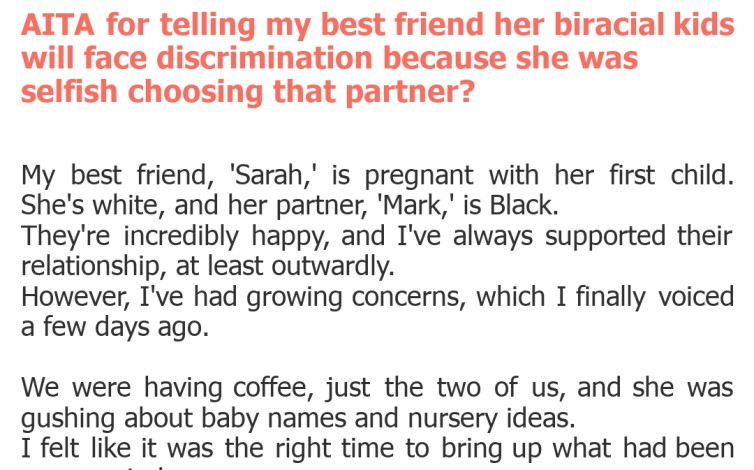
AITA for telling my best friend her biracial kids will face discrimination because she was selfish choosing that partner?
Oh, the complexities of friendship! We've all been there, trying to offer what we believe is sound advice, only for it to backfire spectacularly. This week's AITA story dives deep into the murky waters of unsolicited opinions, especially when they touch on life's most personal choices: who we love and the families we create. Is there ever a right way to deliver a potentially difficult truth, or are some things best left unsaid? \n Our submitter, let's call her 'Concerned Friend', found herself in a heated exchange with her best friend, who is expecting a child with her partner. The advice, or rather, the stark warning, revolved around the future challenges biracial children might face. Concerned Friend believed she was offering a dose of reality, but her best friend clearly saw it as a profound betrayal and judgment. Let's unpack this emotional minefield.

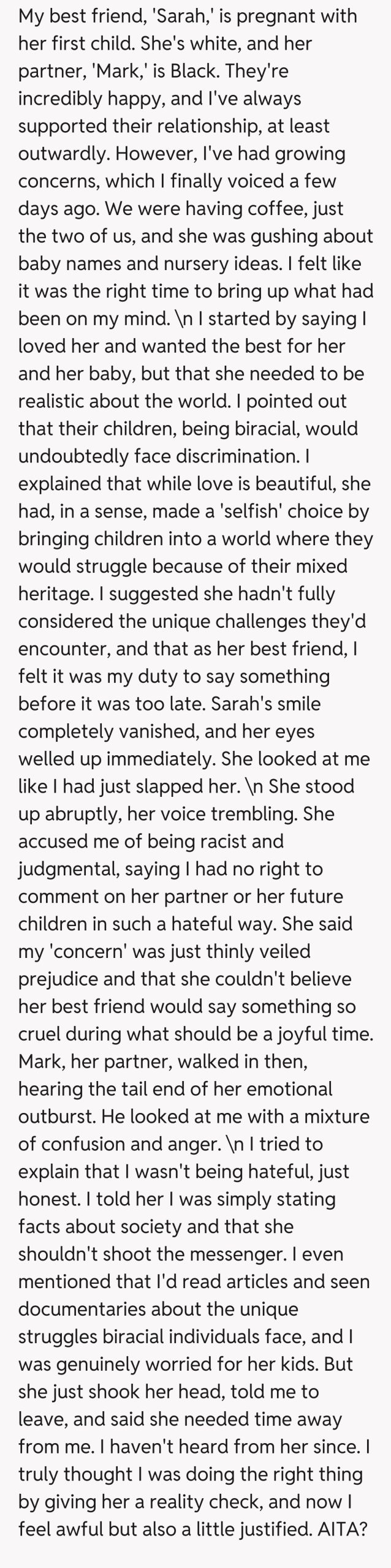
"AITA for telling my best friend her biracial kids will face discrimination because she was selfish choosing that partner?"
This story hits on several raw nerves, primarily the intersection of friendship, race, and personal choice. Our original poster (OP) states her intent was one of concern, believing she was offering a 'reality check' about the societal challenges biracial children might encounter. It's undeniable that individuals of mixed heritage can face unique forms of discrimination and identity struggles, a point often supported by sociological studies and personal narratives. \n However, the way this 'concern' was delivered is where the major conflict lies. Labeling a deeply personal decision to have children with a partner one loves as 'selfish' crosses a significant boundary. It suggests a complete lack of respect for her friend's autonomy, her relationship, and the love she shares with her partner, reducing their connection to a problematic calculation of future societal obstacles. \n Furthermore, placing the burden of future discrimination onto the 'selfish' choice of the parents is a profound misdirection. The issue isn't the existence of biracial children; it's the systemic prejudice that creates those discriminatory challenges. Blaming the parents for the potential struggles their children might face due to others' bigotry is a harmful narrative, shifting accountability from society to the individuals simply existing and loving. \n A true friend would offer support, education, and resources if asked, not condemnation. While anticipating potential difficulties is thoughtful, preemptively judging a friend's entire life choice, especially one involving family and children, as 'selfish' and problematic is likely to be perceived as an attack. The impact of such words often outweighs any well-intentioned (but poorly executed) underlying concern.
The internet weighs in: Is 'tough love' always the right answer?
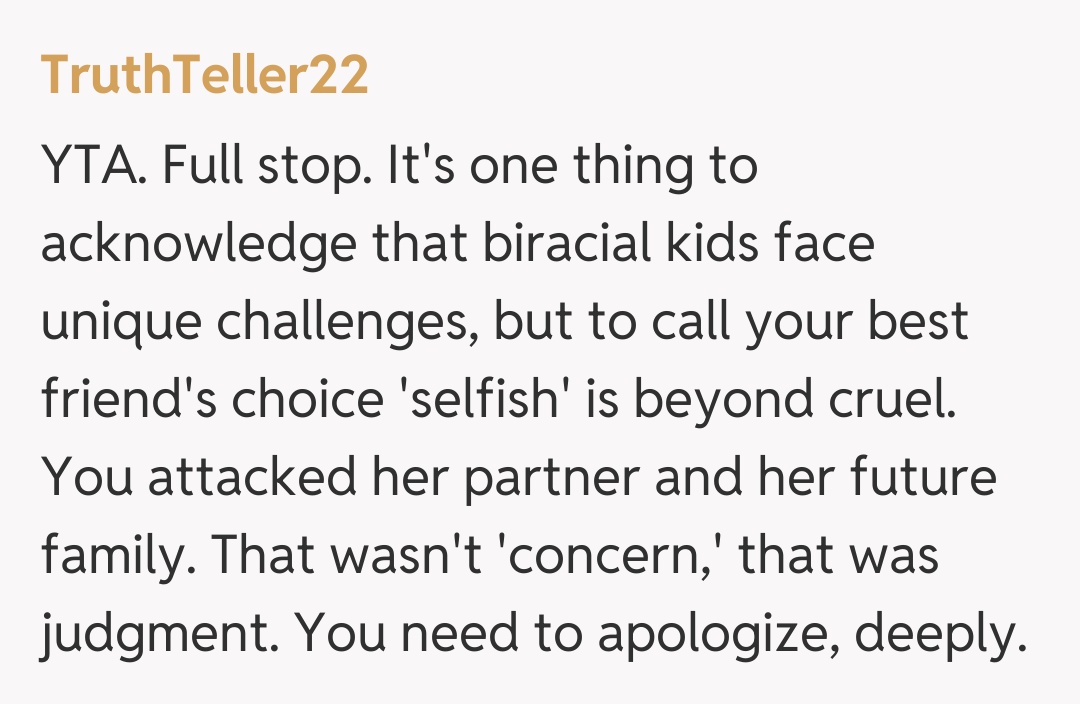
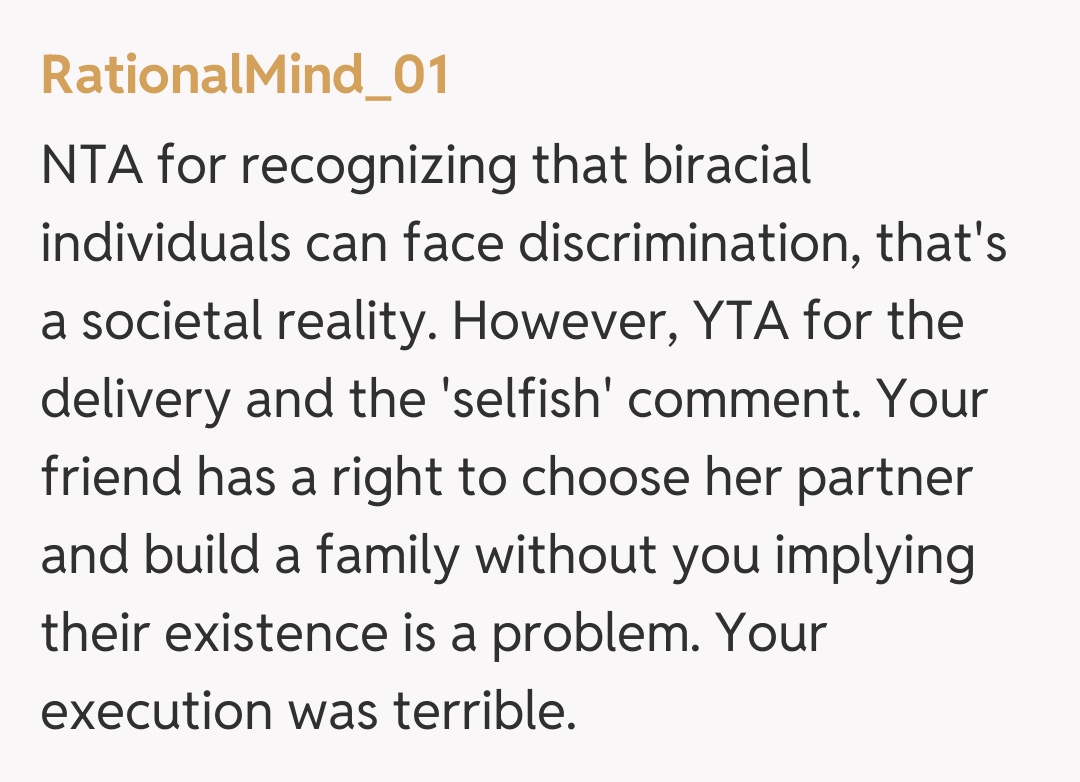
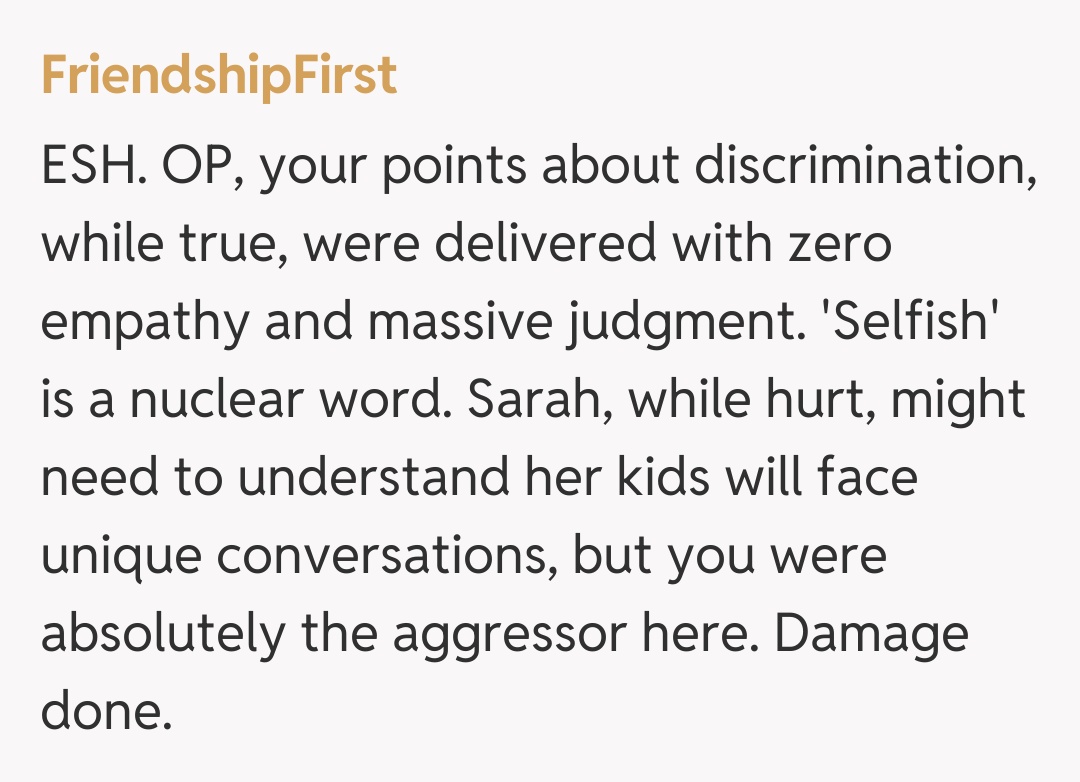
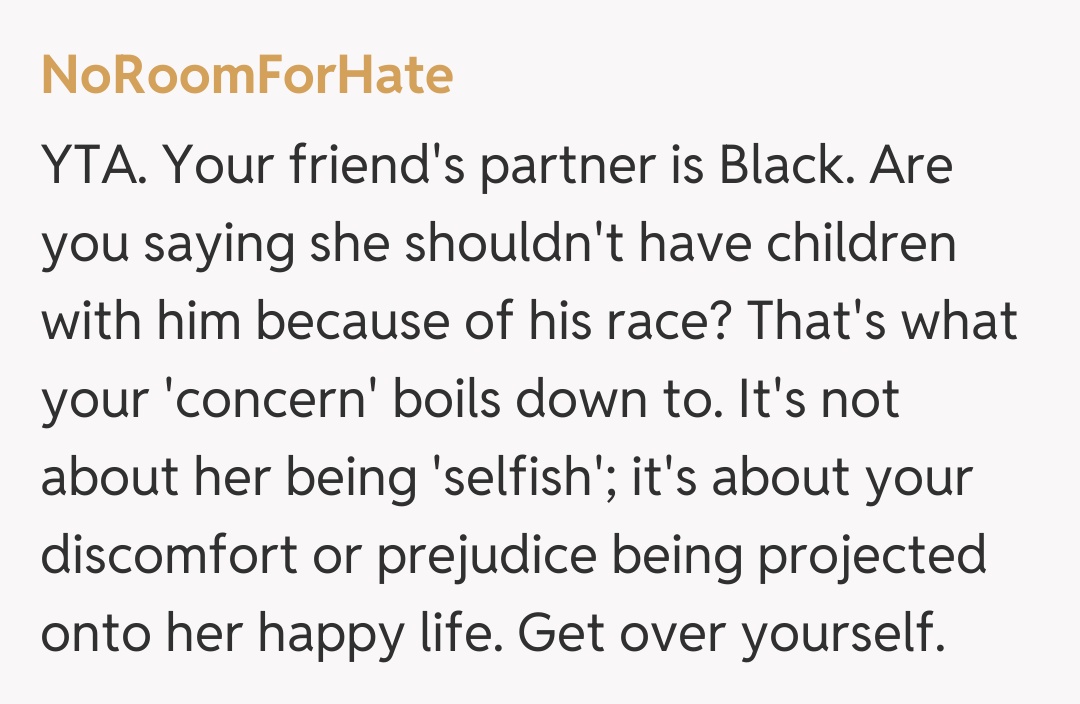
The comment section on this one is predictably divided, yet with a clear lean. Many users are pointing out that while the OP's underlying point about discrimination is sadly valid, her delivery and the 'selfish' accusation were absolutely out of line. It seems the consensus is that one can acknowledge societal issues without condemning a loving relationship or the existence of biracial children. \n A significant number of commenters are outright calling the OP the A-hole, emphasizing that her 'concern' came across as thinly veiled racism and judgment. They argue that a true friend would support her friend's choices and offer practical support, not lecture her about the perceived 'difficulty' of her future children's lives. The sheer insensitivity of the timing and phrasing is a major theme.
This AITA story serves as a stark reminder that even with supposedly good intentions, our words carry immense weight, especially when discussing deeply personal life choices. The line between 'tough love' and outright judgment can be incredibly thin, and in this case, it seems our OP crossed it dramatically. True friendship often means supporting choices even if we don't fully understand them, and offering empathy rather than condemnation. It's crucial to examine not just what we say, but how we say it, and the underlying assumptions that drive our 'advice.'