
My Husband Thought I Had No Defense at Our Divorce Hearing—Until the Judge Watched His Confidence Collapse in Real Time
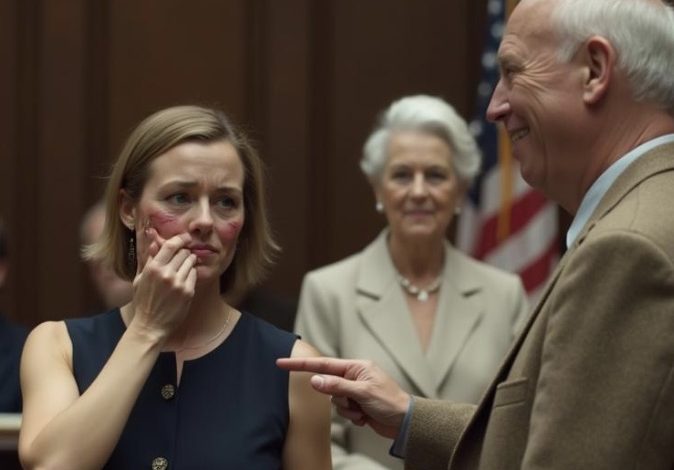
At our divorce hearing, my husband laughed at me because I didn’t have a lawyer. He leaned back and mocked, “You’ve got no money, no influence. Who do you think is going to rescue you, Grace?” He was completely sure I was on my own. He had no idea who my mother really was—until she stepped into the room and everything went quiet. I watched the confident grin on his face collapse into pure fear. In that moment, his entire life began to fall apart.
He sat there in a suit that cost more than most people’s rent, joking with his expensive, aggressive attorney and pointing at the empty chair next to me. Keith Simmons believed the divorce was already finished. He thought that by freezing my accounts, canceling my cards, and cutting me off from everyone, I would break. He had even told the judge earlier that I was too incapable to hire a lawyer on my own.
What Keith forgot—what he never bothered to learn—was my history. More precisely, he forgot whose daughter I was.
When the courtroom doors finally opened, Keith’s smug expression didn’t just fade. The color drained from his face entirely, like a man who suddenly realized the floor beneath him had vanished.
What followed would become one of the most ruthless courtroom defeats the Manhattan Civil Division had ever seen. But before the gavel struck, all there was were the smells of old paper, cleaning chemicals, and my own tightening chest.
Courtroom 304 was small, sealed off, and oppressive. The air felt stale and lifeless. To Keith, though, it smelled like victory.
I watched him straighten the cuffs of his custom jacket and lean back in his chair. He glanced at his watch—a Patek Philippe he bought using our shared savings, claiming it was an “investment”—and let out a mocking breath.
“She’s late,” he whispered to his lawyer. “Or maybe she finally accepted it’s cheaper to quit and go live in a shelter.”
Next to him sat Garrison Ford. He wasn’t just an attorney—he was a weapon. A senior partner at Ford, Miller & O’Connell, he had earned the nickname “The Butcher of Broadway.” He didn’t just win divorces. He destroyed people.
Garrison adjusted his silver tie, scanning the docket with bored confidence. “It doesn’t matter if she shows up,” he said calmly, loud enough for me to hear. “We froze the assets. No money means no lawyer. No lawyer means she takes whatever we allow.”
Keith smiled at me across the room.
I knew exactly what he saw. Grace—the quiet wife. The failed artist. The woman in the same simple gray dress she’d owned for years because her husband controlled the budget. My hands were folded tightly on the scratched wooden table. No files. No assistants. No water. Just me, staring ahead, forcing myself to breathe.
“Look at her,” Keith laughed, making sure others heard. “It’s sad. Like watching an animal waiting to be hit.”
“Focus,” Garrison muttered, though he was smiling. “Judge Henderson hates delays. I have lunch at Le Bernardin at one.”
“Relax,” Keith replied. “By then I’ll be divorced, and she’ll be apartment hunting in Queens.”
The bailiff, Officer Kowalski—a man who had seen too many broken marriages—called the room to order.
“All rise. Judge Lawrence P. Henderson presiding.”
The judge entered quickly, his robe flowing behind him. He was sharp, impatient, and known for clearing cases fast.
“Be seated,” he said. “Case 24-NY-0091. Simmons versus Simmons.”
He nodded to the plaintiff’s side. “Mr. Ford.”
“Ready, Your Honor,” Garrison replied.
Then the judge turned toward me and frowned.
I stood, my legs heavy.
“Mrs. Simmons,” he said. “You’re alone. Are you expecting legal counsel?”
“Yes,” I said softly. “She’ll be here any moment.”
Keith scoffed loudly, pretending to cough.
The judge snapped his eyes toward him. “Is something funny, Mr. Simmons?”
Garrison stood quickly, placing a hand on Keith’s arm. “Apologies, Your Honor. My client is under stress.”
“Control him,” the judge warned. He turned back to me. “Court began five minutes ago. If your lawyer isn’t here—”
“She’s coming,” I said, forcing strength into my voice. “There was traffic.”
Keith leaned forward. “Or maybe her check bounced. Oh wait—you can’t write checks anymore. I canceled everything.”
“Enough!” the judge slammed the gavel.
Keith stood, pretending humility. “Your Honor, I only want fairness. My wife doesn’t understand legal matters. She has no income. I offered her a generous deal—fifty thousand and the Lexus. She refused.”
He looked straight at me. “I tried to help you, Grace. No one wants a charity case.”
“Mr. Ford,” the judge snapped. “Enough.”
“Your Honor,” Garrison said smoothly, “we move to proceed with default judgment. She has had months.”
The judge sighed. “Mrs. Simmons, if your attorney is not here, you’ll be representing yourself.”
“I am not,” I said, staring at the doors. “Two minutes.”
“She’s stalling,” Keith laughed. “Who’s she going to call? Ghostbusters?”
Judge Henderson raised his gavel. “We will proceed—”
BAM.
The courtroom doors flew open.
The sound echoed.
Everyone turned.
Standing there was not a public defender. Not a bargain lawyer.
It was a woman in her late sixties, standing perfectly straight. Her white suit alone cost more than Keith’s wardrobe. Her silver hair was cut sharply. She removed her sunglasses slowly, revealing cold blue eyes—eyes that had crushed powerful men.
Behind her walked three associates, briefcases in hand.
She walked calmly down the aisle.
Garrison Ford dropped his pen.
“No,” he whispered. “That can’t be.”
Keith frowned. “Who is that? Grace said her mother was dead.”
“She said she was gone,” the woman said calmly, stopping at the table. “Not dead.”
She faced the judge. “Catherine Bennett. Senior Managing Partner at Bennett, Crown & Sterling. I represent the defendant.”
Then she looked at Keith.
“And I am her mother.”
The silence was total.
Keith stammered. “You said—”
“I said we were estranged,” I replied.
Catherine sat beside me, opening her case.
She looked at Garrison. “Hello. I remember you. Coffee runner, 2015.”
His face burned red.
She turned to the judge. “I saw the motion. Sloppy.”
She handed documents forward.
“The prenuptial agreement was signed under coercion,” she said calmly. “Threats. Text messages. Exhibit C.”
The judge’s expression darkened.
Garrison panicked.
Catherine continued. “And the hidden assets—twenty-four million dollars. Offshore.”
Keith collapsed into his chair.
“That’s felony fraud,” Catherine said simply.
The judge denied recess.
Catherine placed a hand on my shoulder. “You thought silence meant weakness,” she said to Keith. “You were wrong.”
“I am not here to negotiate,” she added. “I am here to take everything.”
Keith later admitted everything on the stand.
Garrison withdrew.
Assets were frozen.
Keith was removed.
I walked out lighter than ever.
Later, my father tried to claim the penthouse.
Catherine dismantled that too.
Three months later, my art gallery opened.
Keith went to prison.
I stood tall.
I was no longer the woman in gray.
I was Grace Bennett Simmons.
And I was just getting started.