She left her son’s birthday in silence then a flood of calls and a missing boy taught their family what truly matters
I Went to My Son’s Birthday Party, But He Said: “Today Isn’t Convenient.”
The morning began like many others in New England — gray skies, wet air, and the smell of rain-soaked leaves drifting through the open window. Fog rolled over my quiet street in Framingham, wrapping around the maple trees like an old shawl. I sat at the kitchen table of my little house on Oak Street, a cup of tea in hand, watching a delivery truck pass by, its red taillights glowing through the mist.
Seventy-five years old, and mornings like this still made me miss my husband, Arnold. He would’ve called it “movie weather,” the kind of morning made for old films and warm socks. His side of the table sat empty, but I could still see him there — reading the newspaper, pretending not to glance at me over the edge of it. Seven years since he passed in his sleep, and somehow, the silence still knew my name.
My phone buzzed, startling me. A message from Ethan — my only son.
Mom, Quentyn’s birthday is next Saturday at 4 p.m. Hope to see you.
Short. Formal. Like something you’d send to a coworker. Still, after years of distance, it felt like an open door. I replied right away:
Thank you, Ethan. I’ll be there. Love, Mom.
I placed the phone down, steadying my hands against the table. Even after all these years, they still trembled when hope tried to make its way back in.
I walked to the cabinet where I kept old photographs — my private museum of happier days. Ethan as a boy in his Red Sox T-shirt, proudly holding a fish from Learned Pond. Ethan in his graduation gown, smile crooked with nerves. Arnold cradling baby Quentyn, eyes soft and full of the kind of love that didn’t need to be spoken aloud.
Ethan had always been the ambitious type. Debate club captain. Law school on a scholarship. A career that climbed straight to the top floors of Boston offices with glass walls and expensive coffee. He’d built himself into a man who seemed allergic to softness. Then he met Odilia Snow — beautiful, rich, polished. A woman who always looked like she’d been born in perfect lighting.
At our first dinner together, she complimented my “humble background” in a way that made the air heavy. I’d spent thirty-two years teaching second grade at Cliff Street Elementary, but to her, that was something small and ordinary. She carved her duck with the confidence of someone who’d never worked a double shift in her life.
“How noble,” she’d said. “My aunt taught for a few years. Then she married well and focused on more appropriate things.”
Arnold had squeezed my hand under the table — his quiet way of saying, Don’t let it get to you. But I had.
Their wedding was enormous. Three hundred and fifty guests, chandeliers, flowers that probably cost more than my car. I remember standing among strangers, pretending to belong. Afterward, they bought a perfect house across the lake, one of those neighborhoods where lawns looked too green to be real. I’d brought them hand-stitched kitchen towels as a gift. Odilia thanked me with a smile that didn’t reach her eyes, and that was the last time she stepped into my home.
When Quentyn was born, I went to the hospital with soup, excitement, and every ounce of grandmotherly love I had. But when I arrived, the nurse looked confused. “Only immediate family,” she said. Odilia’s parents were already there, of course. I wasn’t on “the list.”
That was the first time I realized how far I’d been pushed out of the frame.
Still, mothers are built from hope — and mine refused to die.
The week before the party, I went shopping for a gift. In a toy aisle full of glowing screens and talking robots, I realized with a sharp ache that I didn’t even know what my grandson liked. Dinosaurs? Space? Science? The shame of not knowing weighed on me.
I was about to give up when I passed an old antique shop I’d ignored for years. Something pulled me inside. The place smelled like lemon oil and history. Behind the counter stood an older man with a kind face and careful hands.
“Looking for something?” he asked.
“It’s my grandson’s birthday,” I said. “He’s turning eight.”
He smiled and disappeared into the back, returning with a small wooden case. Inside lay a brass microscope, tiny specimen jars, and a small magnifying glass.
“A naturalist’s kit,” he said. “For curious minds who want to explore the real world.”
I ran my fingers across the brass lens. “Do kids still care about things like this?”
“Some children want the world to come to them,” he said softly. “Others want to go to it.”
I bought it. It cost more than I’d planned, but it felt right. That night, I wrote a note:
Dear Quentyn, this kit helped people discover the secrets in small things. I hope it helps you discover your own. Love, Grandma Judith.
Party day came with low clouds and drizzle. I wore my turquoise dress — the one the saleswoman swore made me look “vibrant.” I put on Arnold’s pearl earrings for courage.
The Uber driver lifted the box carefully. “Family party?” he asked.
“For my grandson,” I said.
He grinned. “That’s the good kind.”
When we turned onto Lakeside Drive, the houses grew bigger and colder. The lawn at Ethan’s place was full of balloons, catered tables, and people who looked like they belonged in magazines.
I spotted Odilia first — elegant, glass of champagne in hand, talking to women who all wore shades of beige and carried identical handbags. Her parents hovered nearby, their smiles stiff as stone.
Then I saw Quentyn. He was taller than I remembered, quieter too. His dark hair, his father’s jawline, his watchful eyes — all reminders that time had been moving on without me.
I approached him slowly, my heart pounding. “Happy birthday, sweetheart,” I said, offering the box.
He took it politely, then smiled — a real one. “Can I open it?”
“Of course,” I said.
He undid the ribbon carefully, revealing the microscope. His eyes widened. “It’s old!”
“Old, but still works,” I said. “It’s for exploring real things — pond water, leaves, bugs. If you want, I can show you—”
Before I could finish, another boy came over. “That’s junk,” he laughed. “My microscope connects to an iPad.”
Quentyn hesitated, then closed the box quietly. “Thanks, Grandma,” he said softly. “I’ll put it with the others.”
He walked off, and I felt something inside me fold.
When I turned around, Odilia was standing there, perfect as ever.
“Judith,” she said coolly. “What a surprise. We didn’t think you’d come.”
“How could I miss my grandson’s birthday?”
Her smile didn’t waver. “Well, we’ve just been so busy. But it’s nice to see you. Truly.”
“Of course,” I said, knowing it was a lie.
I sat alone near the hedge, listening to laughter and clinking glasses. No one spoke to me. They didn’t have to — I wasn’t really there.
Then Ethan arrived. He looked sharp, tired, and untouchable in his tailored suit. I waited for him to see me. When he finally did, his smile flickered — polite, forced.
“Mom,” he said. “I didn’t think you’d actually make it.”
“You invited me,” I said. “Can we talk?”
He frowned. “Now’s not a good time. It’s Odilia’s family today.”
I looked straight at him. “So I’m not family?”
He sighed, glancing toward the guests. “Mom, this isn’t about that. We just… live differently now.”
“You mean I don’t fit,” I said quietly.
He rubbed his forehead, avoiding my eyes. “Please, don’t make a scene. Not today.”
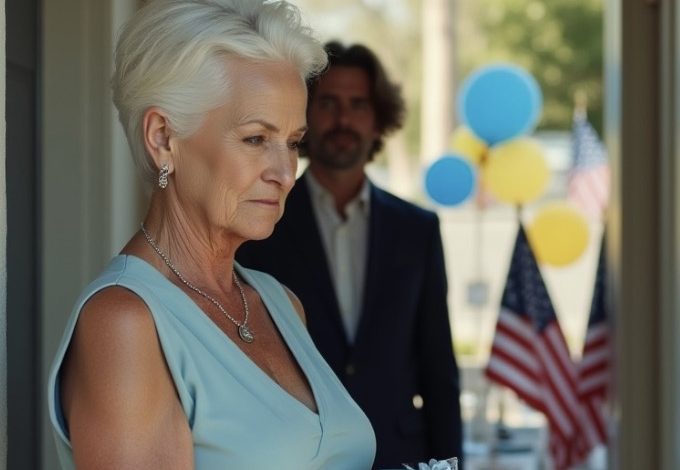
“I wouldn’t dream of it,” I said. I placed my gift on a side table, nodded once, and walked out.
The Uber driver didn’t ask questions. Back home, I hung my dress on a chair and turned my phone face down. I didn’t want to see the pity texts or hollow apologies. I made tea, fed the cat, and tried to silence the echo of Ethan’s voice — not convenient today.
Night came early. Rain tapped against the window, soft but relentless. I washed my face and crawled into bed, hoping sleep would dull the ache.
Somewhere around dawn, a noise broke through — a low, steady vibration on my nightstand. My phone. I turned it over. 269 missed calls. Ethan. Unknown. Private numbers. Even one from Odilia.
My heart sank. Something was wrong.
I answered the next ring.
“Mom,” Ethan’s voice was raw, desperate. “It’s Quentyn. He’s missing.”
The room tilted. “What?”
“He was here last night — then gone. He must’ve slipped out the gate. We called the police. They’re searching.”
“I’m coming,” I said, already on my feet.
When I arrived, flashing lights lit the driveway. Officers moved through the backyard, their voices clipped but calm. Ethan looked shattered. Odilia stood beside him, pale and silent.
“They’re checking the park and the lake,” Ethan said.
“Did he take anything?” I asked.
“Just his jacket,” he said.
And then I remembered — the drawing. The forest in the background of the card he’d made at Christmas. He’d always been fascinated with nature.
I looked Ethan in the eye. “Callahan State Park,” I said. “Near my house. The pond.”
He blinked. “He doesn’t even know where you live.”
“He does,” I said. “Children notice what we think they don’t.”
They found him just before noon, sitting on a bench by the pond. His hair was damp, cheeks pink from the cold, but he was safe. He’d taken the microscope with him. “I wanted to see real things,” he told the officer softly.
When I saw him, I pulled him into my arms. “You scared us, sweetheart.”
“I just wanted to see the forest,” he whispered.
“I know,” I said. “It’s beautiful, isn’t it?”
Odilia’s voice cut the air. “This is your fault,” she said sharply. “You filled his head with nonsense!”
“Odilia,” Ethan warned.
“No,” she snapped. “He could’ve been hurt because she can’t stay in her place!”
I looked at her calmly. “A child wanting to see the world isn’t nonsense. It’s life.”
Ethan said nothing. He didn’t have to. The guilt on his face said everything.
Weeks passed. The air softened, and spring arrived. I started volunteering at the local library, helping kids with science projects. One afternoon, the librarian asked, “Would you consider running a children’s nature club?”
I smiled. “I think I’d love that.”
A month later, there were twelve kids with curious eyes and dirty hands. We built tiny volcanoes, watched pepper scatter on water, made rainbows out of light. Their laughter filled the small room, and for the first time in years, I felt useful again.
Then one Thursday, I looked up — and there they were. Ethan and Quentyn standing at the door.
“Grandma!” Quentyn called, waving. “We made rainbows!”
Ethan smiled — not the polished lawyer smile, but the one I remembered from long ago. “He insisted we come,” he said quietly.
“Well,” I said, trying not to cry. “You’re welcome every week.”
They did come — again and again. We studied pond water, built bridges from spaghetti, and learned why shadows change with time.
One afternoon, Quentyn pulled something from his backpack. My wooden box. The microscope.
“I kept it safe,” he said. “Can we use it?”
“We can,” I said.
That Saturday, we went to Callahan Park. The pond glittered like glass. We filled a jar with water and looked through the lens — tiny worlds, spinning and alive.
“Whoa,” Quentyn whispered. “There’s life in there.”
“There always is,” I said.
Ethan leaned over. “I had no idea,” he said softly.
“Sometimes,” I told him, “you just have to look close enough.”
He hesitated, then said, “Mom… I’m sorry. For everything.”
I met his eyes. “You learned. That’s what matters.”
Months later, Odilia visited the library. No designer clothes, no perfect smile — just a woman humbled by love and loss.
“I owe you an apology,” she said quietly. “I cared too much about appearances. I forgot what mattered.”
“Then remember now,” I said.
She nodded. “Once a week, he should see you. Every Thursday. No excuses.”
It became our rhythm. Thursdays for science and grilled cheese. Sundays for dinner. Laughter began filling the spaces that had gone quiet.
The following spring, the library hosted a science fair. Quentyn stood proudly behind his project — “Life in a Drop.” He showed people how to find worlds inside pond water. “Not magic,” he told them. “Just science.”
Ethan and Odilia watched, their eyes bright. When it was over, Ethan handed me an envelope. “For the club,” he said. “So more kids can learn the way Quentyn did.”
I opened it later — a small fund in my name. My throat tightened.
That night, after everyone left, I stood by the window with my tea. The maple tree outside was covered in new leaves, green and brave. On the table sat the microscope, gleaming under the lamplight.
Next to it, I found a small note in a child’s handwriting:
For Grandma. For emergency sweetness.
A butterscotch candy was taped to the corner.
I smiled. The world, I realized, had finally come full circle — not perfect, but true.
And when the morning light touched the window, soft and gold, I felt something I hadn’t in years.
Peace.