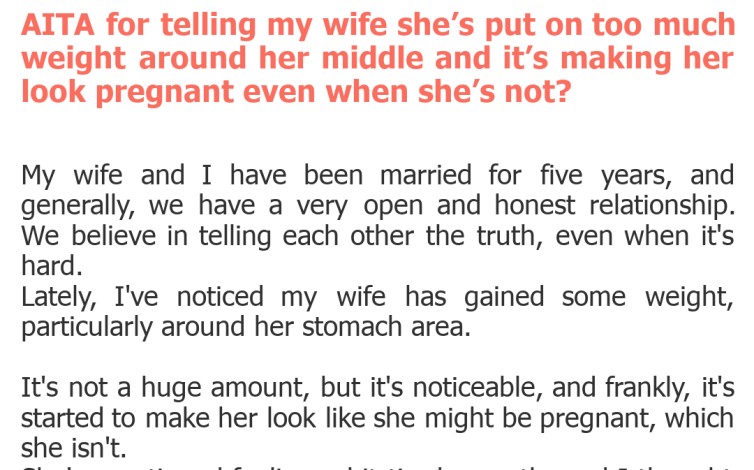
AITA for telling my wife she’s put on too much weight around her middle and it’s making her look pregnant even when she’s not?
Oh boy, do we have a doozy for you today! This AITA post dives headfirst into one of the most sensitive topics imaginable within a marriage: body image. It’s a minefield out there, and our original poster (OP) seems to have stepped right onto one with both feet, leading to a classic 'intent vs. impact' dilemma that has left his wife deeply upset and their relationship on rocky ground. Get ready to debate the nuances of honesty, kindness, and marital communication.\nEvery relationship faces its challenges, but how we navigate sensitive conversations truly defines their strength. When it comes to discussing a partner's weight, especially a woman's, the stakes are incredibly high. Was OP merely trying to be 'helpful' or 'honest,' or did his choice of words cross a line into outright insensitivity? Let's unpack this sticky situation and see if our community can shed some light on who truly is the A-hole here.

"AITA for telling my wife she’s put on too much weight around her middle and it’s making her look pregnant even when she’s not?"
My wife and I have been married for five years, and generally, we have a very open and honest relationship. We believe in telling each other the truth, even when it's hard. Lately, I've noticed my wife has gained some weight, particularly around her stomach area. It's not a huge amount, but it's noticeable, and frankly, it's started to make her look like she might be pregnant, which she isn't. She's mentioned feeling a bit tired recently, and I thought maybe this was contributing to her not being as active.\nI decided to bring it up to her during dinner the other night. I tried to be gentle, saying something like, "Hey, I've noticed you've been looking a bit different lately, particularly around your middle. You've gained some weight there, and honestly, it's starting to make you look like you're expecting." I paused, waiting for her reaction, expecting a conversation about health or perhaps a shared plan to get more active. Instead, her face completely fell. The fork clattered onto her plate, and she just stared at me, her eyes welling up with tears. The silence in the room became deafening, thick with unspoken accusations and profound hurt.\nI immediately knew I had misstepped, but I couldn't understand why her reaction was so extreme. I tried to backtrack, saying, "I didn't mean it in a bad way! I just care about your health, and I thought maybe we could get back into our workout routine together." She didn't say a word. She just got up from the table, went to our bedroom, and locked the door. She hasn't really spoken to me properly since, beyond monosyllabic answers.\nIt's been three days of this cold silence. I feel terrible that I hurt her, but I genuinely believed I was being honest and concerned. In my mind, it was a factual observation, and I framed it as a health concern. We've always prided ourselves on our honesty. Now I'm wondering if I was truly the asshole here for pointing out something I thought was just a neutral observation about her body, or if she's overreacting to a well-intentioned comment. So, AITA?
This post really highlights the delicate tightrope walk that is communication within a marriage, especially when it concerns a partner's physical appearance. While the original poster (OP) states his intention was rooted in 'honesty' and 'health concern,' the impact of his words was clearly devastating for his wife. It's a classic example of how even well-meaning comments can be deeply hurtful if not delivered with extreme care and empathy. Body image is intensely personal.\nOne must consider the cultural and societal pressures women face regarding their bodies, particularly the emphasis on maintaining a certain physique. To imply someone looks pregnant when they are not can be especially triggering, whether due to past fertility struggles, societal expectations, or simply the general anxiety many women have about their changing bodies. OP's specific phrasing about her 'middle' and 'looking pregnant' strikes at a very vulnerable spot for many women, even if he didn't intend to.\nThe issue isn't necessarily about the observation itself, but rather the framing and the assumption behind it. Did OP consider if his wife was already aware of her weight gain? Was this something she was already sensitive about? An unsolicited comment, especially one phrased so bluntly, can feel like a judgment rather than a loving concern. There's a significant difference between saying "I'm worried about our general health; maybe we could go for walks together?" and commenting specifically on her 'pregnant-like' appearance.\nUltimately, sincerity of intent doesn't always absolve one of the hurt caused. Relationships thrive on trust and feeling safe. When one partner feels criticized or shamed about their body by the person who is supposed to love them unconditionally, that trust can be severely eroded. OP needs to reflect not just on *what* he said, but *how* he said it, and more importantly, *why* he felt it was his place to bring it up in that particular manner. The silence from his wife speaks volumes about the depth of her hurt.
The Verdict Is In: Brutal Honesty or Cruel Insensitivity?
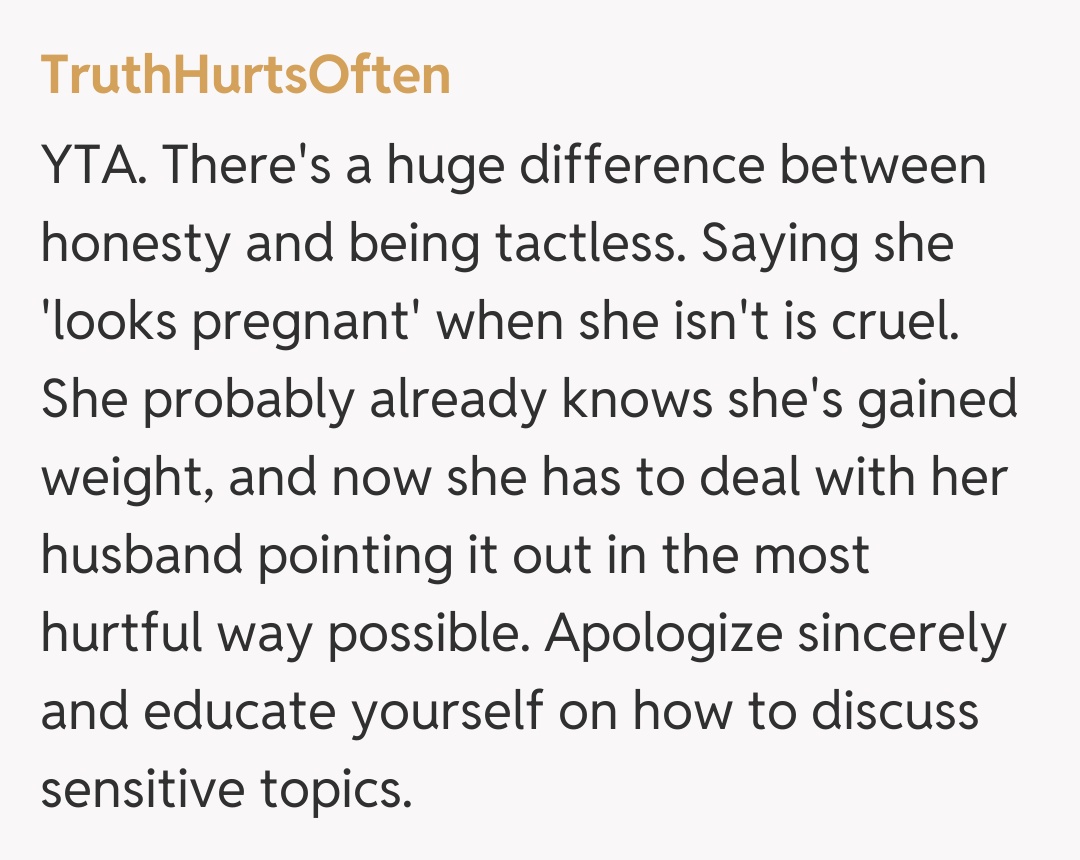
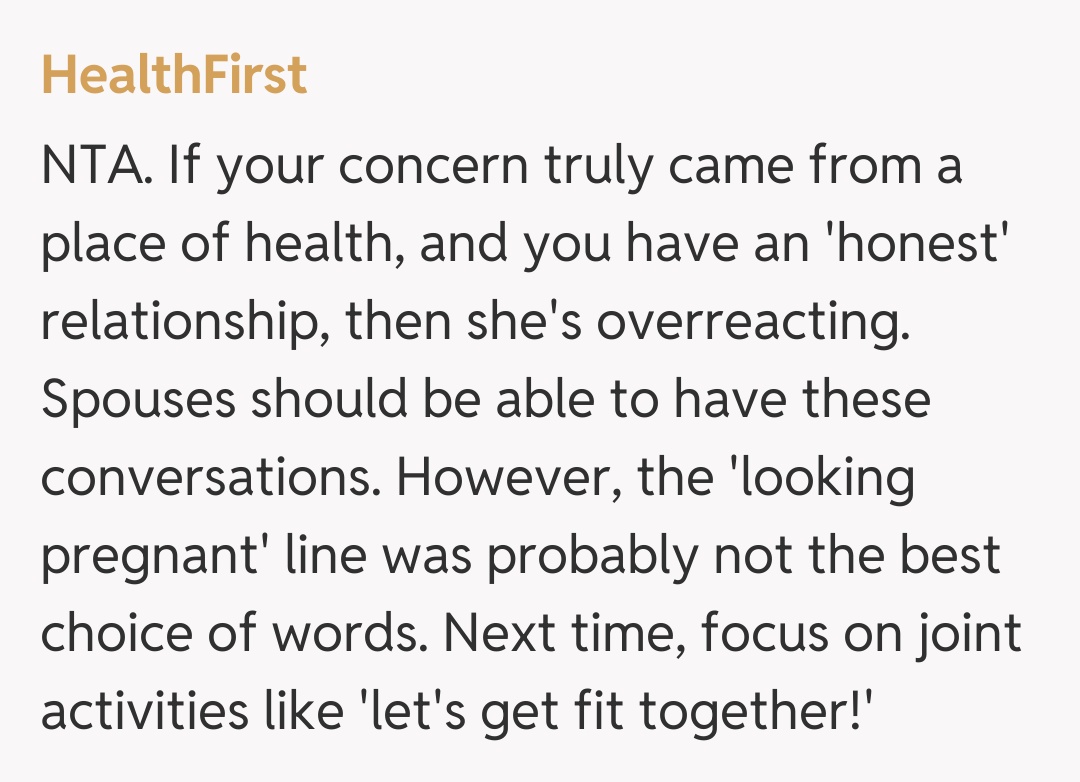
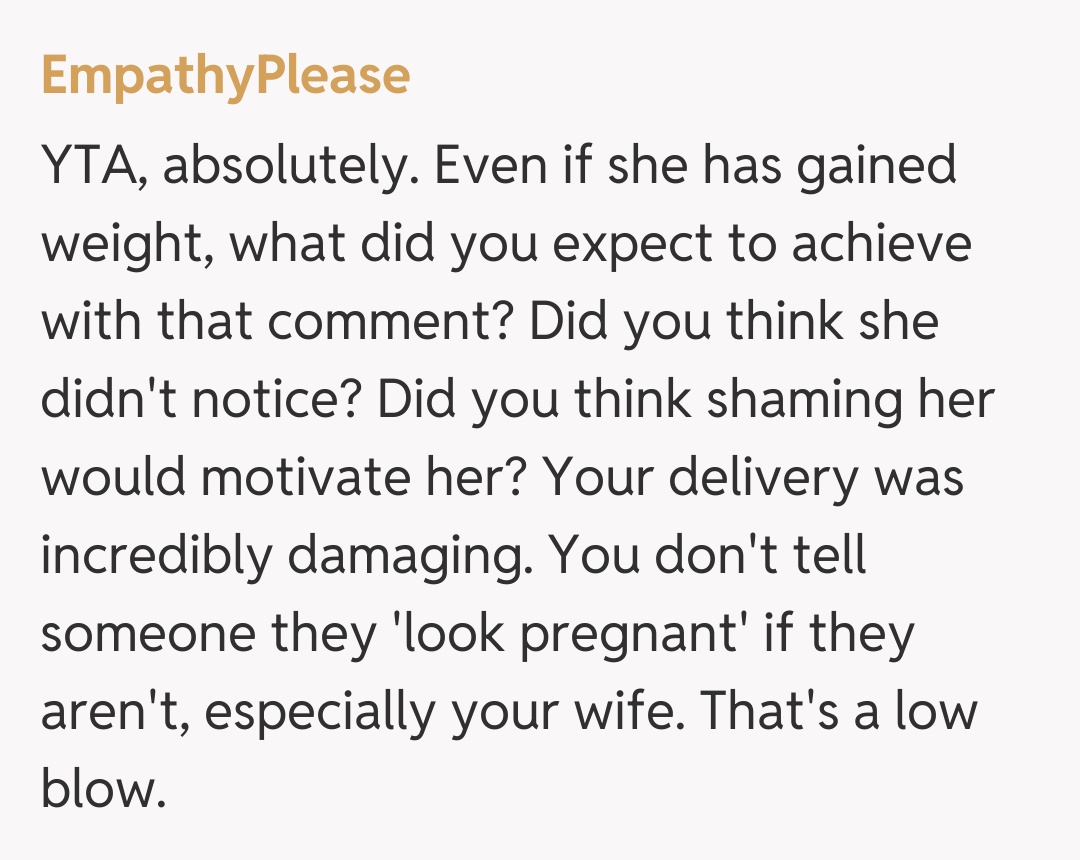
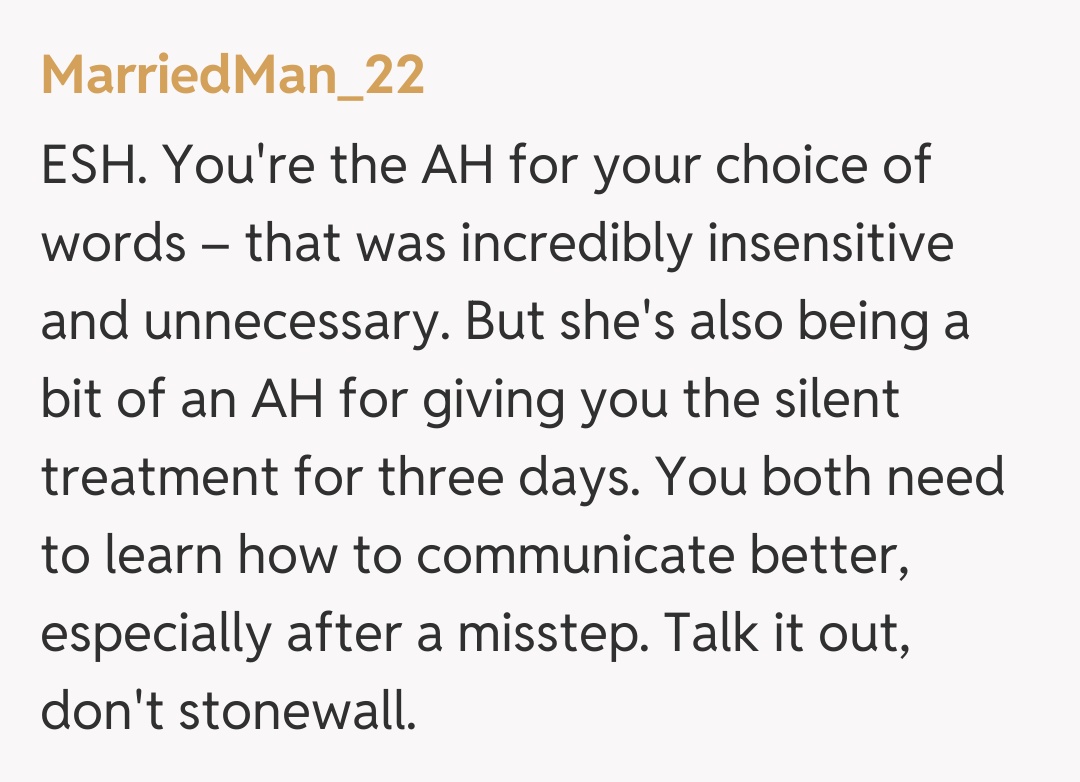
The comments section for this one exploded, as expected! A vast majority of users leaned heavily towards YTA, emphasizing that while honesty is important, kindness and empathy are paramount, especially regarding body image. Many pointed out that his choice of words – specifically the 'looking pregnant' comment – was incredibly insensitive and likely triggered a deep emotional reaction in his wife, regardless of his 'good intentions.'\nHowever, there were a few NTA votes, primarily from users who believe that spouses should be able to discuss anything, including health and appearance, honestly. These commenters argued that if OP's concern truly stemmed from health, then his wife's reaction was an overreaction. Still, even these opinions often came with the caveat that his delivery could have been significantly better, perhaps focusing on shared health goals rather than a direct critique of her body.
This AITA post serves as a powerful reminder that words have immense power, especially within the intimate confines of a marriage. While honesty is a cornerstone of any strong relationship, it must always be tempered with empathy, kindness, and respect. A 'factual observation' can become a deeply painful wound if not delivered with careful consideration for the other person's feelings and vulnerabilities. OP has a lot of apologizing and repairing to do, not just for what he said, but for how it made his wife feel. Hopefully, this experience will lead to better, more compassionate communication in the future.