AITA for telling my wife she’s not allowed to post selfies anymore because “married women don’t need likes from strangers”?
Oh, the digital age and its endless relationship dilemmas! We've all seen how social media can introduce new complexities into even the most solid partnerships. What seems like harmless fun to one person can be a major source of anxiety or disagreement for another, especially when it comes to self-expression and external validation online.
Today, we're diving headfirst into a classic modern quandary: the selfie-posting spouse. Specifically, a husband's strong feelings about his wife's online presence. Is it about protecting the sanctity of marriage, or is it a controlling move wrapped in a veneer of concern? This one is sure to spark some passionate debate among our readers, so let's get into the nitty-gritty.

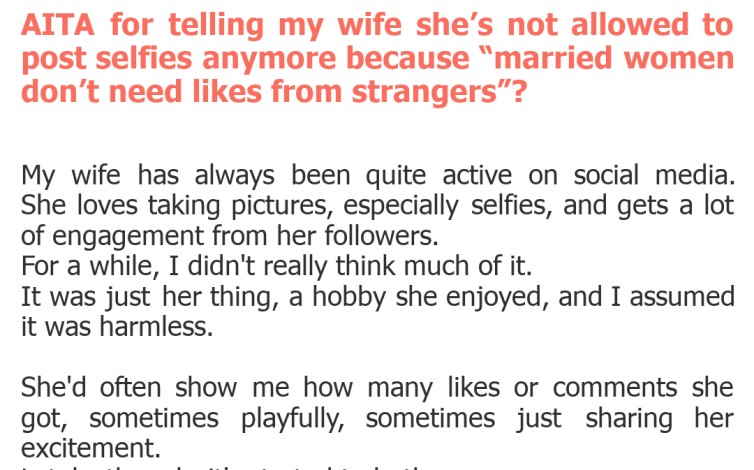
"AITA for telling my wife she’s not allowed to post selfies anymore because “married women don’t need likes from strangers”?"
My wife has always been quite active on social media. She loves taking pictures, especially selfies, and gets a lot of engagement from her followers. For a while, I didn't really think much of it. It was just her thing, a hobby she enjoyed, and I assumed it was harmless. She'd often show me how many likes or comments she got, sometimes playfully, sometimes just sharing her excitement.
Lately, though, it's started to bother me. I see her getting all this attention from people I don't know, commenting on her looks, and it makes me feel uneasy. We're married, and it feels like she's seeking validation outside of our relationship. I brought it up casually a few times, saying maybe she should cool it with the constant posting, but she brushed it off, saying it's just social media and I'm overthinking it.
So, I decided to be more direct. I sat her down and told her that I don't think it's appropriate for a married woman to be posting so many selfies. I explained that in my opinion, married women don't need likes from strangers; their validation should come from their partner and within the marriage. I told her that I'd prefer if she stopped posting them altogether or at least significantly cut down.
She reacted pretty badly. She got really quiet, then started saying I was being controlling and insecure. She said it was her body, her social media, and she could post whatever she wanted. She also said it wasn't about seeking validation, but about self-expression and sharing her life with friends and family, many of whom are online. She felt like I was trying to dictate her actions and didn't trust her.
I don't think I'm being controlling. I genuinely feel like it's a boundary that protects our marriage. Why does she need strangers telling her she's attractive when she has me? I think it's a reasonable request to make sure we're both respecting the sanctity of our relationship. Now she's barely speaking to me, and I'm wondering if I really went too far.
This scenario highlights a common tension point in modern relationships: the intersection of personal freedom, social media, and partner expectations. From one perspective, the husband’s concern might stem from a desire to protect the intimacy and exclusivity of his marriage. He may genuinely feel that external validation, especially based on appearance, undermines the unique bond they share.
However, the phrasing “not allowed” immediately raises a red flag regarding control. A healthy partnership is built on mutual respect and open communication, not dictates. The wife’s social media activity could be a form of self-expression, a harmless hobby, or a way to connect with a wider circle, which she is entitled to pursue as an individual.
The core issue here seems to be a significant communication breakdown. Instead of expressing his insecurities or discomfort in a way that invites dialogue, the husband resorted to a prohibitory statement. This approach often leads to defensiveness and resentment, making it harder to find common ground or understand each other's underlying needs and feelings.
Ultimately, resolving this requires both parties to listen actively and empathize. The husband needs to articulate his fears without imposing rules, and the wife needs to understand his feelings without feeling policed. The conversation should shift from 'you can't' to 'how can we both feel secure and respected in our relationship, both offline and online?'
The Internet weighs in: Is 'likes' validation or just harmless fun?
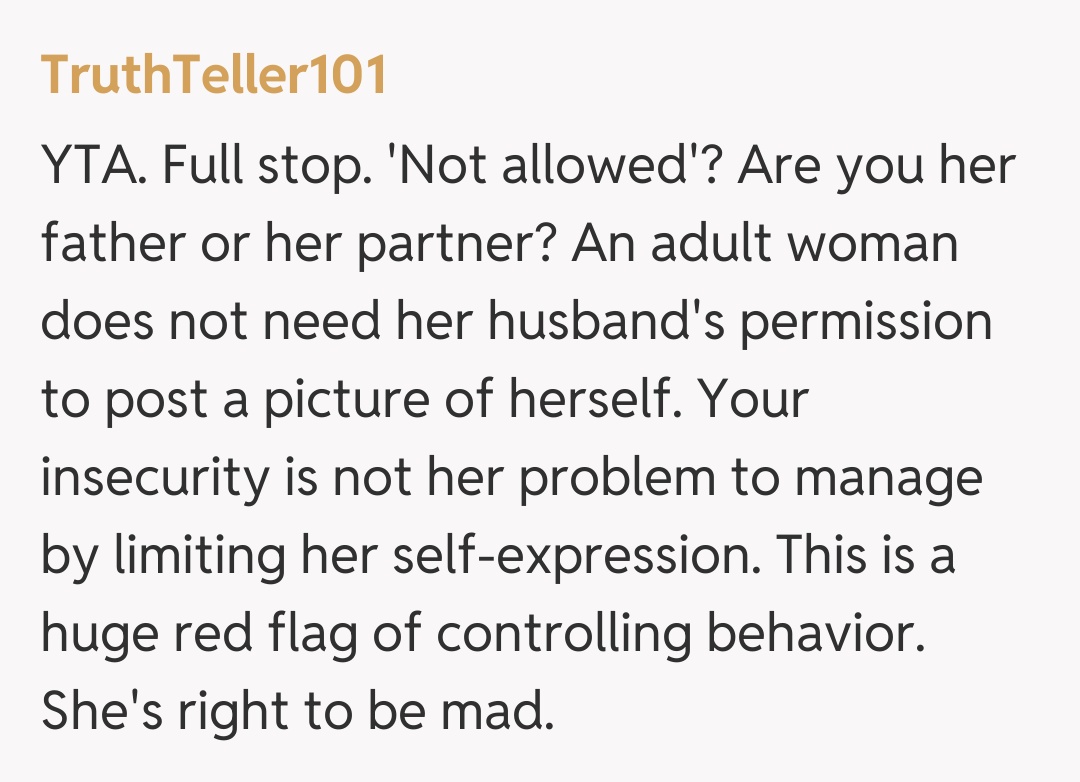
The comments section, as expected, was a fiery battleground of opinions on this one! Many users sided strongly with the wife, calling out the husband's 'not allowed' statement as a classic example of controlling behavior and insecurity. The general sentiment was that an adult woman should be free to post what she wants on her own social media without her partner's permission.
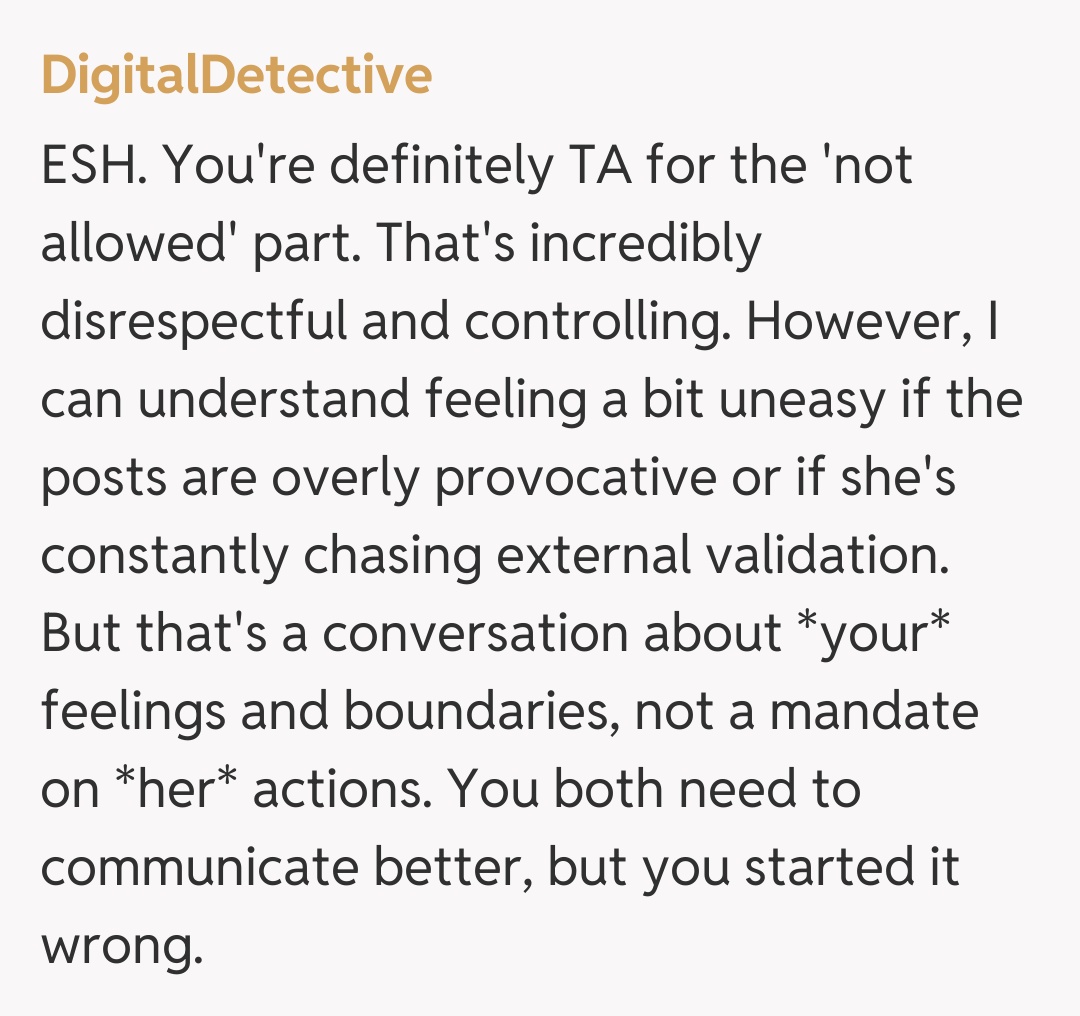
However, there were also a surprising number of nuanced takes. Some acknowledged the husband's potential insecurities, suggesting that while his approach was wrong, his feelings weren't entirely invalid. They emphasized the importance of discussing boundaries and mutual respect in a digital age, rather than resorting to ultimatums or restrictive demands.
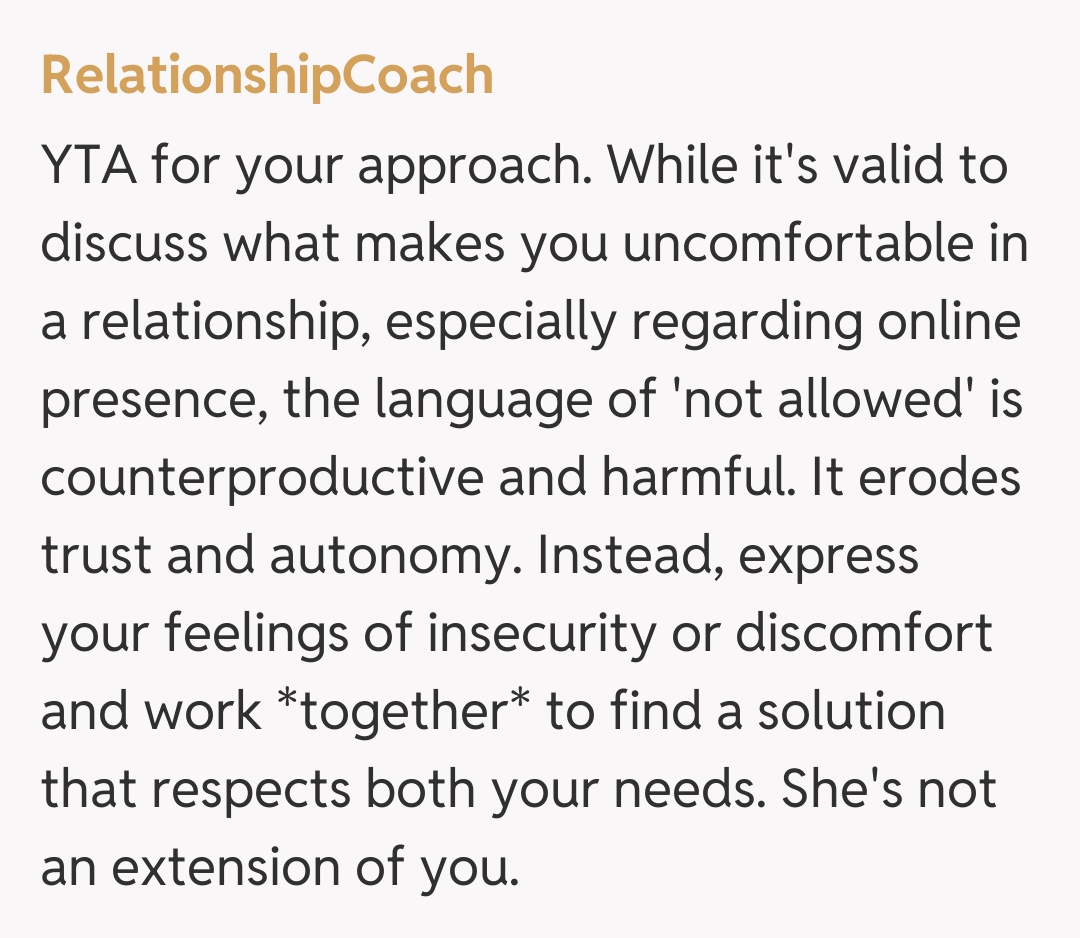
This story serves as a stark reminder that communication is paramount. While feelings of discomfort or insecurity about a partner's online activity are valid, the way those feelings are expressed makes all the difference. Relationships thrive on trust, respect, and open dialogue, not mandates. Finding a balance between individual freedom and partnership boundaries in the digital age requires empathy and a willingness to understand each other's perspectives. Let's hope this couple can move past the 'allowed' and 'not allowed' and find a path to mutual understanding.