AITA for refusing to initiate s** anymore because my girlfriend always says “not tonight” first and it kills my confidence?
Intimacy in a relationship is a complex dance, often requiring both partners to be on the same page, or at least willing to communicate when they're not. When one person consistently feels rejected, it can chip away at their confidence and create a chasm in what should be a connecting experience. Today's AITA post delves into this very sensitive territory, exploring the emotional toll of repeated refusals.
This post highlights a common dilemma many couples face: what happens when one partner's repeated 'no' starts to affect the other's willingness to even try? It's not just about the act itself, but the underlying feelings of desirability and connection. Our OP is grappling with a situation that has left them feeling unloved and undesirable, leading to a drastic change in their approach to intimacy.

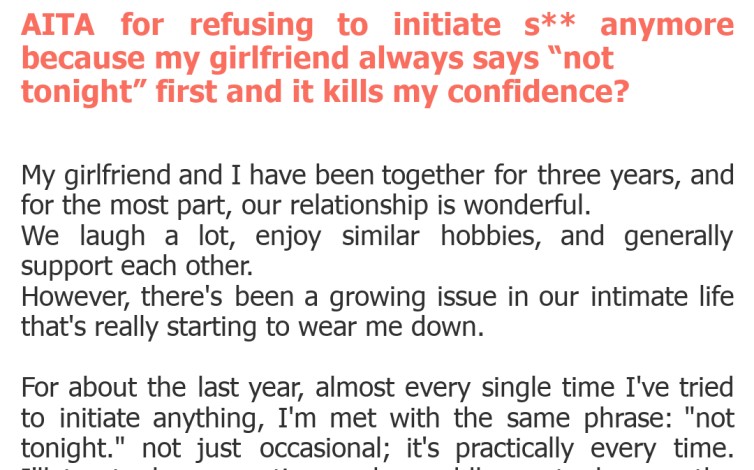
"AITA for refusing to initiate s** anymore because my girlfriend always says “not tonight” first and it kills my confidence?"
My girlfriend and I have been together for three years, and for the most part, our relationship is wonderful. We laugh a lot, enjoy similar hobbies, and generally support each other. However, there's been a growing issue in our intimate life that's really starting to wear me down. For about the last year, almost every single time I've tried to initiate anything, I'm met with the same phrase: "not tonight."
It's not just occasional; it's practically every time. I'll try to be romantic, maybe cuddle up to her on the couch, or try to create a mood in the bedroom, and before I can even properly suggest anything, she'll pre-emptively shut it down. Sometimes she doesn't even use the words, just a subtle shift away, a sigh, or a turning of her back. It feels like she can sense what I'm thinking before I even make a move. At first, I tried to be understanding, thinking she might be tired or stressed from work. I gave her space, waited longer between attempts, tried different approaches. But the pattern continued, and frankly, it started to kill my confidence. Every single time I was met with that rejection, I felt a little bit smaller, a little less desirable. It reached a point where I just couldn't bring myself to try anymore. The fear of that immediate "not tonight" became overwhelming, and the emotional toll was too much. So, about a month ago, I just stopped initiating.
Now, she's noticed. She asked me a couple of days ago why I haven't been initiating anything. I tried to be gentle and explained that her constant rejections have really hurt my feelings and confidence, and that I'm tired of feeling like I'm always bothering her or pushing something she doesn't want. I told her it felt like she was always saying "not tonight" before I even opened my mouth.
She got really upset. She said I was being unfair, that she has a right to say no, and that I'm making her feel guilty for not always being in the mood. She accused me of essentially giving her an ultimatum or punishing her. I explained that it's not about making her feel guilty for saying no occasionally, but about the consistent, almost automatic rejection that has made me feel undesirable and unwanted. I told her I just can't keep putting myself out there to be shot down every single time. I also said that it felt like she wasn't even considering it, just shutting it down immediately. She still thinks I'm being an ass for changing my behavior and making her feel bad. AITA?
This situation is a truly tricky one, highlighting the delicate balance of desire, communication, and self-worth within a relationship. On one hand, the girlfriend absolutely has the right to decline intimacy whenever she's not in the mood. No one should ever feel pressured or obligated into any sexual act. Consent is paramount, and a 'no' should always be respected without question or guilt-tripping.
However, the OP's feelings are also completely valid. Consistent, preemptive rejection, especially over an extended period, can be incredibly damaging to a person's self-esteem and their perception of their desirability within the relationship. It's not about forcing intimacy, but about the emotional impact of feeling consistently unwanted by a partner. The expectation of rejection can become so strong that it stifles any inclination to try.
The core issue here seems to be a breakdown in communication regarding intimacy and needs. While the girlfriend has the right to say no, the *way* it's communicated and the frequency of it have clearly caused significant emotional distress for the OP. There's a difference between a respectful 'not tonight, but maybe tomorrow' or a conversation about mismatched libidos, and an almost automatic shutdown that leaves one partner feeling undesirable.
By stopping initiation, the OP has reacted to their emotional pain, which is a natural human response to persistent rejection. While the girlfriend might perceive this as punishment, it's more likely a form of self-preservation. The crucial step now is for both partners to engage in a deeper, more empathetic conversation about their individual needs, feelings, and expectations surrounding intimacy, without blame.
What the internet had to say about navigating intimacy's rejections…
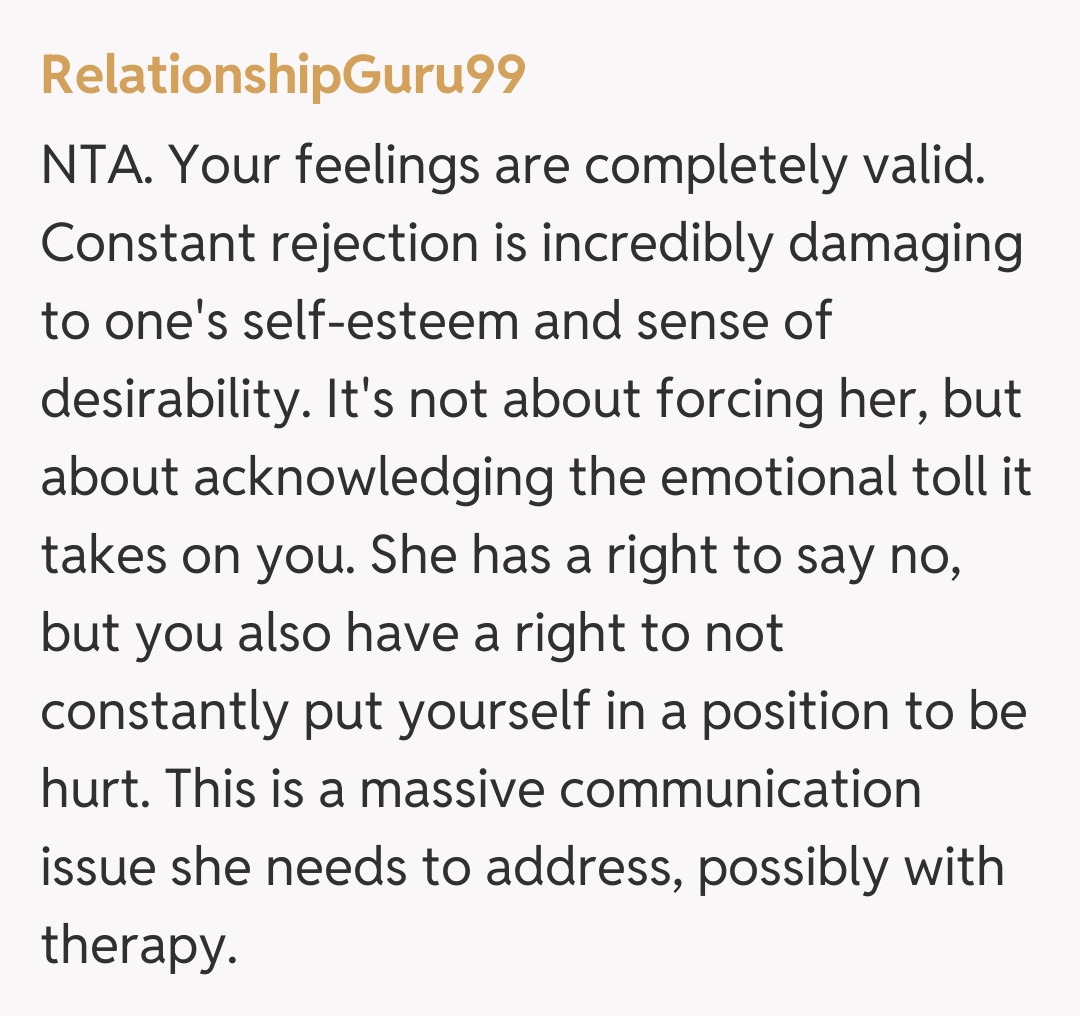
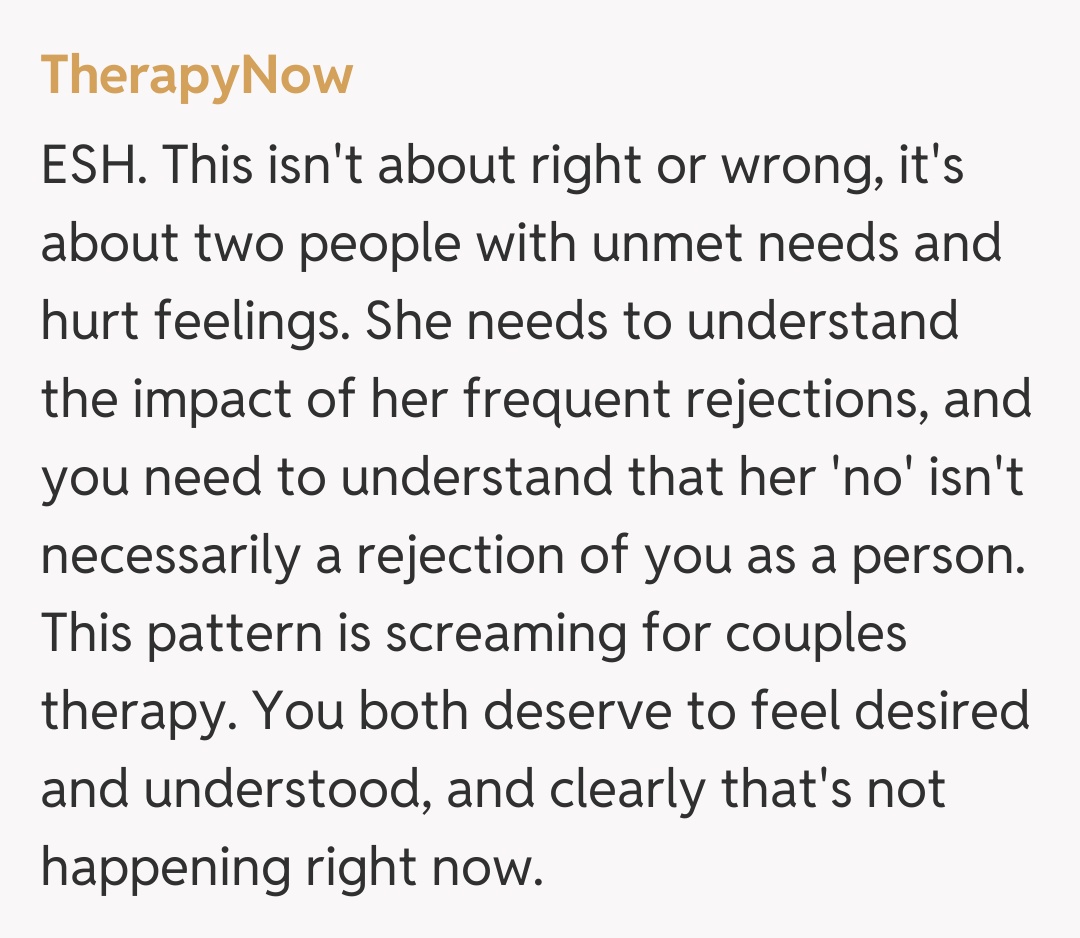
The comments section for this story was, as expected, a lively debate. Many empathized deeply with OP, highlighting how soul-crushing consistent rejection can be. Users shared similar experiences where their confidence was eroded, leading them to also stop initiating. The sentiment was strong that while consent is vital, the impact of constant 'no's' on the initiator's emotional well-being cannot be ignored in a healthy partnership.
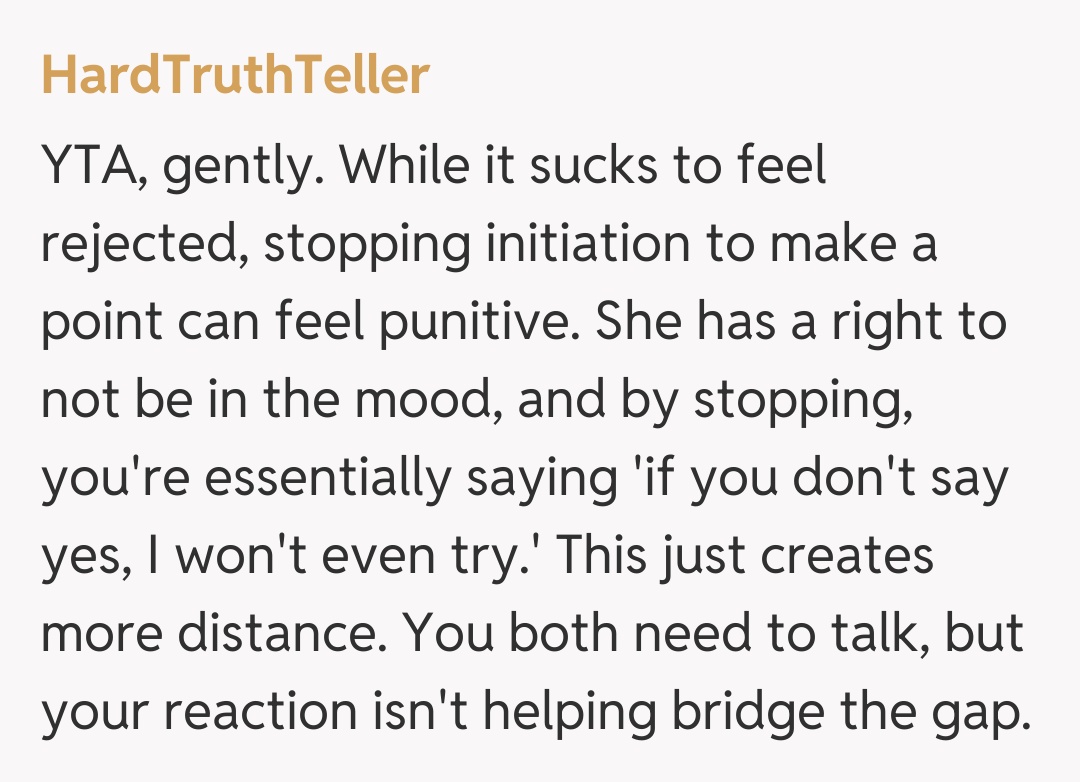
However, there were also voices supporting the girlfriend's right to say no without repercussions. Some argued that OP's decision to stop initiating *was* a form of punishment, regardless of intent, and that the girlfriend shouldn't be made to feel guilty for her own desires or lack thereof. The consensus pointed towards a fundamental communication breakdown, with many urging both partners to seek couples counseling to address the underlying issues.
This AITA story serves as a stark reminder that intimacy is a two-way street, built on desire, respect, and above all, honest communication. While consent is non-negotiable, the manner and frequency of declining intimacy can have profound effects on a partner's emotional health. This couple desperately needs to move beyond accusation and into a space of open dialogue, perhaps with professional guidance, to address the underlying issues. Otherwise, this rift in their intimate life could easily fracture their entire relationship, leaving both partners feeling isolated and misunderstood.