AITA for hoping my wife’s upcoming surgery fails because “a wheelchair would make her finally appreciate how trapped I feel”?
Oh, dear readers, we've got a doozy for you today. This one landed in our inbox with such a raw, shocking confession that we had to pick our jaws up off the floor. The title alone sends shivers down your spine, revealing a level of marital resentment that's truly unsettling. It's a stark reminder that beneath the surface of many relationships, there can be a brewing storm of unspoken pain and anger.
Today's Original Poster (OP) presents a scenario that forces us to confront the darkest corners of human thought. It's easy to immediately condemn, but the brilliance of AITA lies in unpacking the 'why' behind such extreme sentiments. Let's delve into the intricate tapestry of this couple's life, where chronic illness, caregiving, and profound emotional neglect seem to have woven a devastating narrative.

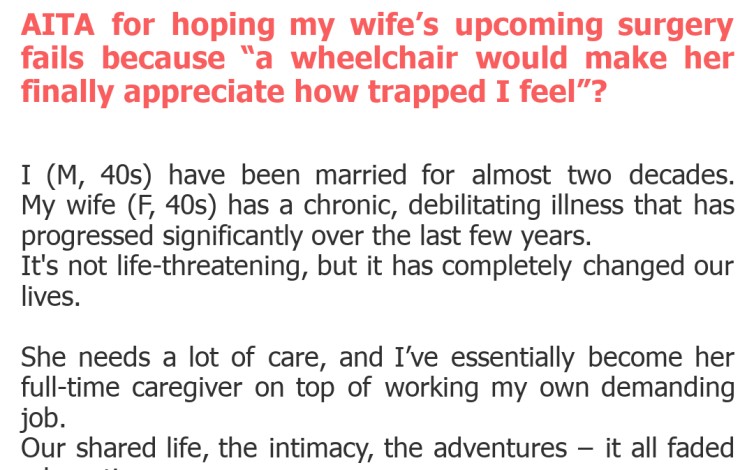
"AITA for hoping my wife’s upcoming surgery fails because “a wheelchair would make her finally appreciate how trapped I feel”?"
I (M, 40s) have been married for almost two decades. My wife (F, 40s) has a chronic, debilitating illness that has progressed significantly over the last few years. It's not life-threatening, but it has completely changed our lives. She needs a lot of care, and I’ve essentially become her full-time caregiver on top of working my own demanding job. Our shared life, the intimacy, the adventures – it all faded a long time ago. Now it's just appointments, managing her pain, and trying to keep everything afloat. I feel like a resentment factory. Every day is a struggle, and I often feel completely invisible and utterly trapped in a life I didn't sign up for anymore. She's scheduled for a major surgery soon. There's a chance it could significantly improve her mobility, but there's also a risk it could make things worse, potentially leading to her needing a wheelchair long-term. And this is where my dark thoughts come in. I've found myself, more than once, secretly hoping the surgery fails. Not because I want her to suffer, not really, but because I have this sick idea that if she were truly confined, truly dependent on a wheelchair, she might finally, truly understand how trapped I feel.
I know how awful this sounds. I really do. On one hand, I love her, and I don't want her to hurt. On the other, a part of me, a very dark, bitter part, craves for her to experience a fraction of the physical and emotional confinement that has become my daily existence. I’ve tried to talk to her about my burnout, about feeling lonely, about missing our old life, but she's so consumed by her own pain and medical issues that it always feels like I'm complaining or not being supportive. She just doesn't seem to grasp the toll it's taken on me.
I feel like I'm drowning, and these horrible thoughts are my twisted way of crying for help, or perhaps, a desperate attempt to find empathy where I feel there is none. I hate myself for thinking this way, but the thoughts persist. I fantasize about her being in a wheelchair and finally having to rely on me in a way that forces her to acknowledge my contributions, my sacrifices, and the incredible weight I carry. It's a sick, selfish desire. So, AITA for hoping my wife's surgery fails because a wheelchair would make her finally appreciate how trapped I feel?
Let's be unequivocally clear: wishing harm, or even hoping for a negative medical outcome, on a loved one is a deeply troubling thought. The immediate gut reaction to this OP's confession is likely one of shock and condemnation. These are not sentiments that stem from a place of love or healthy attachment. However, the AITA forum, and our platform, strives to unpack the complexities behind such extreme statements, not just to judge them at face value.
The OP's narrative paints a vivid picture of caregiver burnout, an incredibly difficult and often isolating experience. The loss of intimacy, the constant demands of care, and the erosion of a former life are immense burdens. It's understandable that someone in this position might feel invisible, unheard, and resentful. These feelings, while not excusing the dark thought, do provide context for the immense emotional pressure the OP is under.
Simultaneously, we must acknowledge the wife's perspective. Dealing with a chronic, debilitating illness is a profound struggle, often accompanied by constant pain, fear, and the grief of losing one's own capabilities. Her focus on her health and pain is not malicious; it's a natural response to her circumstances. She is likely fighting her own battles, and may truly be unable to perceive the OP's specific struggles amidst her own suffering.
What this story truly highlights is a profound breakdown in communication and mutual understanding within the marriage. The OP's twisted hope is a symptom of deep-seated resentment and a desperate, albeit destructive, plea to be seen and validated. This isn't about one person being 'the bad guy'; it's about a couple drowning in their individual struggles, unable to connect or find healthy ways to cope together. Professional intervention is desperately needed here.
The Verdict Is In: A Storm of Opinions on a Dark Confession!
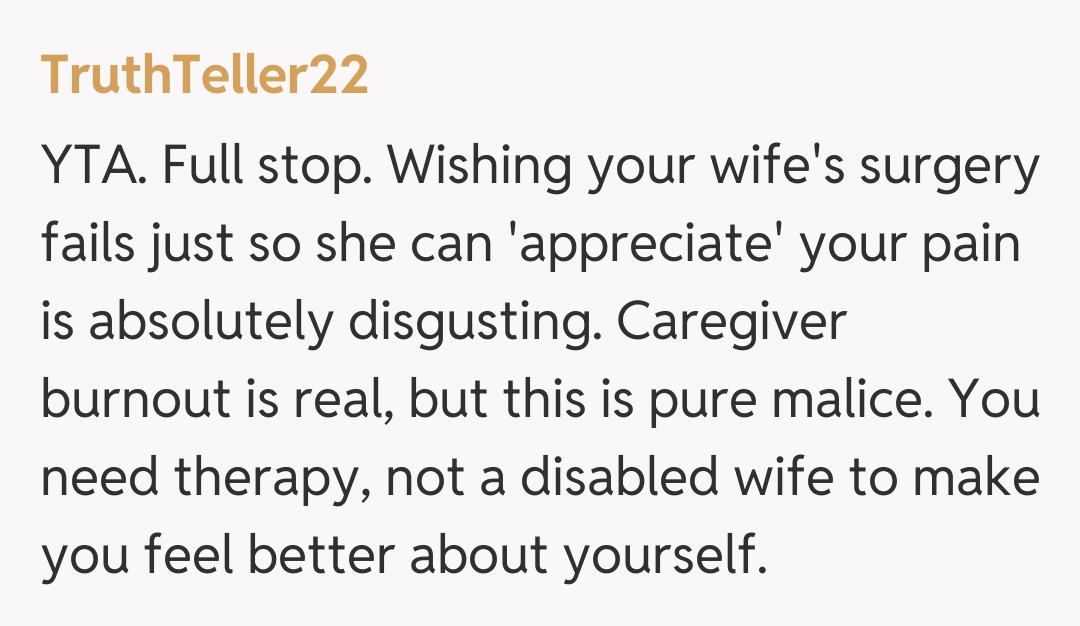
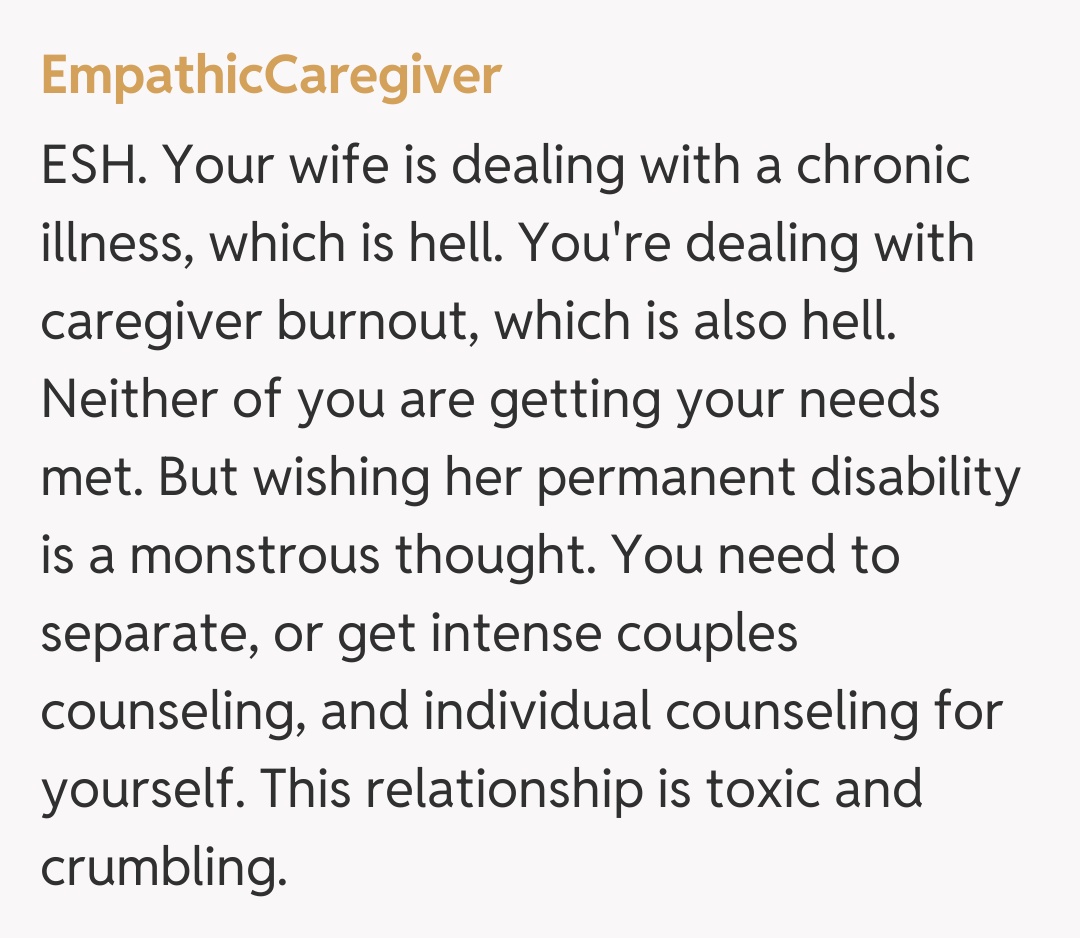
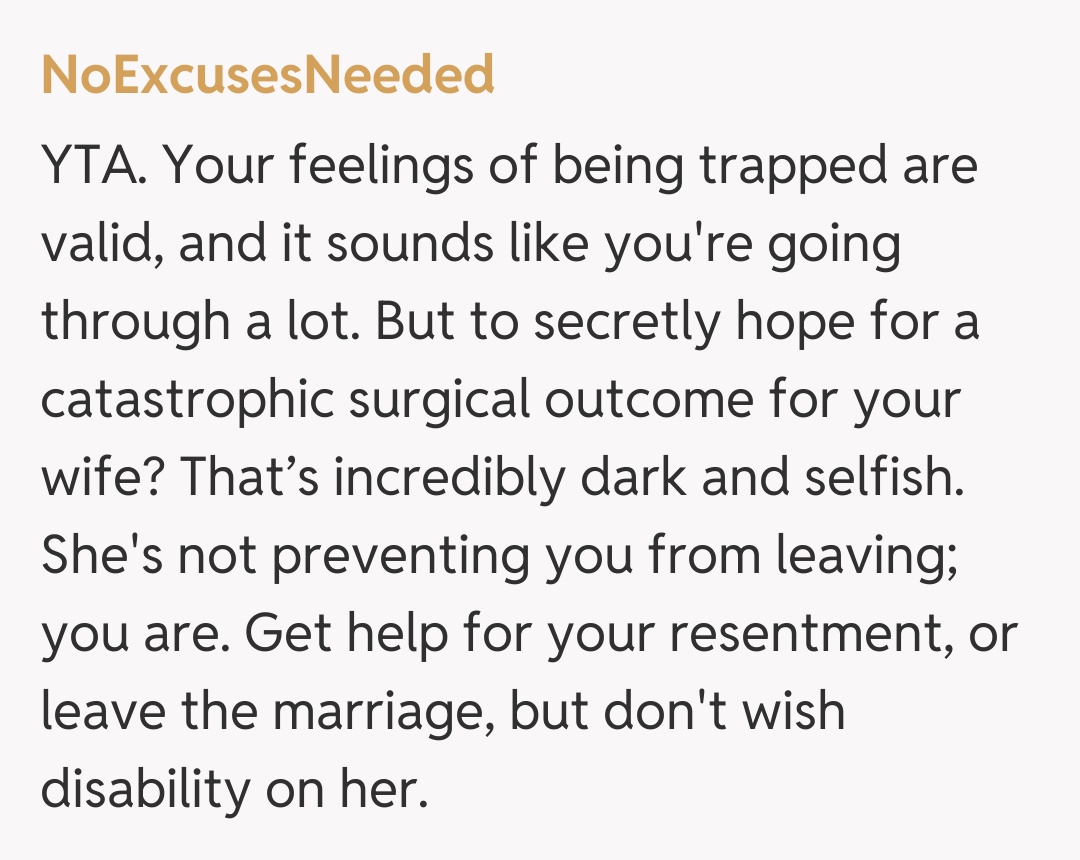
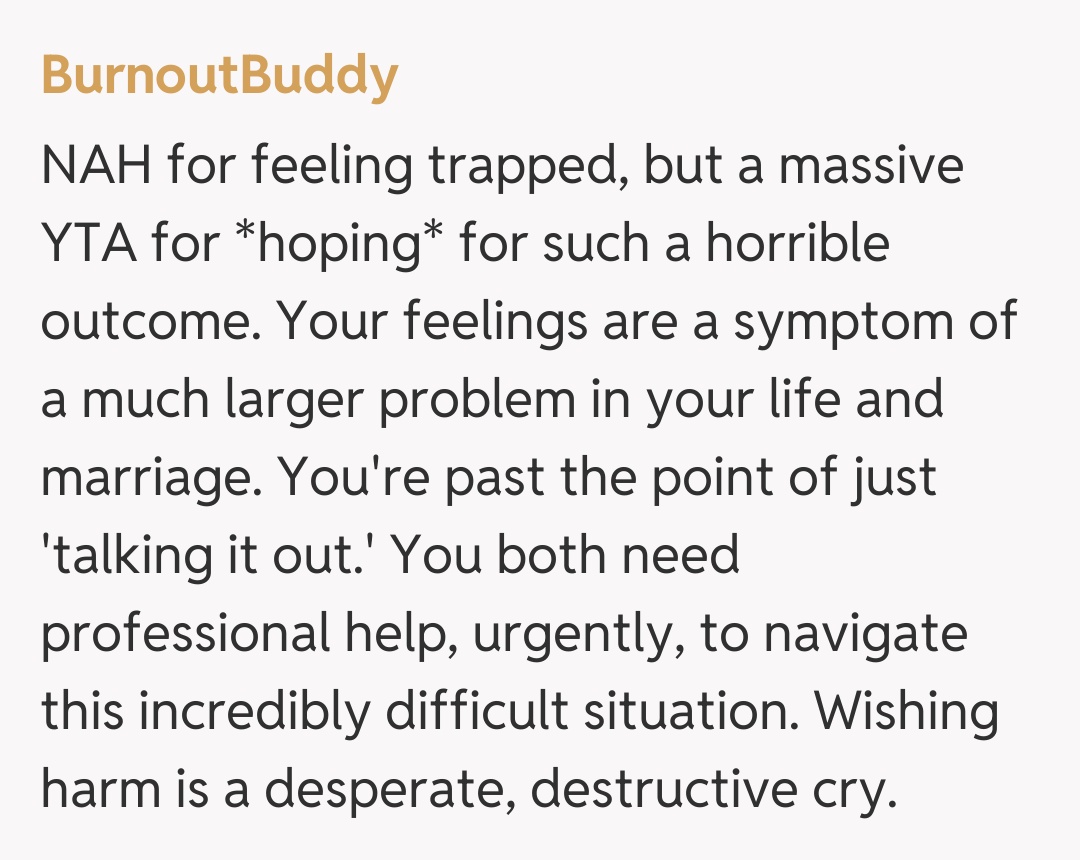
As expected, the comment section exploded with a powerful mix of reactions, leaning heavily towards 'YTA' for the OP's truly disturbing thought. Many users were quick to condemn the sheer malice of hoping for a medical failure. The consensus was that while caregiver burnout is real and valid, wishing harm on another person, especially a spouse, crosses a significant line into truly unacceptable territory.
However, amidst the strong condemnation, a thread of empathy emerged for the OP's overall situation. Many commenters acknowledged the immense difficulty of being a long-term caregiver, suggesting individual therapy for the OP to process his burnout and resentment, and couples therapy to address the profound disconnect in the marriage. The core message was: your feelings of being trapped are valid, but your dark hopes are not.
This heartbreaking story serves as a stark warning about the destructive power of unspoken resentment and caregiver burnout. While the OP's thoughts are undeniably disturbing, they are symptomatic of a marriage in profound crisis, where both individuals are suffering in isolation. It's a reminder that chronic illness impacts everyone in its orbit, and without adequate support and communication, even the strongest bonds can fray. The path forward for this couple, if one exists, must involve honest, difficult conversations and, most importantly, professional guidance to navigate the treacherous waters of their current reality.