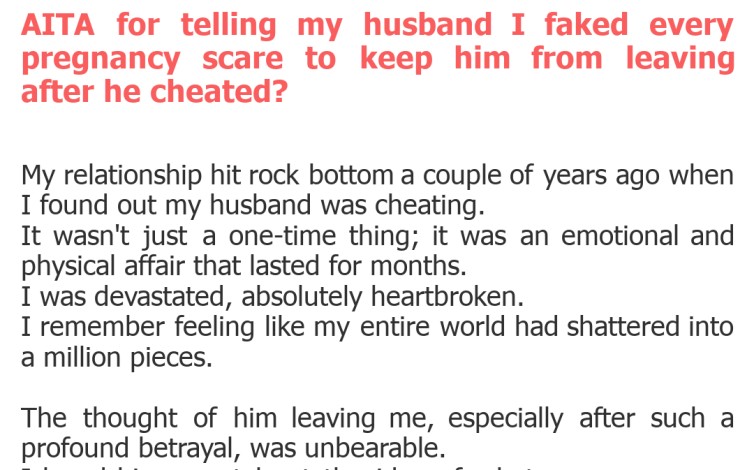
AITA for telling my husband I faked every pregnancy scare to keep him from leaving after he cheated?
Oh boy, do we have a doozy of a story today! Relationships are complex ecosystems, full of unspoken rules, emotional investments, and the occasional seismic event that shakes everything to its core. When trust is broken, especially through infidelity, people can react in ways they never imagined, sometimes leading to decisions driven by a primal fear of loss and abandonment. It's a dark path many have walked, but few have confessed to something quite like this.
Our original poster (OP) found themselves in such a predicament after discovering their spouse's profound betrayal. What followed was a series of increasingly desperate measures, an attempt to anchor a relationship that felt adrift and on the brink of collapse. The confession itself, laid bare, reveals a web of deceit born from deep hurt and a twisted desire to cling to what was. Let's dive into the messy, heartbreaking details and see if we can untangle this ethical dilemma.

"AITA for telling my husband I faked every pregnancy scare to keep him from leaving after he cheated?"
My relationship hit rock bottom a couple of years ago when I found out my husband was cheating. It wasn't just a one-time thing; it was an prolonged emotional and physical entanglement that lasted for months. I was devastated, absolutely heartbroken. I remember feeling like my entire world had shattered into a million pieces. The thought of him leaving me, especially after such a profound betrayal, was unbearable. I loved him, or at least the idea of what we once were, and I was terrified of facing a future without him. I confronted him, and he begged for forgiveness, promising it would never happen again. He said he would do anything to make it right, to prove his commitment to our relationship.
But a part of me always remained wary, constantly on edge, fearing he would stray again. The trust was shattered, and I felt like I was constantly walking on eggshells. One night, after a particularly bad argument where he seemed distant and I worried he was pulling away, I made a rash, desperate decision. I had a late period and he was stressed about it, so I saw an opening. I told him I thought I might be pregnant. The look on his face, the immediate shift in his demeanor, the way he seemed to recommit to us, was profound. A few days later, I 'confessed' it was a false alarm, a relief for both of us in different ways.
That first 'scare' worked so well. It brought him back, made him focus on our future, on us. It wasn't planned to be a pattern, but as time went on, whenever I felt him pulling away, whenever an argument lingered too long, or when he seemed too engrossed in work or friends, the fear would resurface. The fear of him leaving, of repeating the past. So, I did it again. And again. Over the past two years, I've faked three more pregnancy scares. Each time, it reignited his attentiveness, his desire to prove he was committed to our shared life.
I lived with this immense guilt, but also a twisted sense of control. It was a secret that ate away at me, yet I couldn't stop. Until last night. We were having an intense conversation about our future, about kids specifically, and the pressure just became too much. I broke down. I confessed everything. I told him that every single pregnancy scare, every late period I'd mentioned, every emotional rollercoaster we'd been through because of it, had been completely faked. I explained it was because I was so terrified of him leaving me after he cheated, that I felt I had to do something drastic to keep him. He just stared at me, his face turning from confusion to utter disbelief, then to raw hurt and anger. He called me manipulative, cruel, and said I was just as bad, if not worse, than he was. He walked out and hasn't returned my calls. AITA?
This story is a truly complex emotional entanglement, where both parties have contributed to a toxic dynamic. On one hand, the husband's initial act of infidelity was a profound breach of trust, a deeply hurtful action that caused immense pain and insecurity. His betrayal set the stage for the subsequent events, fundamentally altering the fabric of their relationship and planting seeds of fear and desperation in his partner.
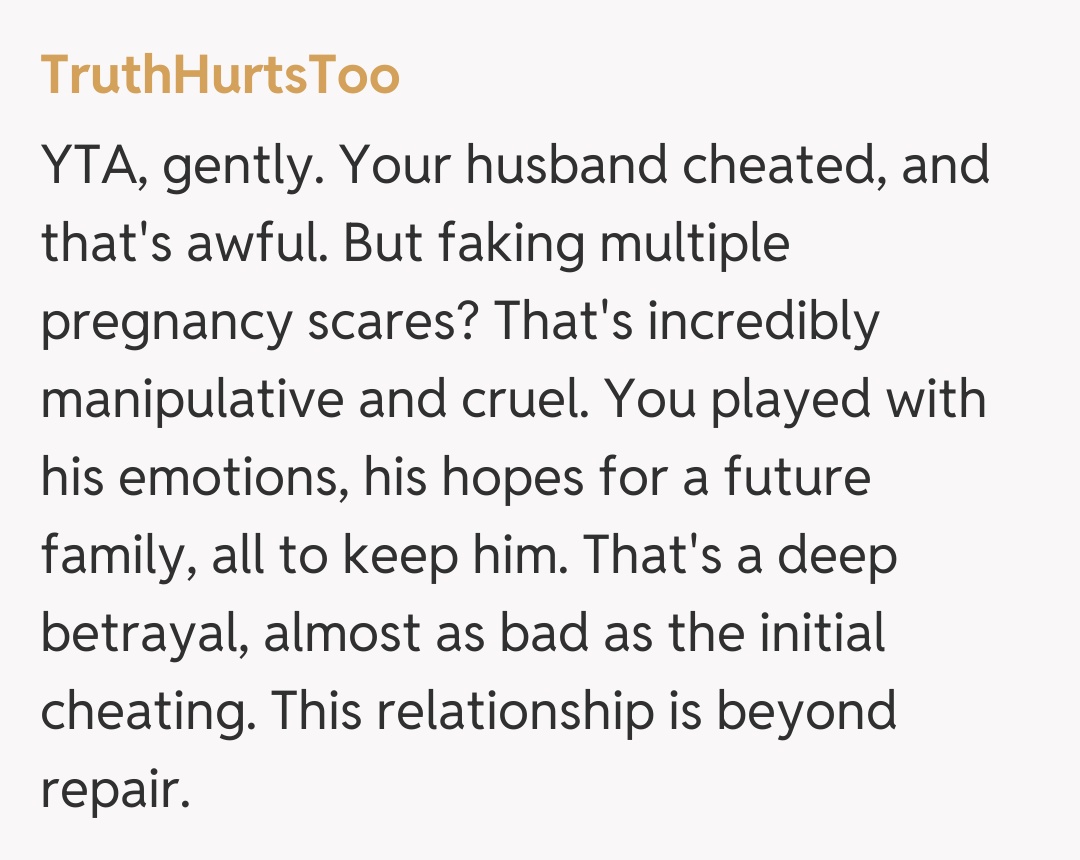
However, the protagonist's response, while born from immense pain, crosses a significant line. Faking a potential pregnancy, and then doing so repeatedly, is a manipulative act that exploits deep-seated emotions and hopes. It's a cruel form of deception, playing on the husband's feelings and potential desire for a family to exert control and prevent abandonment. This behavior undermines any remaining trust and creates an environment of profound dishonesty.
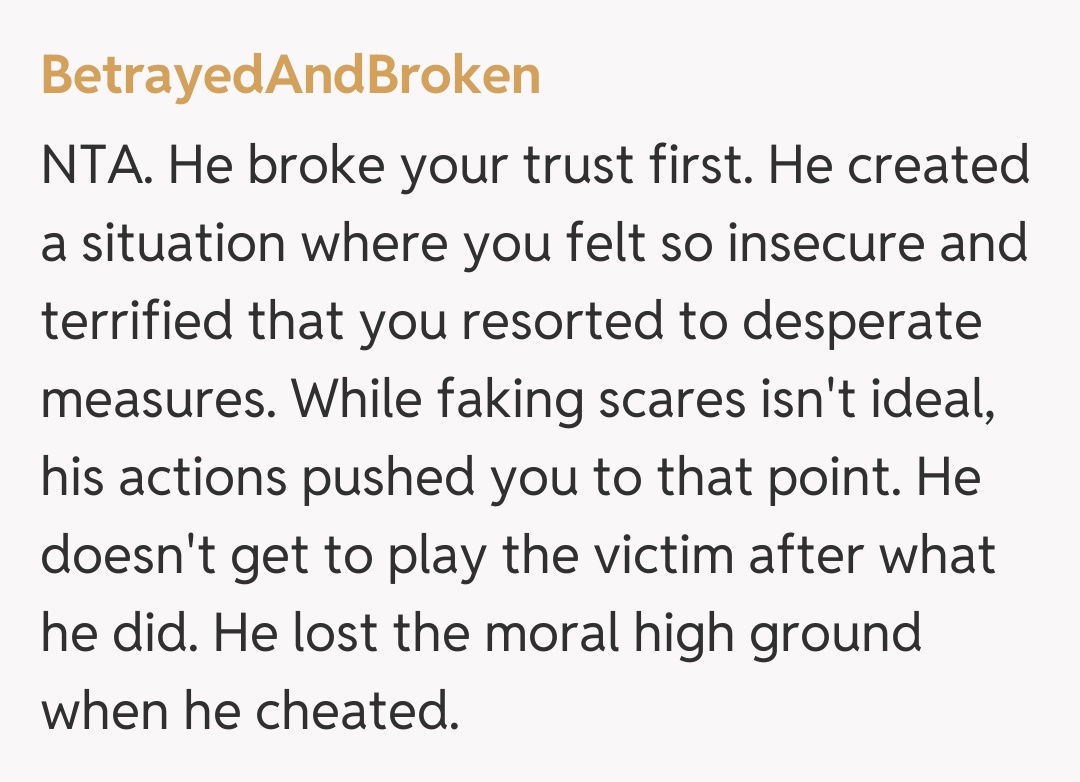
One could argue that the husband's actions initially destroyed the foundation of trust, leading the protagonist to resort to extreme measures. The fear of abandonment and the desperation to hold onto the relationship, however misguided, are understandable emotional responses to deep hurt. However, understanding the motivation does not absolve the protagonist of responsibility for their own deceptive actions, which inflict a new layer of pain and betrayal.
Ultimately, this situation highlights a relationship that has been poisoned by betrayal and dishonesty on multiple fronts. Both individuals have inflicted significant emotional damage. Forgiveness, trust, and genuine reconciliation seem incredibly difficult to achieve when the foundation has been so thoroughly eroded by a cycle of deceit, originating from one partner's infidelity and spiraling into the other's manipulative counter-measures.
The internet weighs in: Can a relationship recover from this double betrayal?
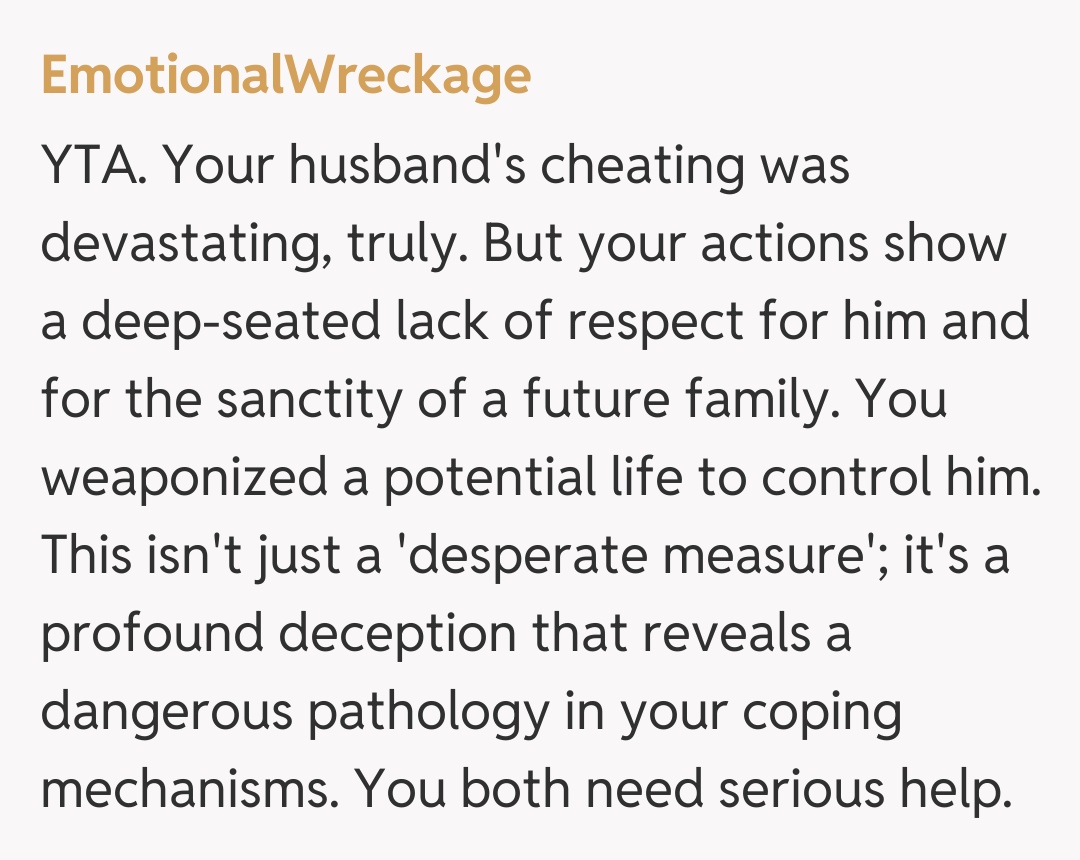
The comments section on this one is absolutely ablaze, as expected! Many users are quick to point out that while the husband's cheating was inexcusable, the protagonist's actions are equally, if not more, damaging. The consensus seems to be that two wrongs don't make a right, and using something as profound as a potential pregnancy for manipulation is a severe breach of ethical conduct. The discussion often circles back to the idea that both individuals have contributed to a deeply unhealthy relationship dynamic.
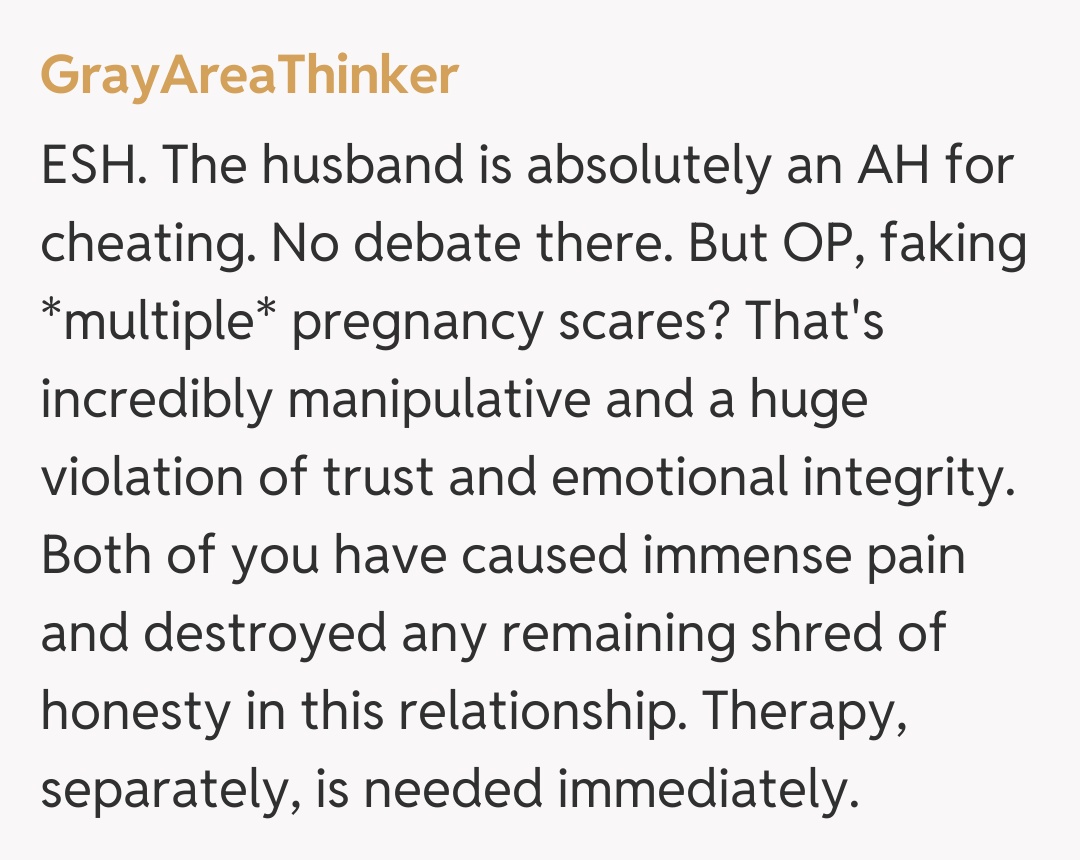
There's a significant contingent arguing for 'ESH' (Everyone Sucks Here), emphasizing that while the initial infidelity caused immense pain, the protagonist's sustained deception created an entirely new, destructive layer of betrayal. Users also highlight the psychological toll this must have taken on both parties, demonstrating how a lack of healthy communication and coping mechanisms can lead to a toxic spiral. The future of this relationship, as many commenters suggest, seems incredibly uncertain.
This heartbreaking story serves as a stark reminder of the devastating ripple effects of betrayal in a relationship. While the initial infidelity undoubtedly caused immense pain and fear for the protagonist, their subsequent actions, however driven by desperation, introduced a new and deeply harmful layer of deceit. It's a tragic example of how a cycle of mistrust can spiral, leaving both parties deeply wounded. Ultimately, this situation underscores the critical need for open communication, professional help, and genuine accountability from both sides when trust is shattered. Recovery, if even possible, would require monumental effort from everyone involved.