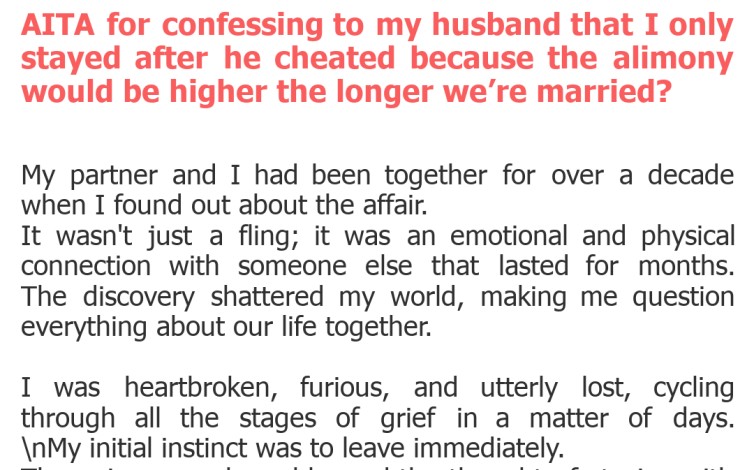
AITA for confessing to my husband that I only stayed after he cheated because the alimony would be higher the longer we’re married?
Oh, relationship dilemmas! We've all been there, standing at a crossroads wondering which path to take after a devastating event. Infidelity, in particular, throws a wrench into even the most stable partnerships, forcing individuals to confront harsh realities and make incredibly difficult decisions about their future. It's never as simple as 'stay or go,' especially when shared lives and resources are involved. \nToday's AITA story brings a truly unique and morally complex situation to the forefront. It challenges our notions of forgiveness, pragmatism, and what constitutes a justifiable action in the face of betrayal. Get ready to dive into a tale that will undoubtedly spark a fierce debate, as the lines between right and wrong blur considerably.

"AITA for confessing to my husband that I only stayed after he cheated because the alimony would be higher the longer we’re married?"
My partner and I had been together for over a decade when I found out about the affair. It wasn't just a fling; it was an emotional and physical connection with someone else that lasted for months. The discovery shattered my world, making me question everything about our life together. I was heartbroken, furious, and utterly lost, cycling through all the stages of grief in a matter of days. \nMy initial instinct was to leave immediately. The pain was unbearable, and the thought of staying with someone who could do that felt impossible. However, as the dust started to settle a tiny bit, a very pragmatic, albeit cold, thought began to form in my mind. We had been married for eight years at that point. I knew that in our jurisdiction, alimony calculations are heavily weighted by the length of the marriage. A significant threshold for higher payments kicks in at the ten-year mark, and another even more substantial one at fifteen. I started doing some quiet research, calculating potential outcomes. The difference was staggering. The idea, once a fleeting dark whisper, solidified into a plan. I decided to stay, to outwardly try to 'work through things,' knowing full well that my true motivation was financial security down the line. We spent another six years together, and I truly did my best to be a functional partner, even though a part of me always resented him. We went to couples counseling, and I put on a brave face, convincing myself and, more importantly, him, that I was working towards forgiveness. The truth was, I was just biding my time, waiting for the marriage to mature enough to secure a more favorable financial future for myself. \nLast week, after fourteen years of marriage, he told me he was finally ready to buy that dream house we'd always talked about, and he wanted to renew our vows as a symbol of our renewed commitment. Something inside me snapped. The weight of the lie, the years of pretense, and the thought of committing to even more years under false pretenses became too much to bear. I looked at him, genuinely happy and hopeful, and the words just spilled out. I confessed everything: that I never truly forgave him, that I stayed purely for the increased alimony I would receive after a longer marriage, and that I was planning to leave him soon anyway, after we hit the fifteen-year mark. \nThe look on his face was devastating. He went from joyous to utterly broken in an instant. He called me cold, calculating, and manipulative, saying I had exploited his guilt and pain for my own gain. He feels like I've betrayed him even worse than he betrayed me because I did it deliberately and over such a long period. Now, I'm left wondering if he's right. Am I the a**hole for playing the long game for financial security after his infidelity?
This story opens a veritable Pandora's Box of ethical dilemmas. On one hand, we have the initial wound of infidelity, a profound betrayal that rips apart the trust in a relationship. The partner who cheated undeniably caused immense pain and fundamentally broke the marital contract. It's a natural human response to feel a desire for self-preservation and perhaps even a sense of justice or recompense after such a devastating blow.\nHowever, the strategy employed here introduces a layer of calculated deception that is deeply unsettling. To consciously decide to remain in a marriage, feigning an attempt at reconciliation, all while harboring a secret, financially-motivated agenda, crosses into a different realm of betrayal. It essentially turns the marriage into a transactional arrangement, using the other person's guilt and desire for repair against them.\nThe husband, having committed the initial wrong, now finds himself in a position of being doubly betrayed. His attempts at making amends, his hope for a renewed future, were built on a foundation of sand. The confession doesn't just end the marriage; it recontextualizes years of their shared life, turning genuine efforts into perceived manipulation. This second betrayal hits different, as it was a long-term, conscious act.\nUltimately, this is a tale with no clear heroes or villains, only individuals navigating deeply flawed situations. While the initial infidelity was wrong, the prolonged, calculated deception for financial gain also raises serious questions about integrity and emotional cruelty. It's a classic example of how two wrongs don't make a right, and how the pursuit of 'justice' can sometimes lead to further emotional damage.
The Verdict is In: Money, Betrayal, and the Long Game!
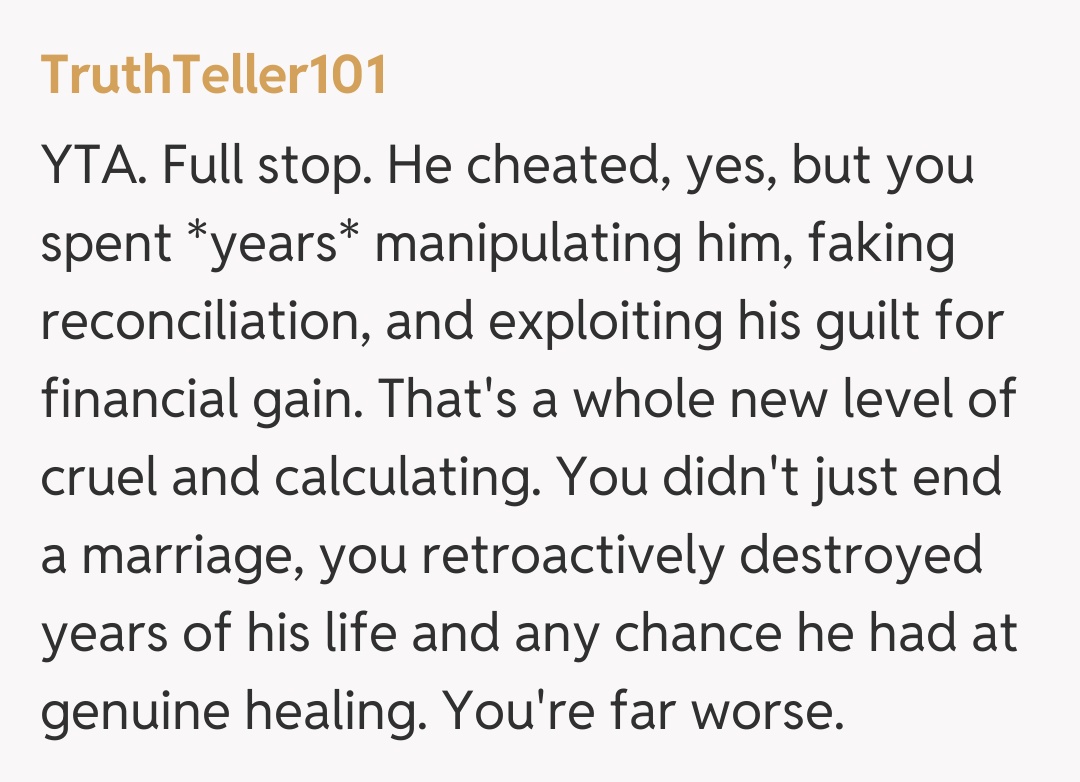
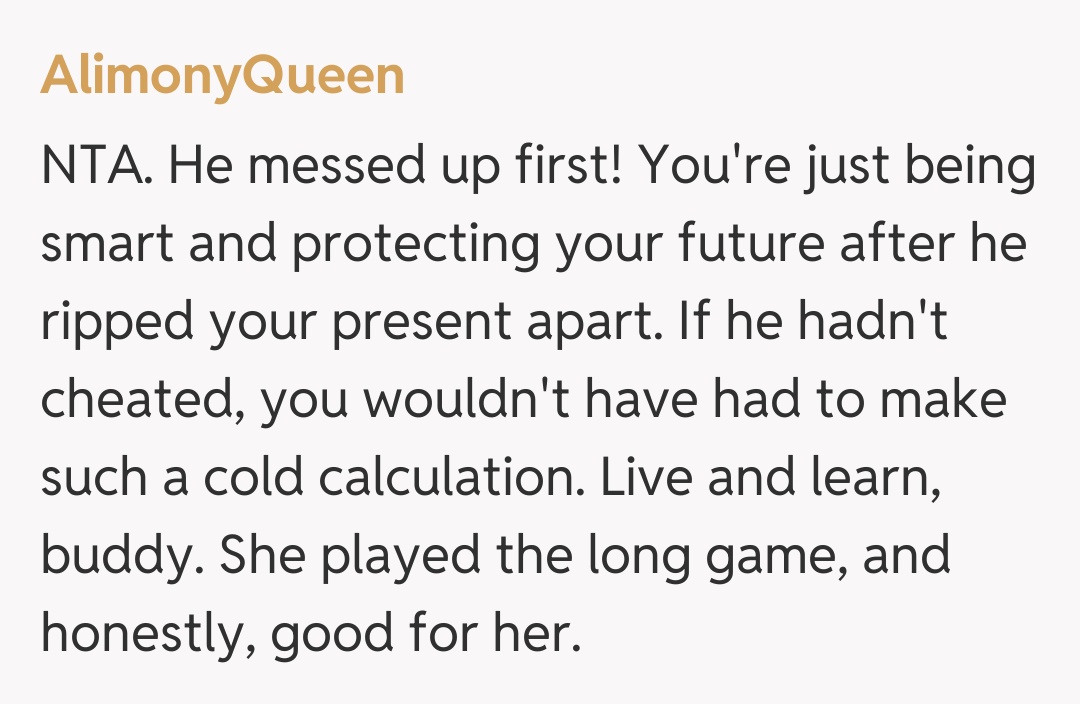
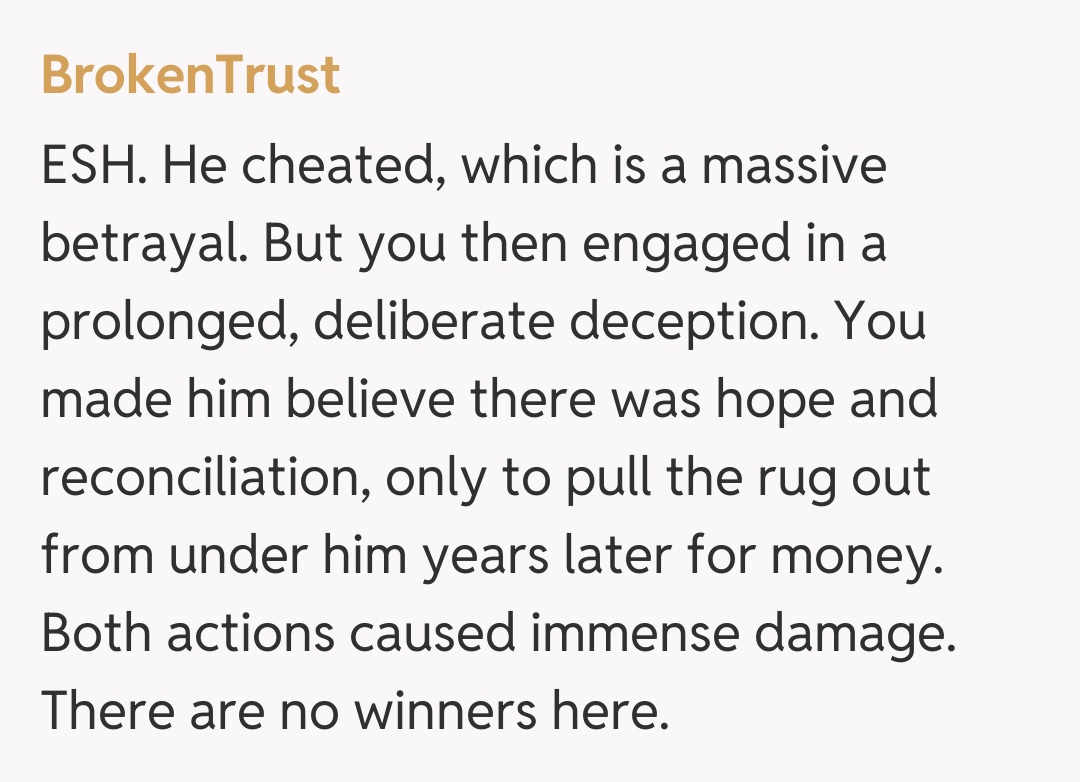
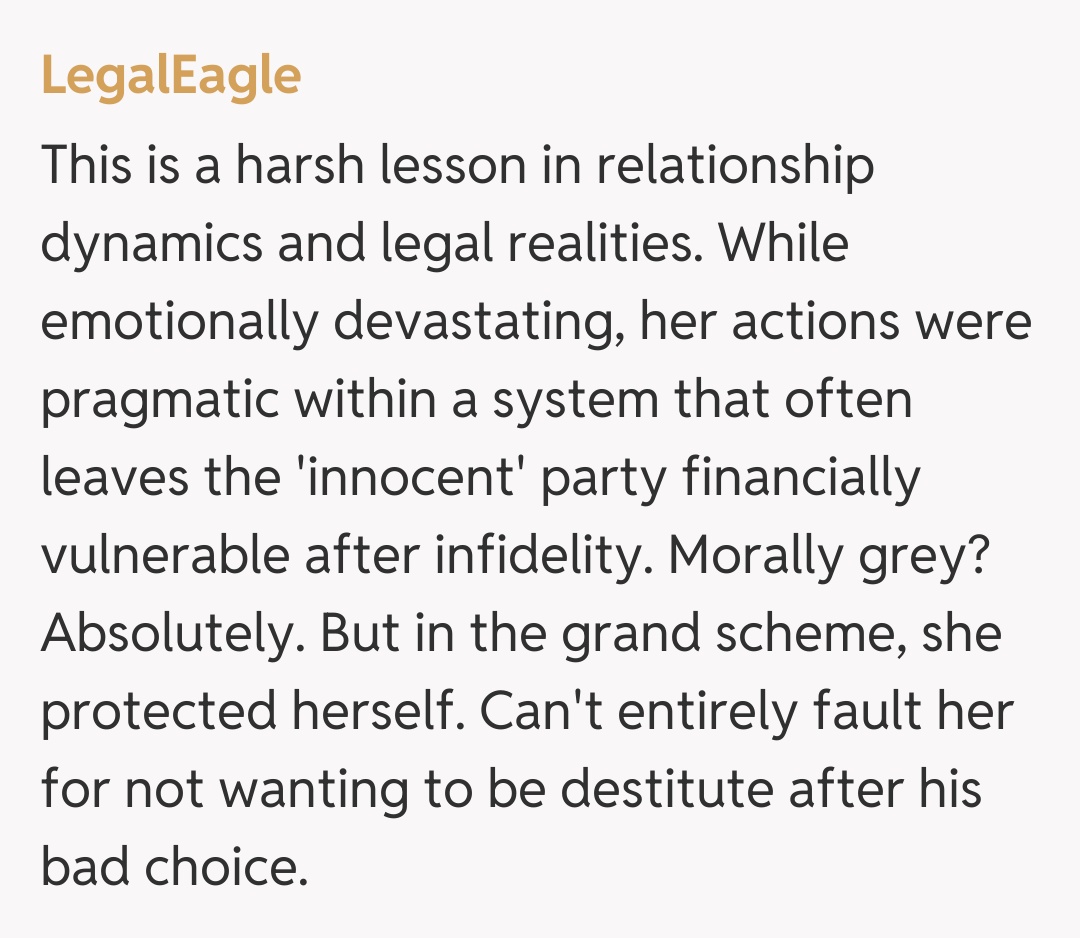
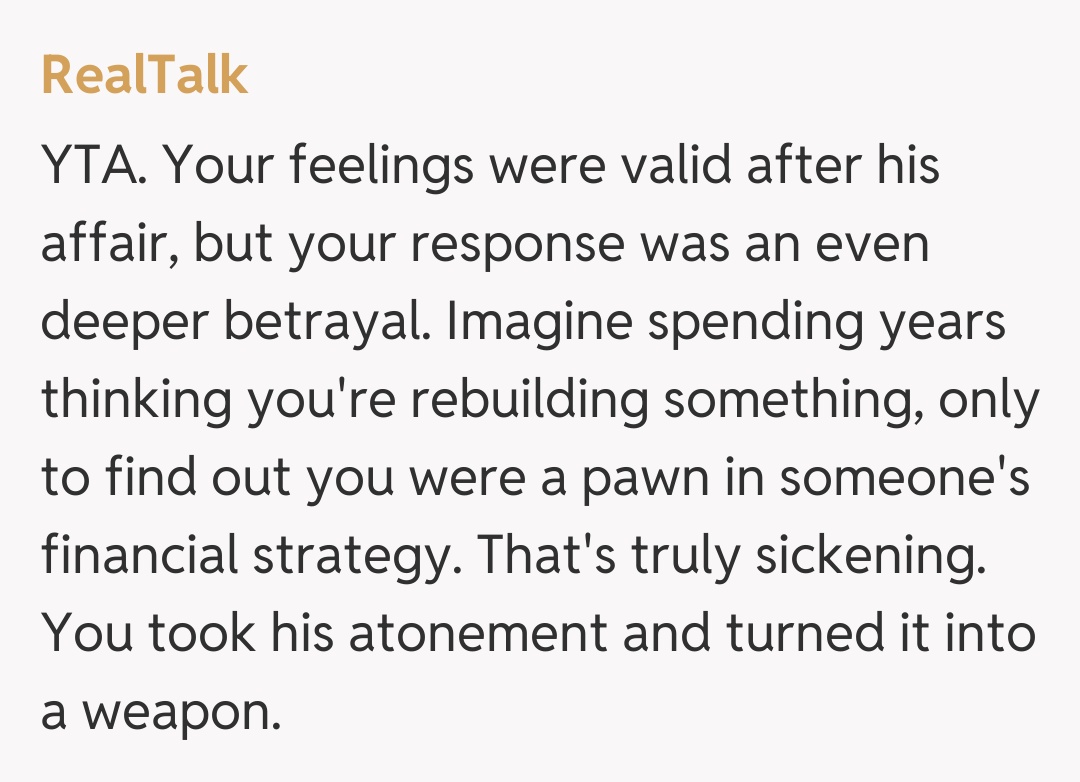
The comments section on this one was, as expected, a firestorm! Many readers immediately jumped to the defense of the wife, arguing that the husband's initial infidelity absolved her of any guilt. They emphasized that he broke the trust first, and her actions were merely a form of self-preservation, ensuring her financial stability after his devastating choice. Some even praised her for being 'smart' and 'strategic' in a difficult situation. \nOn the other side, a significant portion of the audience vehemently condemned her actions, labeling them as cold, manipulative, and ultimately a more profound betrayal than the initial cheating. They argued that stringing someone along for years, feigning forgiveness, and exploiting their guilt is emotionally abusive. The consensus seemed to lean slightly towards 'Everyone Sucks Here' (ESH), acknowledging the deep flaws in both parties' conduct.
This AITA story is a stark reminder that relationships are incredibly complex, and human motivations can be deeply intertwined with self-interest, especially after a profound betrayal. While the initial act of infidelity caused undeniable harm, the ensuing years of calculated deception for financial gain present a challenging moral landscape. There’s no easy answer, as both parties contributed to the ultimate breakdown and emotional fallout. It forces us to confront uncomfortable questions about forgiveness, revenge, and the boundaries of justifiable actions in pursuit of personal security. A truly captivating and thought-provoking dilemma!