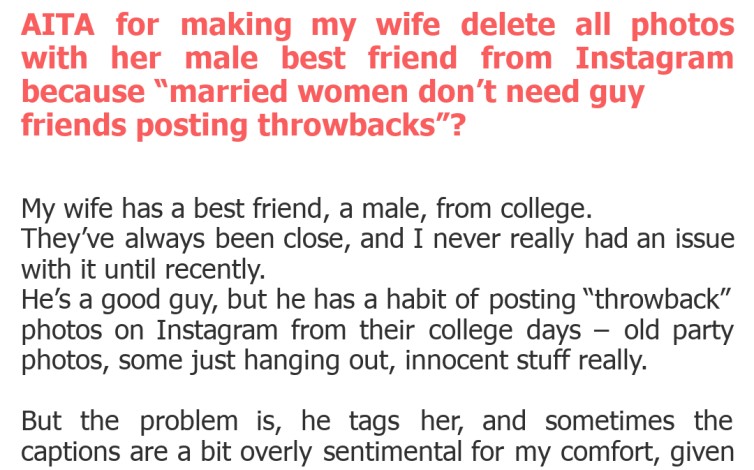
AITA for making my wife delete all photos with her male best friend from Instagram because “married women don’t need guy friends posting throwbacks”?
Oh boy, do we have a doozy for you today! This story dives deep into the tricky waters of social media, past friendships, and marital boundaries. In an age where digital footprints are permanent and accessible, how do couples navigate the comfort of shared memories with the potential discomfort they might cause a current partner? It's a modern dilemma many can relate to.
This particular post sparks a fiery debate about trust, control, and what's considered appropriate behavior once you tie the knot. Our submitter took a firm stance on his wife's Instagram, leading to a significant conflict. Was his demand reasonable, born from insecurity, or a completely over-the-line act of control? Let's unpack this thorny situation together.

"AITA for making my wife delete all photos with her male best friend from Instagram because “married women don’t need guy friends posting throwbacks”?"
My wife has a best friend, a male, from college. They’ve always been close, and I never really had an issue with it until recently. He’s a good guy, but he has a habit of posting “throwback” photos on Instagram from their college days – old party photos, some just hanging out, innocent stuff really. But the problem is, he tags her, and sometimes the captions are a bit overly sentimental for my comfort, given she’s a married woman.
I’ve mentioned it to her before, casually, that I find it a bit odd, but she always brushed it off, saying it’s just how he is, and there’s nothing to it. I tried to ignore it, but it started bothering me more and more. Especially when people who don't know the full context started asking me about it, making me feel uneasy. I felt like it was disrespectful to our marriage.
So, last week, he posted another one – a picture of them at a concert, really close, looking very chummy. I saw it and felt a pang of annoyance. That night, I finally sat my wife down and told her how I really felt. I explained that while I trust her, I don't appreciate her male friend posting these intimate-looking throwbacks on public social media. I told her that in my opinion, married women don’t need guy friends posting throwbacks like that, and I asked her to delete all photos of them together from her own Instagram profile, and to ask him to stop tagging her in new ones. She was shocked, then got really upset. She said I was being controlling and insecure, and that these are just old, innocent memories. I stood my ground, explaining that it makes me uncomfortable and if she respects our marriage, she would understand. I believe it's a reasonable request for a healthy relationship.
She eventually, begrudgingly, went through her Instagram and deleted everything. She also messaged him, though I don’t know what she said. But she hasn't been herself since. She’s quiet, withdrawn, and frankly, a bit cold towards me. She thinks I’m the bad guy here, but I just wanted to establish a boundary that makes me feel secure in our marriage. Am I the a**hole for asking her to do this?
This situation highlights a common friction point in modern relationships: the intersection of past friendships, social media, and spousal comfort. While it's understandable for a partner to feel a pang of jealousy or discomfort when seeing old, seemingly intimate photos of their spouse with someone else, the way this discomfort is addressed is crucial. Feelings are valid, but actions can cross lines, impacting trust and autonomy.
From the perspective of the original poster (OP), his feelings of unease stemmed from public perceptions and the 'overly sentimental' captions. He articulated his discomfort, which is a good first step in communication. However, the blanket statement that 'married women don’t need guy friends posting throwbacks' and the subsequent demand for deletion veers into problematic territory, implying a restriction on his wife's past and friendships.
The wife's reaction of feeling 'shocked' and 'upset' suggests that she perceives this as an attack on her autonomy and the innocence of her past relationships. These weren't new photos but historical snapshots. Forcing her to erase these memories from her public profile, even if they were just on *her* feed, could feel like an attempt to rewrite her history or dictate her friendships, which can be very damaging to a marital bond.
Ultimately, while the OP's feelings of discomfort are valid and deserve to be heard, the solution he chose—a demand for deletion—appears to be more about control than genuine compromise or building trust. A healthier approach might involve a deeper conversation about insecurities, discussing boundaries with the friend directly if his actions are truly inappropriate, or finding a way for the couple to address these feelings together, rather than through a unilateral dictate.
The internet weighs in: Is this a boundary or a red flag?
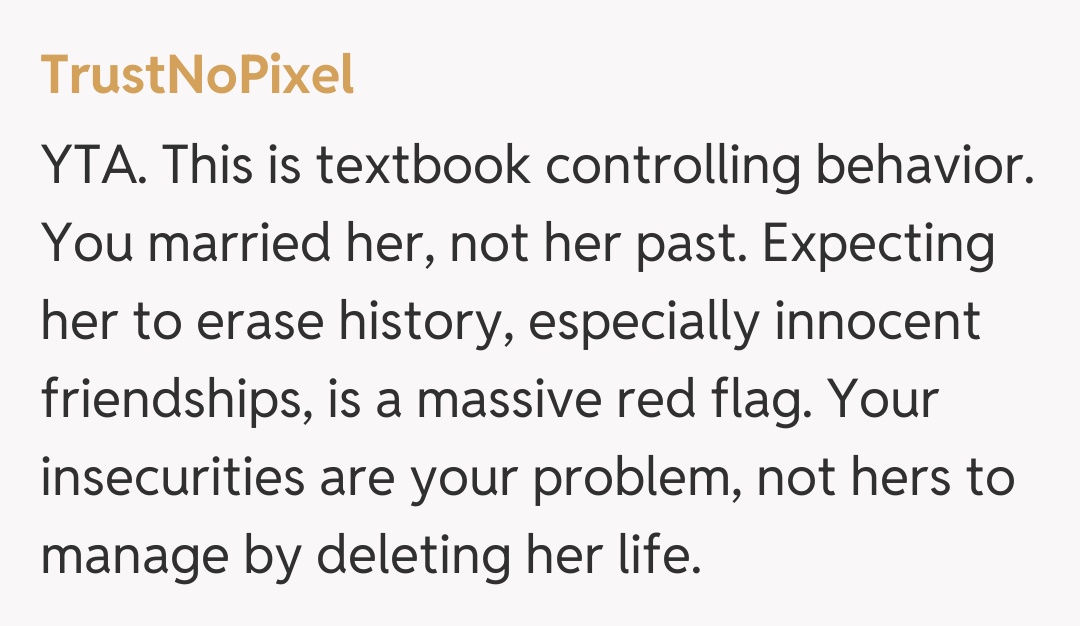
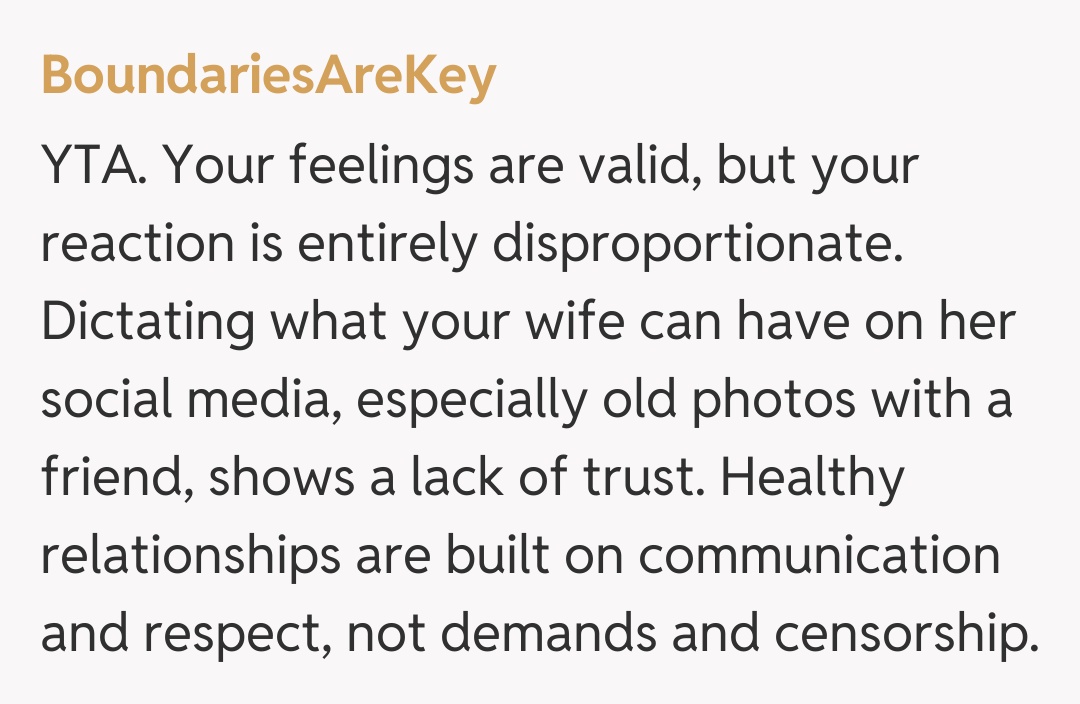
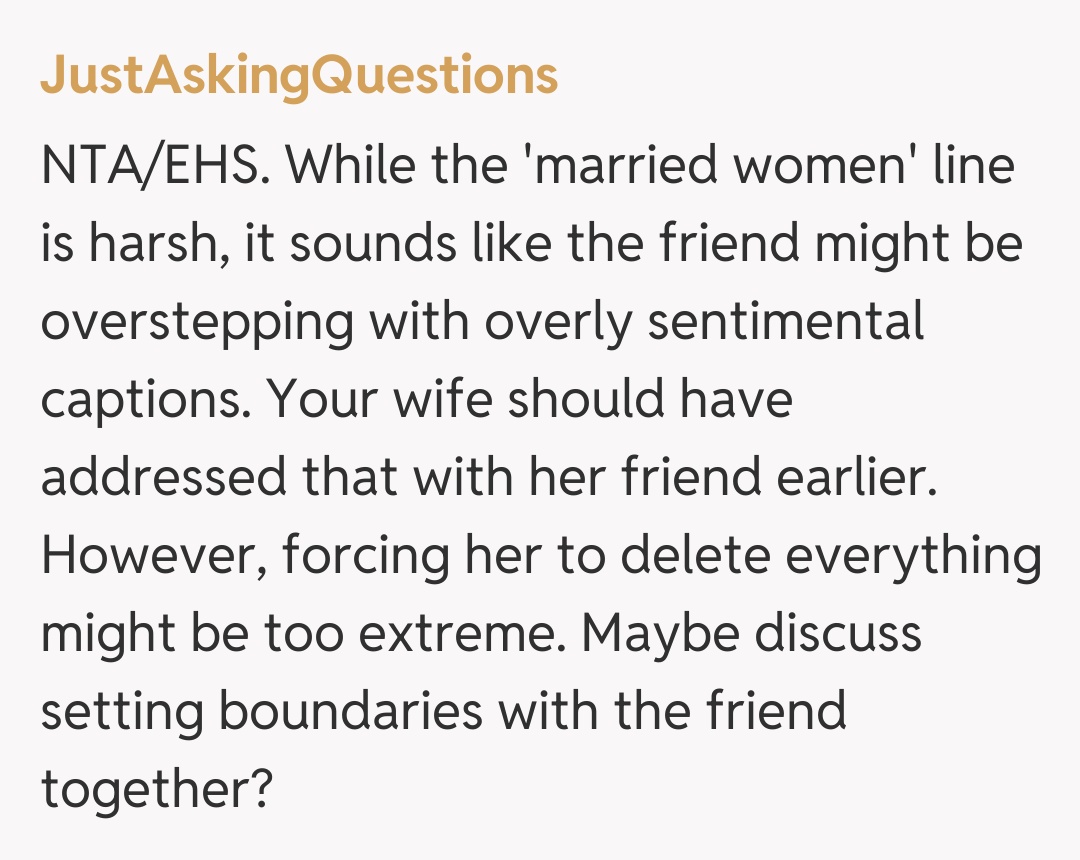
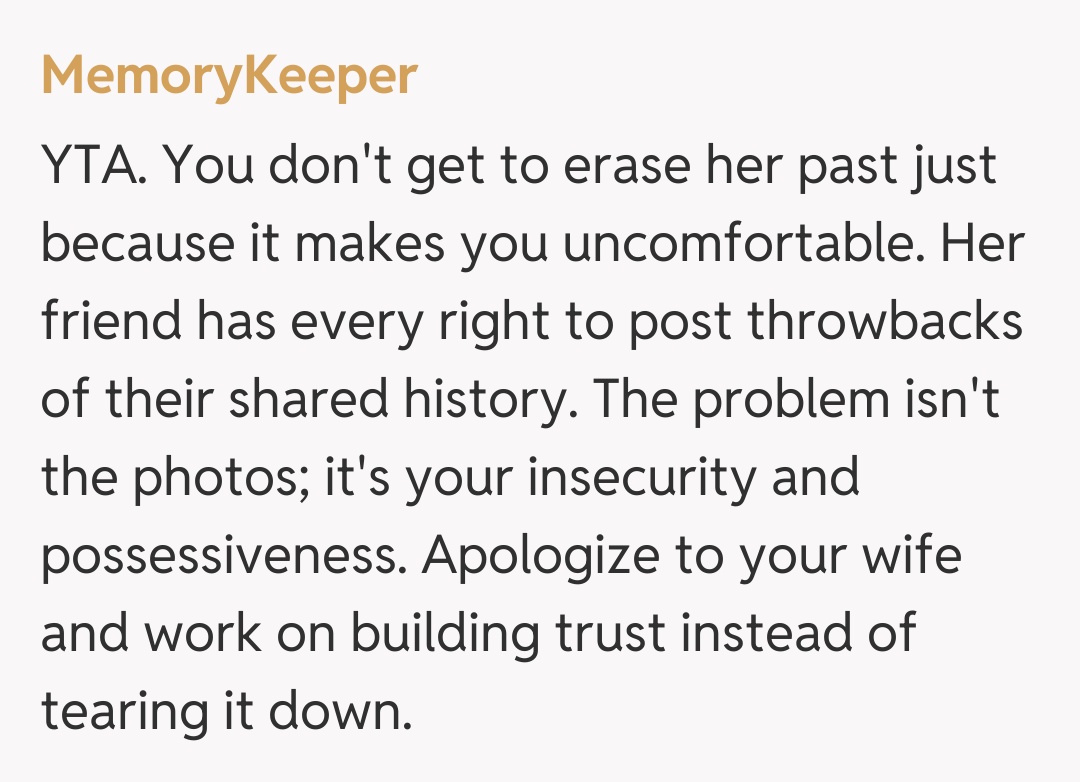
The comments section for this post was, as expected, a whirlwind! The overwhelming sentiment leaned heavily towards 'You're The A**hole,' with many users calling out the original poster's behavior as controlling and insecure. Many pointed out that deleting old photos doesn't erase memories or feelings, and that true security in a marriage comes from trust, not censorship. It seems the internet collectively agrees this approach was misguided.
A significant number of comments also focused on the 'married women don’t need guy friends' phrasing, labeling it as archaic and chauvinistic. Users emphasized that friendships, regardless of gender, are valuable and should not be dictated by a spouse. Some did offer a sliver of understanding for his discomfort, suggesting a conversation with the friend directly might have been more appropriate, but still criticized the handling of the situation with his wife.
This AITA post serves as a stark reminder that true partnership means respecting each other's past, present, and friendships. While insecurities can arise, demanding your partner erase parts of their history often backfires, eroding trust rather than strengthening it. Open, honest communication about feelings, without resorting to ultimatums or control, is paramount. Ultimately, healthy boundaries are negotiated with respect, not enforced with fear. Let's strive for understanding and empathy in our relationships, both online and off.