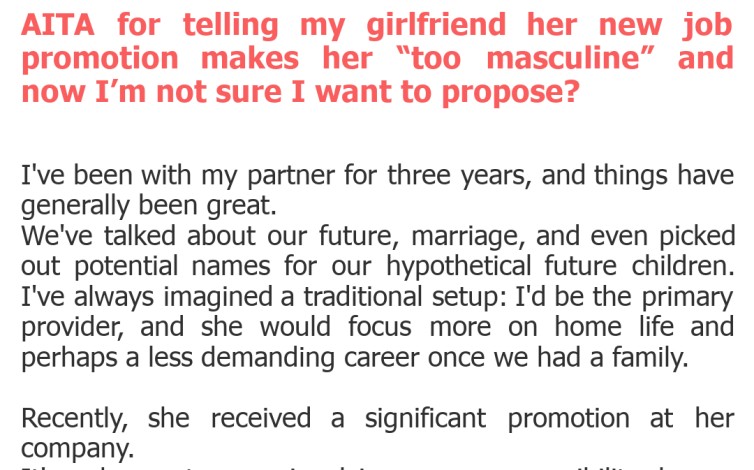
AITA for telling my girlfriend her new job promotion makes her “too masculine” and now I’m not sure I want to propose?
Welcome back, relationship navigators! Today, we're diving headfirst into a post that's already sparking a firestorm across the internet. It involves a couple at a critical juncture: one partner's career success clashing dramatically with the other's preconceived notions of gender roles and relationship dynamics. This isn't just about a job; it's about fundamental values.
Our poster is grappling with the idea of proposing after making a comment that has understandably caused a massive rift. The core issue revolves around a girlfriend's recent promotion and the boyfriend's controversial reaction, specifically his labeling her newfound professional power as 'too masculine.' Buckle up, folks, because this one is a bumpy ride.

"AITA for telling my girlfriend her new job promotion makes her “too masculine” and now I’m not sure I want to propose?"
I've been with my partner for three years, and things have generally been great. We've talked about our future, marriage, and even picked out potential names for our hypothetical future children. I've always imagined a traditional setup: I'd be the primary provider, and she would focus more on home life and perhaps a less demanding career once we had a family. I grew up with a very clear picture of what a partnership should look like, with distinct roles.
Recently, she received a significant promotion at her company. It's a huge step up, involving more responsibility, longer hours, and a substantial pay increase. Initially, I tried to be supportive, but honestly, a part of me felt uneasy. She was ecstatic, of course, and started talking about all her new projects and leadership roles. The way she carried herself changed; she seemed more assertive, more dominant in conversations, and frankly, a bit different from the person I thought I knew.
One evening, after she spent an hour detailing a complex work strategy, I blurted out that her new role was making her 'too masculine' and I wasn't sure I liked this new version of her. The look on her face… it was pure shock and hurt. She went silent, then asked if I was serious. I tried to explain that I just missed her old self, the one who wasn't so career-focused, but the words just came out wrong. I meant that I felt like she was becoming less nurturing, less focused on us, and more on her ambition.
She got incredibly upset, saying I was undermining her achievements and implying that success for a woman means losing her femininity. She asked if my love was conditional on her staying in a specific, less ambitious role. I fumbled for words, denying it, but deep down, I do worry about how this new trajectory impacts my vision of our future together, especially with kids.
Now, she's barely speaking to me, and I'm genuinely questioning everything. I had plans to propose soon, but this makes me wonder if we're truly compatible. Am I the a**hole for expressing my genuine feelings about her changing demeanor and questioning our future given her new, demanding career path? I feel like I'm just being honest about my preferences, but she's made me feel like I'm a monster.
This story touches on deeply ingrained societal expectations regarding gender roles and relationships. The original poster's comment about his partner becoming 'too masculine' is problematic because it implies a woman's professional success or assertiveness is somehow unfeminine or undesirable. It unfairly links traditionally masculine traits to competence, while simultaneously devaluing ambitious women.
The partner's reaction is entirely understandable. Being told that your hard-earned professional achievement makes you less attractive or desirable to your partner is incredibly hurtful and undermines years of effort. Her question about conditional love cuts to the heart of the matter, suggesting a lack of acceptance for who she is becoming, rather than who she was.
The original poster's feelings, while perhaps rooted in his upbringing and expectations for a traditional family structure, need critical examination. It's one thing to have preferences for a certain lifestyle, but it's another to project those onto a partner in a way that stifles their growth or denigrates their achievements. Compatibility isn't just about shared dreams, but shared values.
Ultimately, this is a moment of truth for the couple. They need to have an open, honest, and possibly difficult conversation about their individual aspirations, their collective future, and whether their visions align. If the poster cannot genuinely support his partner's ambition without resentment, the relationship may struggle to thrive.
The internet weighs in: Is ambition a dealbreaker for love?
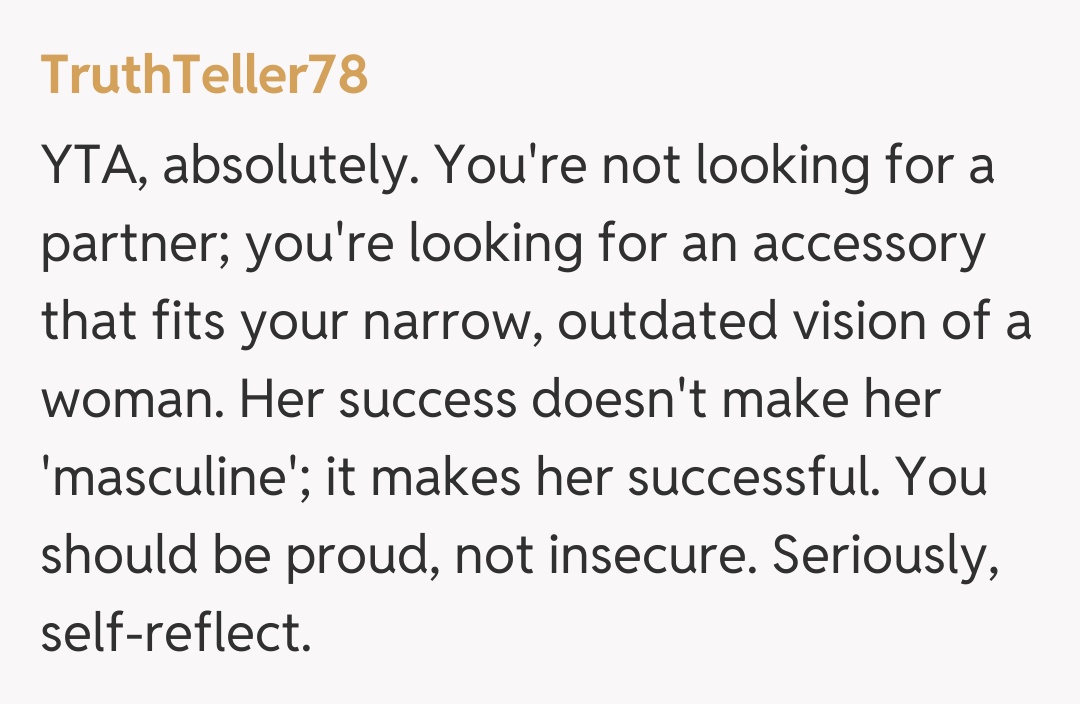
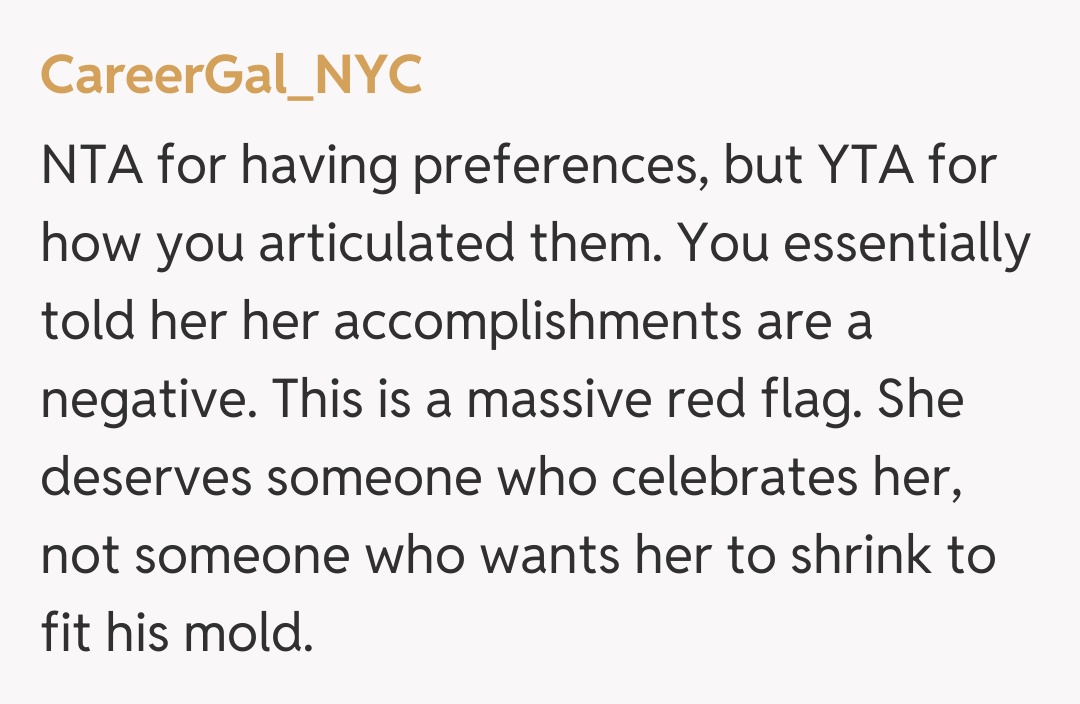
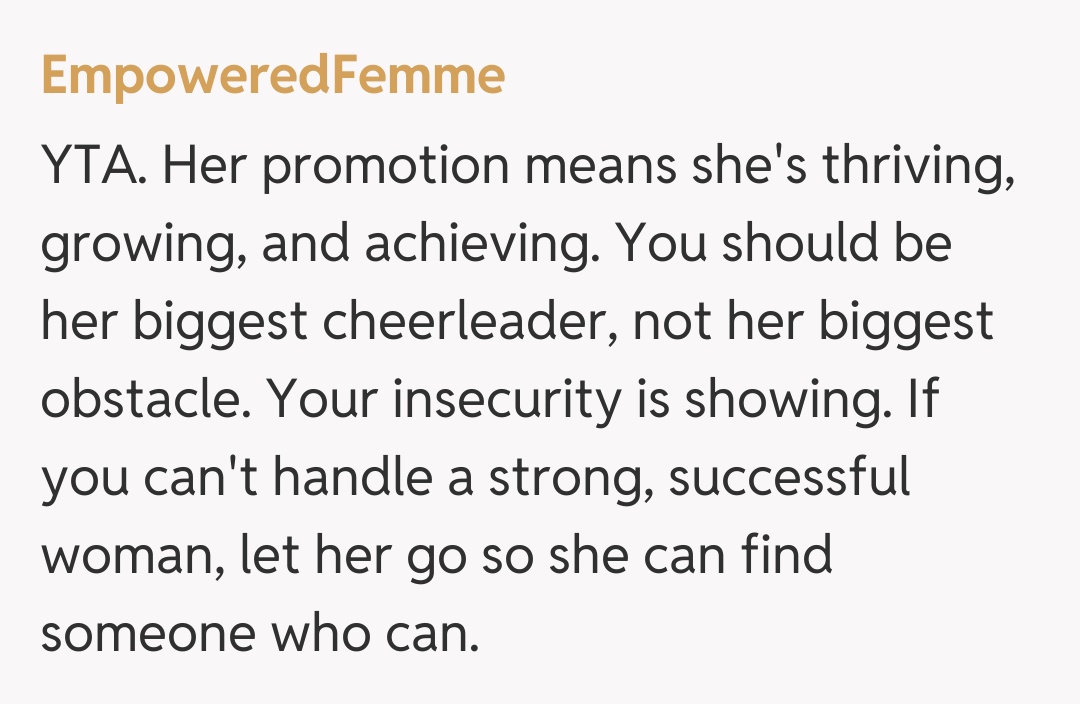
The comments section for this post was, predictably, an absolute firestorm! A vast majority of users leaned heavily towards 'YTA,' lambasting the original poster for his outdated views and his disrespectful comment. Many pointed out that his concern seemed less about her happiness and more about how her success impacted his traditional expectations of a partner and provider role.
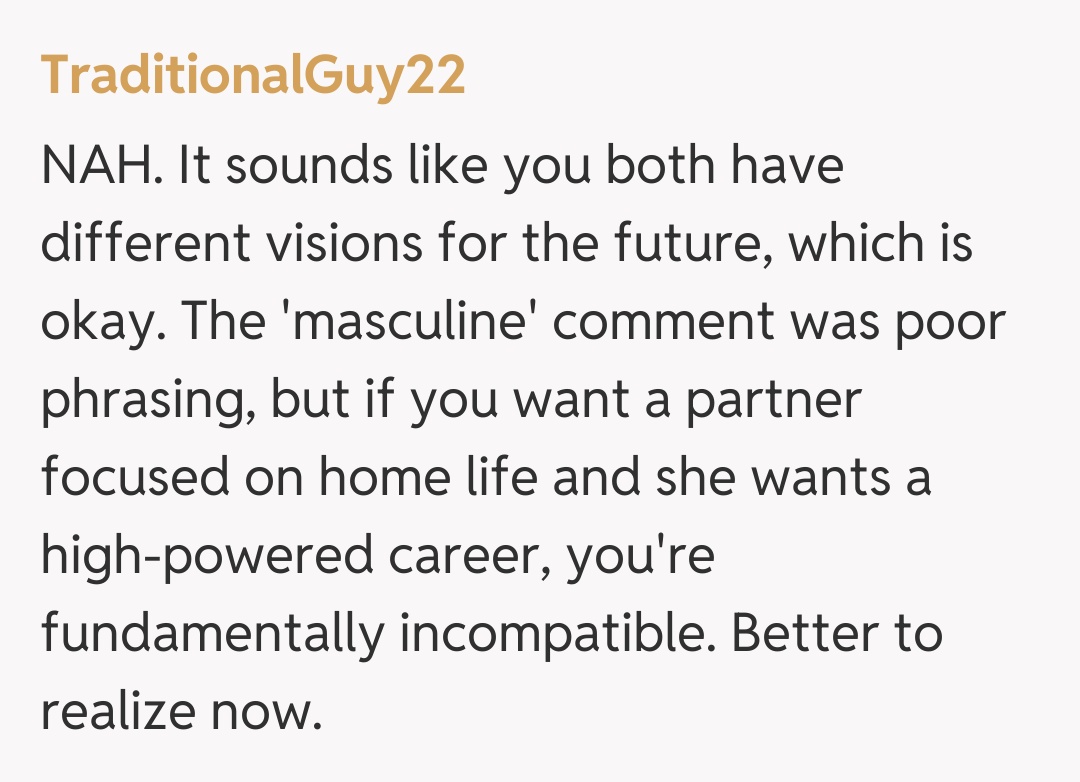
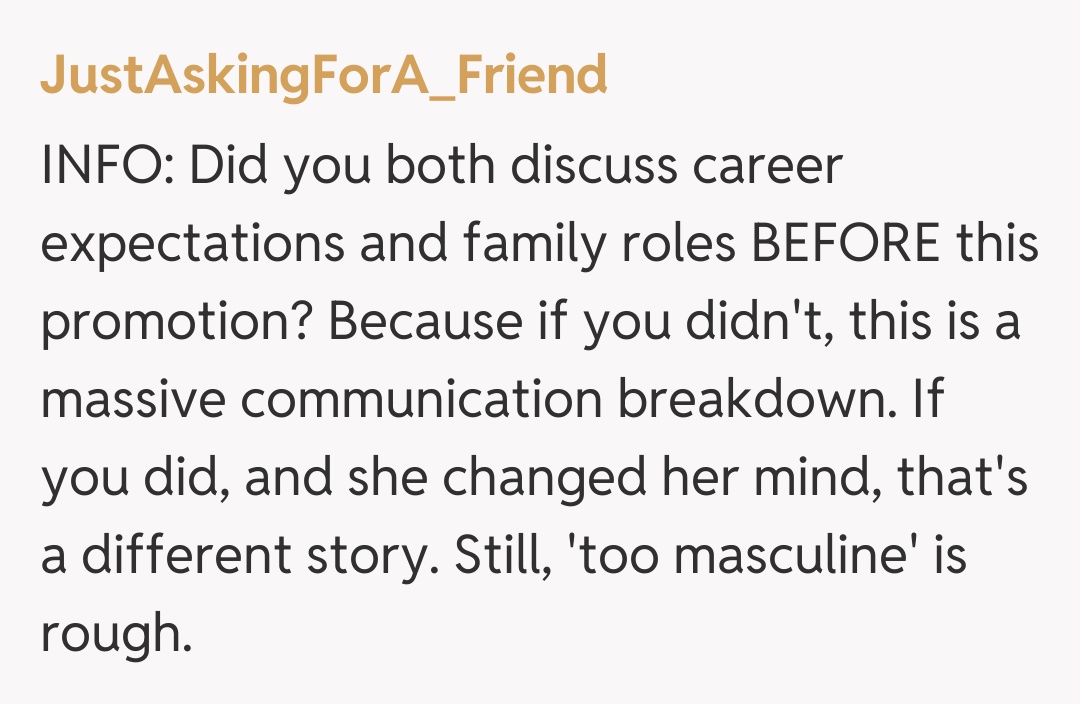
However, there were a few 'NAH' or 'ESH' comments, suggesting that while the poster's delivery was poor, his underlying feelings about wanting a traditional family structure were valid, and perhaps they simply aren't compatible. These users emphasized that fundamental differences in life goals need to be addressed, even if the phrasing was regrettable. The consensus strongly condemned the 'too masculine' remark.
This AITA post serves as a powerful reminder that fundamental compatibility extends far beyond initial attraction. It encompasses shared values, future aspirations, and crucially, an acceptance of each other's evolving selves. While the original poster's comment was undoubtedly hurtful and misguided, it brought to light a significant disconnect in their visions for a life together. For any relationship to flourish, both partners must feel supported, celebrated, and free to pursue their dreams without feeling like they are losing their partner's affection. This couple has a lot to unpack before any proposal should be considered.