AITA for refusing to let my boyfriend move in with me unless he signs a contract saying he’ll pay half the rent AND do all the cooking and cleaning?
Welcome back to another edition of 'Am I the A**hole?' where we dissect relationship dilemmas that make you question everything. Today’s story brings up a thorny issue: cohabitation. Moving in with a partner is a huge step, often seen as a sign of commitment and deepening love. But what happens when one partner tries to introduce a legalistic approach to domestic harmony? Is it smart planning or a recipe for disaster?
Our original poster (OP) is grappling with this very challenge. They own their apartment and want to ensure fairness when their boyfriend moves in. However, the specific terms they’re demanding in a formal contract have certainly raised some eyebrows across the internet. Get ready to dive into a debate about boundaries, financial expectations, and the true meaning of partnership.

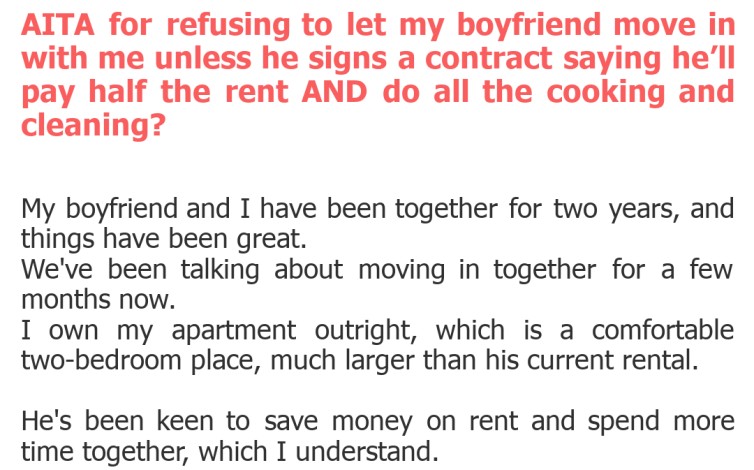
"AITA for refusing to let my boyfriend move in with me unless he signs a contract saying he’ll pay half the rent AND do all the cooking and cleaning?"
My boyfriend and I have been together for two years, and things have been great. We've been talking about moving in together for a few months now. I own my apartment outright, which is a comfortable two-bedroom place, much larger than his current rental. He's been keen to save money on rent and spend more time together, which I understand. However, I've had some bad experiences in the past with live-in partners where I ended up bearing the brunt of all household expenses and chores, despite promises to split things equally. I'm a naturally tidy person and I work long hours, so I value my free time and a clean living space. I didn't want to repeat past mistakes, so I decided to be proactive. I told him I'd be happy for him to move in, but with some conditions. I explained that since I own the apartment, I wouldn't charge him for mortgage, but I would expect him to contribute significantly to other aspects. I drafted a simple agreement outlining my expectations. When I presented it to him, he looked absolutely shell-shocked. The agreement stated that he would pay half of all utilities, groceries, and household supplies. It also specified that he would be responsible for all cooking and all general household cleaning, including bathrooms and dusting. I thought it was a fair proposal, given that he wouldn't be paying any rent towards the property itself. He just stared at the document, then at me, as if I'd grown a second head.
He argued that expecting him to do *all* the cooking and cleaning was completely unreasonable, especially since I'd also be living there and using the space. He said it sounded less like moving in with a partner and more like becoming a live-in housekeeper who also pays half the bills. He even called it 'controlling' and 'untrusting.' I tried to explain my perspective: I'm providing a rent-free home, which is a huge financial advantage for him. In exchange for that, I believe taking on the domestic labor is a fair trade. He claims his current rent is higher than half the utilities would be, so he'd be saving money, but then he'd be doing more work. I suggested we could review the terms after six months if it wasn't working, but he refused to even discuss it further. He said if I truly loved and trusted him, I wouldn't need a contract like this, especially one that puts all the domestic burden on him. Now he's staying at his place, barely talking to me. My friends are split, some saying I'm smart to protect myself, others saying I'm ruining a good relationship over an extreme demand. So, AITA?
This situation presents a classic dilemma about fairness, expectations, and the often-unspoken rules of cohabitation. On one hand, the original poster (OP) has a clear right to protect their assets and ensure a comfortable living situation, especially since they own the property. Past negative experiences are valid motivators for setting clear boundaries, and being proactive before a move-in can prevent future resentment.
However, the specifics of the proposed contract raise questions about whether it fosters an equitable partnership. While not paying rent is a significant benefit, demanding *all* cooking and cleaning responsibilities in exchange for half utilities and groceries could be seen as an imbalanced distribution of labor. A household requires contributions from everyone living there, both financially and domestically, tailored to individual circumstances.
The core issue might not just be the terms themselves, but the method of implementation. Introducing a formal contract with such specific, non-negotiable demands can signal a lack of trust and create an immediate power imbalance. Relationships thrive on communication, compromise, and mutual respect, not strictly legalistic agreements for everyday living. This approach could inadvertently create a landlord-tenant dynamic rather than a partnership.
Ultimately, whether OP is the 'a**hole' is subjective. They are certainly within their rights to set terms for their home. Yet, the question is whether these terms are conducive to a healthy, loving relationship, or if they are so skewed that they alienate a partner. The boyfriend's reaction suggests that the proposed agreement felt more like a job offer than an invitation to build a shared life.
Contracts of Love or Control? The Internet Weighs In!
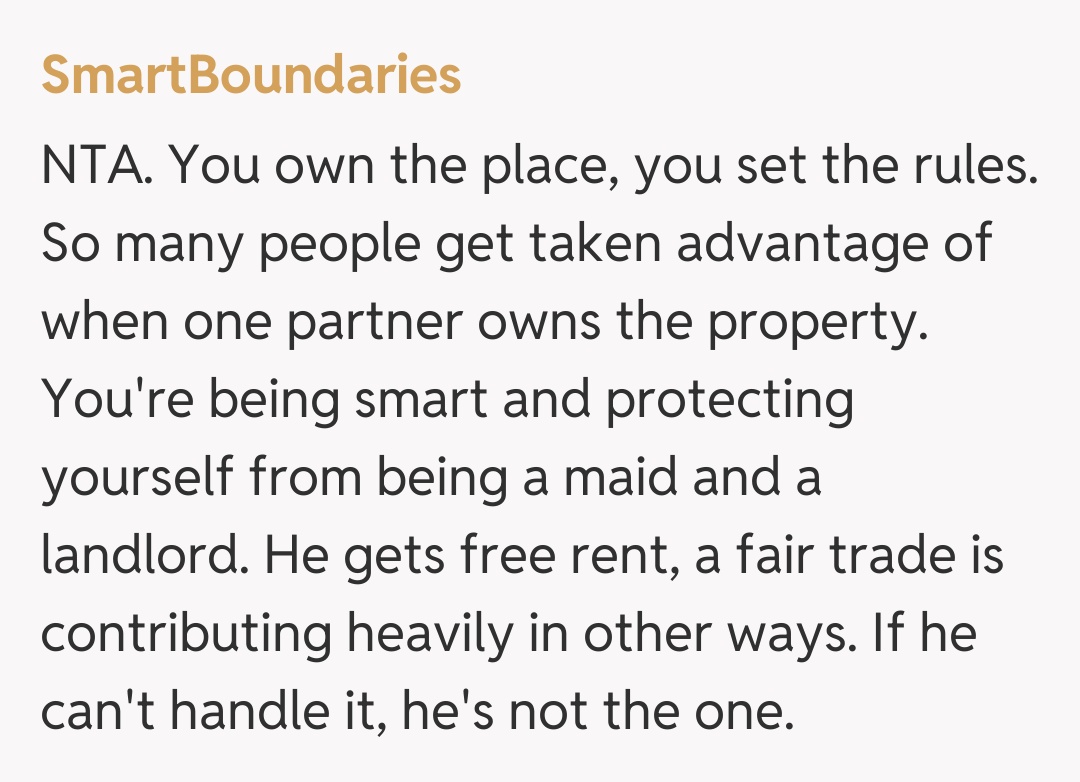
The comment section on this post was, predictably, a lively battleground. Many users sided with the original poster, emphasizing the importance of protecting one's assets and preventing the exploitation often seen when one partner owns the home. They applauded OP for being clear and upfront, arguing that clear expectations are better than unspoken resentments later on. The argument for financial fairness, given OP owns the property, resonated with many.
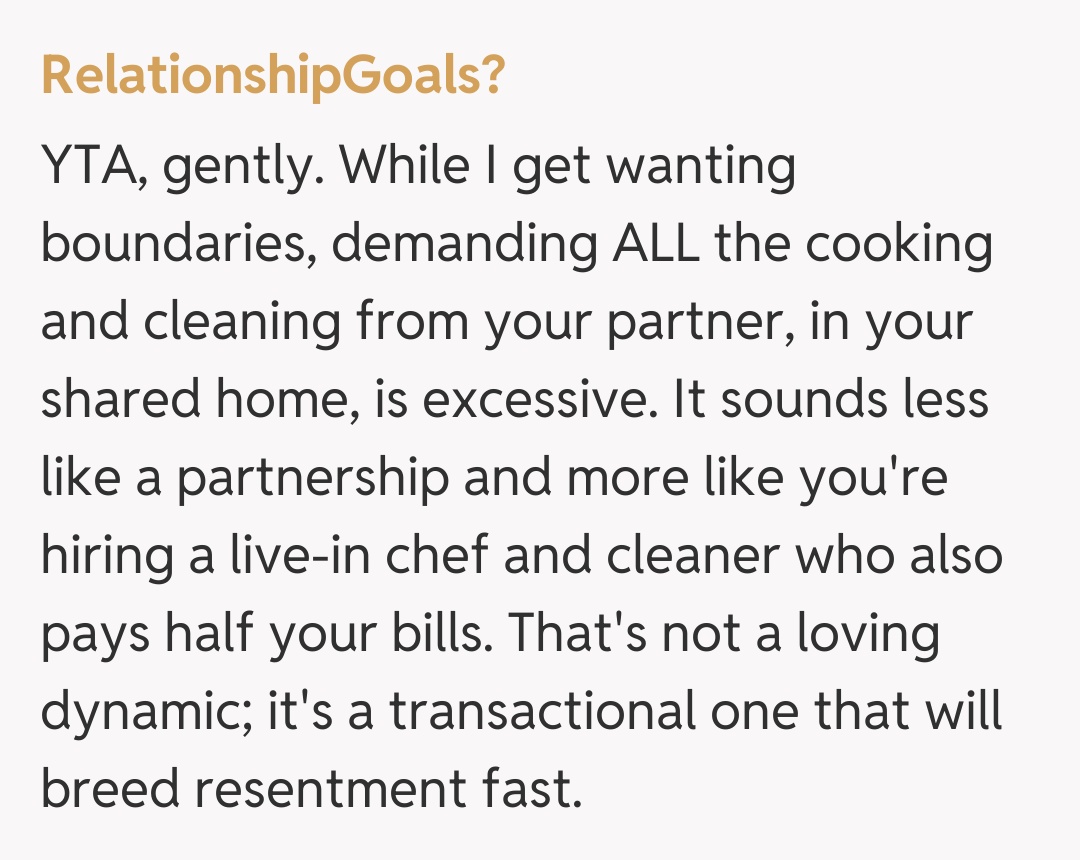
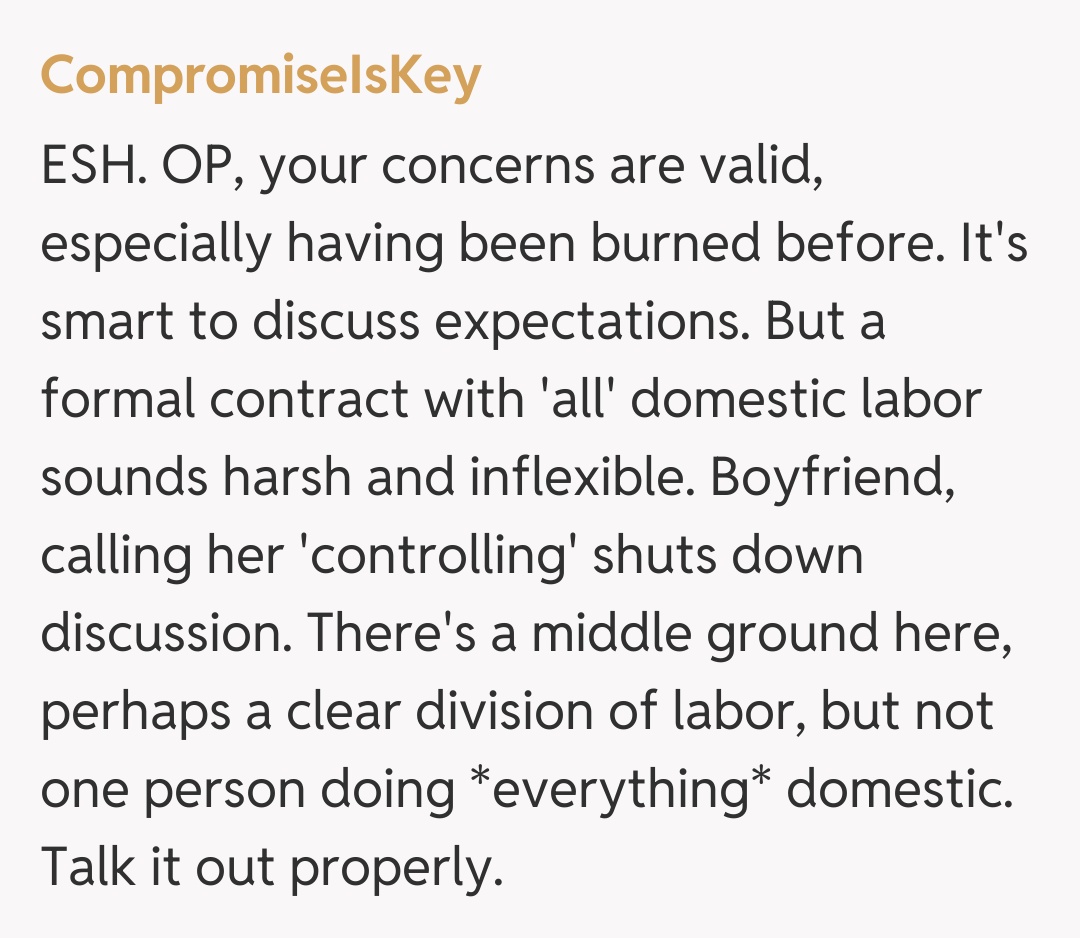
However, a significant portion of the community found OP's demands extreme, labeling them as 'controlling' and 'unrealistic' for a romantic partnership. The 'all cooking and cleaning' clause was a major sticking point, with many pointing out that a relationship built on such a stringent contract might lack warmth and genuine partnership. Users questioned if the boyfriend would truly feel like an equal partner under these conditions.
This story highlights the delicate balance between practicalities and emotional connection in a relationship. While clear communication about expectations is crucial for any successful cohabitation, the form that communication takes can significantly impact the dynamic. A contract might work for business, but for love, it often requires a softer, more collaborative approach. Perhaps the lesson here is not just about what is fair, but what truly fosters a sense of partnership and mutual respect, allowing both individuals to feel valued without feeling exploited or controlled.