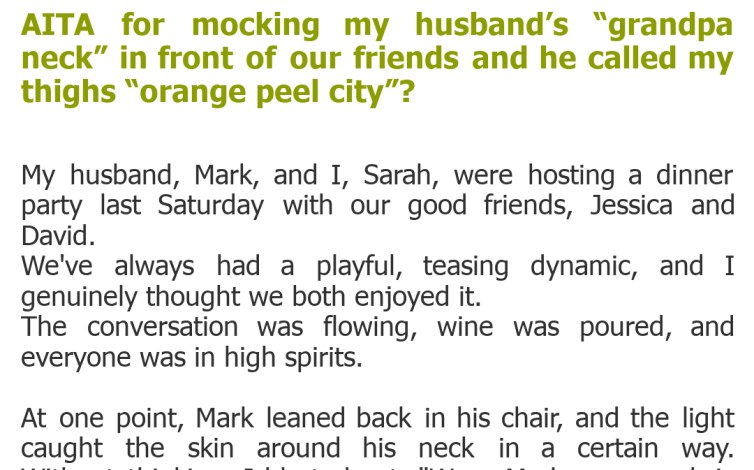
AITA for mocking my husband’s “grandpa neck” in front of our friends and he called my thighs “orange peel city”?
Oh, the delicate dance of couple's humor! Sometimes it's a delightful waltz, full of playful jabs and inside jokes that only strengthen bonds. Other times, it's a clumsy stumble, tripping over unspoken boundaries and leaving everyone, especially the couple involved, feeling bruised. Today's AITA story takes us right into that precarious territory, where a seemingly innocent jest turns into a full-blown public showdown.
We've all been there, right? You make a joke about your partner, thinking it's harmless fun, only to find you've accidentally stepped on a landmine. This tale explores the fine line between lighthearted teasing and outright disrespect, particularly when said in front of company. Get ready to dive into a classic 'who started it?' dilemma, served with a side of awkward silence and a hefty dose of hurt feelings.

"AITA for mocking my husband’s “grandpa neck” in front of our friends and he called my thighs “orange peel city”?"
My husband, Mark, and I, Sarah, were hosting a dinner party last Saturday with our good friends, Jessica and David. We've always had a playful, teasing dynamic, and I genuinely thought we both enjoyed it. The conversation was flowing, wine was poured, and everyone was in high spirits. At one point, Mark leaned back in his chair, and the light caught the skin around his neck in a certain way.
Without thinking, I blurted out, "Wow, Mark, your neck is really embracing its inner grandpa tonight!" I said it with a laugh, a lighthearted nudge, as I thought. Jessica and David chuckled politely, but Mark's smile faltered. There was a brief, almost imperceptible pause. I thought he was just surprised, maybe a little put out, but then he looked at me, a glint in his eye I hadn't seen before, and slowly said, "Well, Sarah, if we're doing observations about aging skin, your thighs are looking like 'orange peel city' these days."
The air immediately became thick with an awkward silence. Jessica quickly tried to change the subject, and David looked down at his plate. My face burned. I felt a wave of humiliation wash over me. I know I started it, but his comment felt so much more personal, so much more cruel, and it hit on an insecurity I've always had about my cellulite. The rest of the evening was incredibly strained, with forced smiles and superficial conversation.
After Jessica and David left, I confronted Mark. I told him he was an absolute jerk for saying something so mean and personal, especially in front of our friends. He just shrugged and said, "You started it, Sarah. You made fun of my neck, so I made fun of your thighs. What's the big deal? It's just playful banter, isn't it?" He claimed I was being overly sensitive and that he was just giving me a taste of my own medicine.
I feel like there's a huge difference between a harmless joke about a "grandpa neck" and attacking a woman's body image. He knows I'm sensitive about my thighs. He crossed a line, even if I initiated the teasing. I've been upset ever since and he thinks I'm being unreasonable. So, AITA?
This story perfectly encapsulates the dangers of playful teasing when boundaries aren't clearly established or respected. Sarah's initial comment about Mark's "grandpa neck" might have been intended as lighthearted, but the impact clearly wasn't. Public comments about appearance, even if framed as jokes, can easily sting, especially if the recipient is caught off guard or feels put on the spot.
From Sarah's perspective, her husband's retaliation felt disproportionate and cruel. While she admits to starting the teasing, she draws a clear distinction between her comment and his, feeling that his targeted a deeply personal insecurity. This is a common defense: believing one's own jab was mild while the response was harsh. The public setting amplified her humiliation, making the sting even sharper.
Mark's reaction, while certainly escalating the conflict, stems from feeling publicly mocked. His "eye for an eye" approach suggests he felt justified in returning the same energy, or even a magnified version, that he perceived from Sarah. He likely saw her comment as a direct attack, and his response was a defensive counter-attack, perhaps not fully grasping the deeper insecurity he was touching upon.
The core issue here is a breakdown in communication and empathy within the relationship. Both parties contributed to the uncomfortable situation. Sarah might not have intended malice, but her words had an impact. Mark's response, regardless of his justification, deliberately targeted a known insecurity. Relationship dynamics dictate a level of respect, especially in front of friends, that seems to have been absent here.
The Verdict Is In: Who's Really the A-hole in This Teasing Tussle?
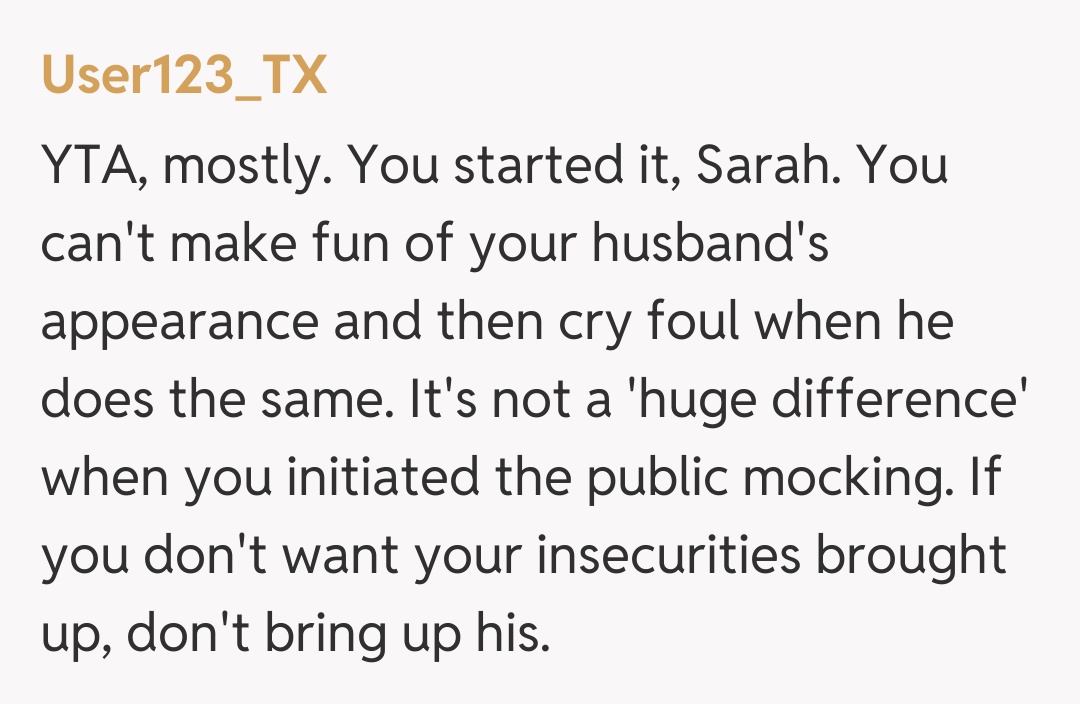
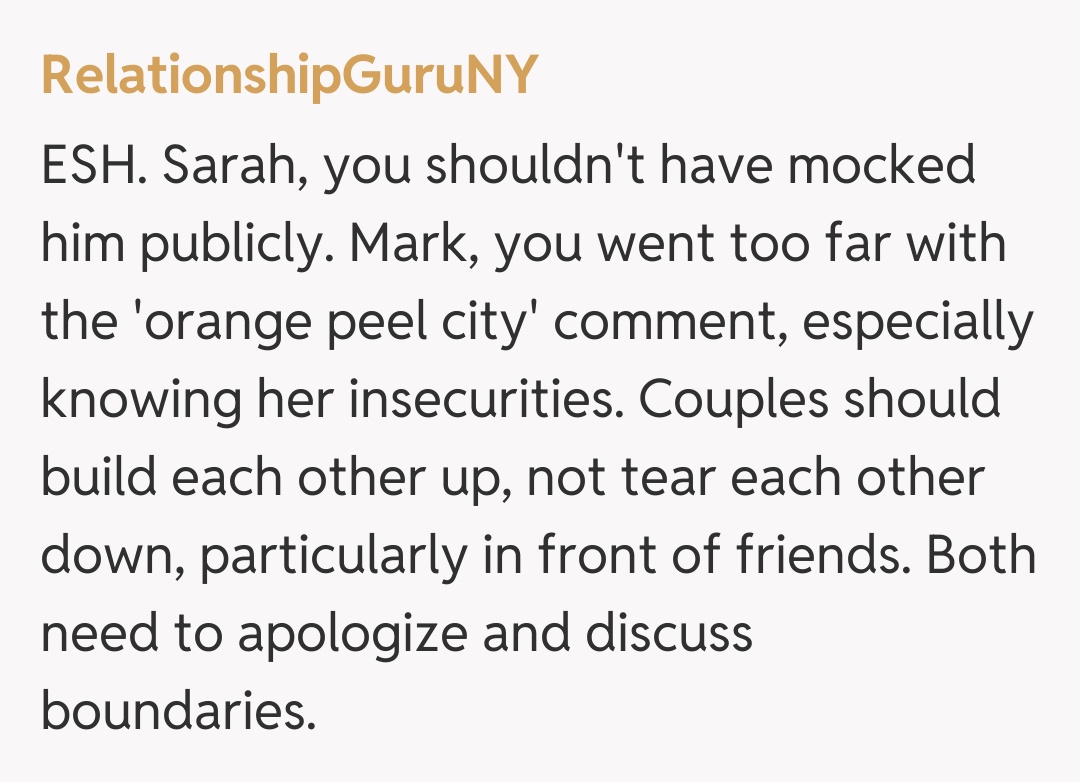
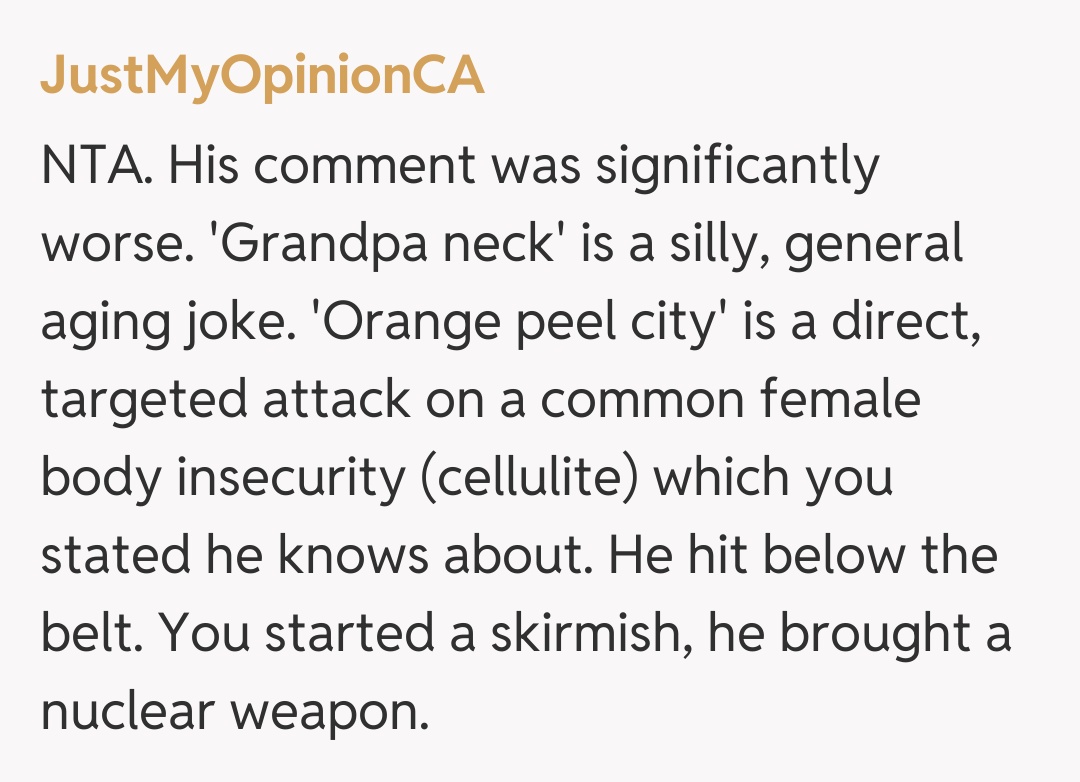
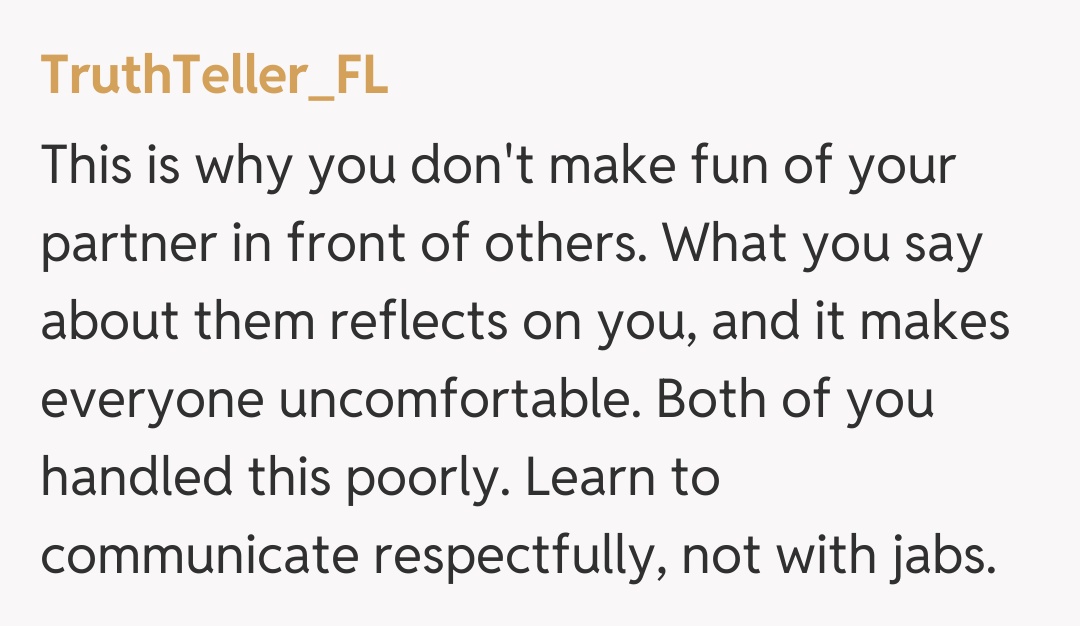
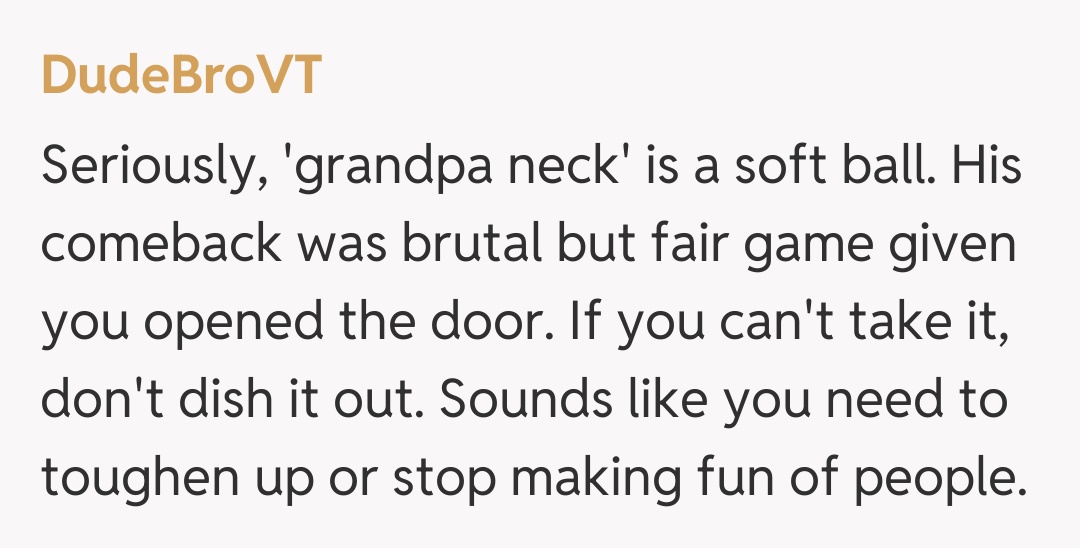
The comment section on this post was, as expected, a lively debate! Many users leaned towards 'ESH' (Everyone Sucks Here), arguing that while Sarah started it, Mark's retaliation was equally, if not more, damaging due to its personal nature. There was a strong consensus that public humiliation, even as a tit-for-tat, is never a good look for a couple.
However, a significant number of commenters also pointed out that Sarah 'dished it out but couldn't take it.' They argued that if you're going to make fun of your partner's appearance in front of others, you should be prepared for a similar response. The general sentiment was a call for better communication and a clear understanding of what constitutes acceptable 'teasing' within a relationship, especially when friends are present.
So, who's the A-hole? It's a tricky one, highlighting how subjective humor and sensitivity can be. While Sarah initiated the public teasing, Mark's response clearly crossed a line for her, exposing a deeper insecurity. Ultimately, this story serves as a potent reminder that couples need to define their boundaries, especially regarding public comments. Respect and kindness should always trump a perceived 'right' to retaliate. Perhaps a private conversation about what's truly acceptable in their dynamic is long overdue.