AITA for buying my wife a scale and meal-prep service as her birthday gift, then saying “this is me helping you fix what’s broken in our marriage”?
Oh boy, do we have a doozy for you today from the wilds of the AITA subreddit! This story tackles the treacherous terrain of gift-giving in relationships, especially when one partner decides to 'help' the other with their perceived flaws. We’re diving deep into a scenario that will undoubtedly spark a heated debate about intentions versus impact, and whether some gifts are just a thinly veiled insult.
Our original poster, Mark, thought he was being a supportive and proactive husband. However, his chosen birthday gifts for his wife, Sarah, combined with an utterly baffling accompanying statement, have sent shockwaves through their marriage and, predictably, the internet. Get ready to dissect a tale of good intentions gone horribly, horribly wrong, and ponder if Mark is genuinely trying to help or if he's the ultimate birthday villain.

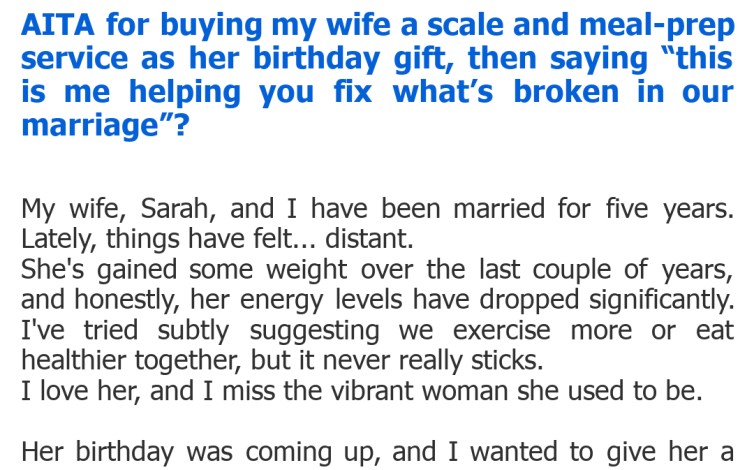
"AITA for buying my wife a scale and meal-prep service as her birthday gift, then saying “this is me helping you fix what’s broken in our marriage”?"
My wife, Sarah, and I have been married for five years. Lately, things have felt… distant. She's gained some weight over the last couple of years, and honestly, her energy levels have dropped significantly. I've tried subtly suggesting we exercise more or eat healthier together, but it never really sticks. I love her, and I miss the vibrant woman she used to be.
Her birthday was coming up, and I wanted to give her a gift that would genuinely help her get back on track, for her health and for us. I did a lot of research and decided on a high-tech smart scale that tracks body composition, along with a six-month subscription to a gourmet meal-prep service specializing in healthy, portion-controlled meals. I thought it was a thoughtful, practical gift. I wrapped them beautifully.
When she opened them, her smile slowly faded. She looked at the scale, then the meal-prep brochure, then back at me, her eyes wide with confusion and a hint of something else I couldn't quite place. I leaned in, took her hand, and said, "Honey, this is me helping you fix what’s broken in our marriage." I genuinely believed I was being supportive and addressing a core issue.
Well, that didn't go as planned. Her face crumpled. She pulled her hand away, stood up, and without saying a word, walked into our bedroom and locked the door. She hasn't spoken to me since, other than through texts telling me she needs space. I tried explaining that I meant well, that I want her to be healthy and happy, and that I feel her lack of motivation has affected our intimacy and connection. She just responded, "You think my weight is what's broken? On my birthday?" I feel like I'm being misunderstood. I thought I was offering a solution, a way for us to move forward.
Let's unpack this rather explosive birthday scenario, shall we? On one hand, Mark's stated intention was to 'help' his wife, Sarah, regain her health and energy, which he believes would, in turn, improve their marriage. It's not uncommon for partners to notice changes in each other and desire a return to a perceived healthier state. From this perspective, one might argue that he was simply trying to be practical and supportive, offering tools he believed would facilitate positive change for her.
However, the execution here is where things veer dramatically off course. A birthday is traditionally a day of celebration, joy, and showering a loved one with gifts that make them feel cherished and seen for who they are. Presenting a scale and a meal-prep service, regardless of the underlying intention, can easily be perceived as a direct criticism of one's body and eating habits, especially on such a personal occasion. It puts the onus of 'fixing' something squarely on her.
Now, let's address the elephant in the room: Mark's accompanying comment. "This is me helping you fix what’s broken in our marriage." This single sentence transforms a questionable gift into a deeply hurtful accusation. It explicitly links her body and health to the marital problems, implying that *she* is solely responsible for what's 'broken.' It's not a statement of shared concern or a gentle encouragement; it's a blame game wrapped in a shiny, passive-aggressive bow.
Ultimately, while Mark might genuinely feel he was being helpful, his approach demonstrates a profound lack of empathy and understanding of how sensitive topics like weight and body image should be handled within a loving relationship. Such issues require open, honest, and *mutual* communication, not a unilateral 'fix-it' solution delivered as a birthday present. The damage to trust and self-esteem caused by this act will likely be far more difficult to 'fix' than any perceived physical changes.
The Internet Weighs In: A Storm of Opinions on Mark's 'Helpful' Gift!
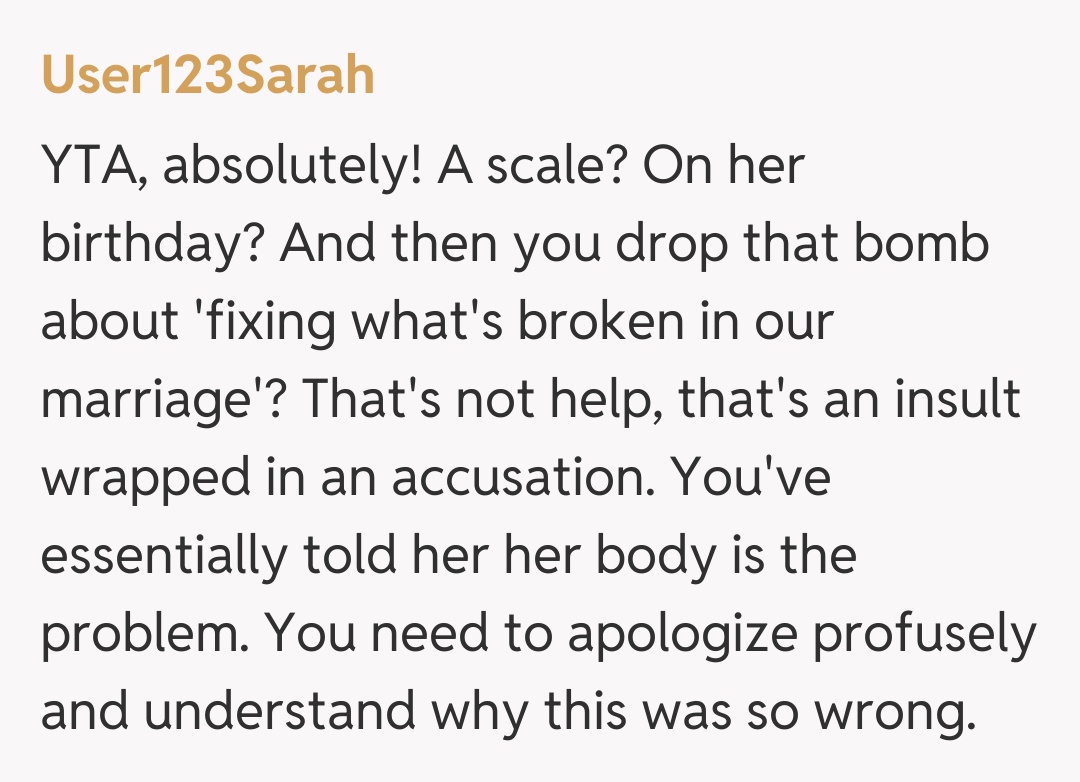
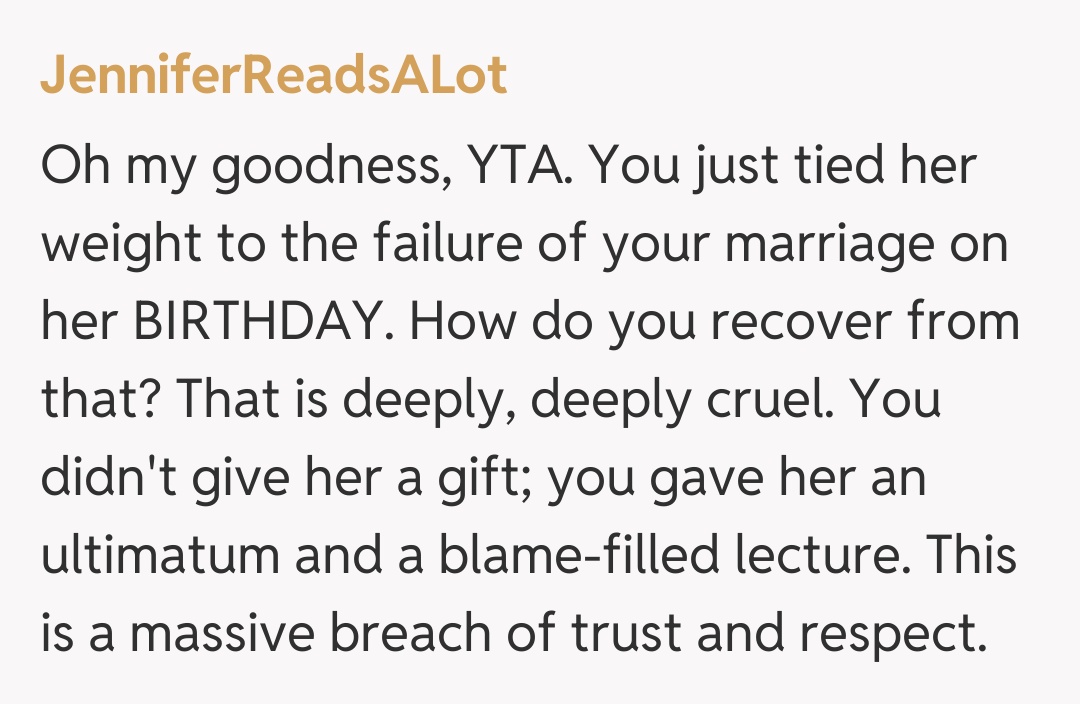
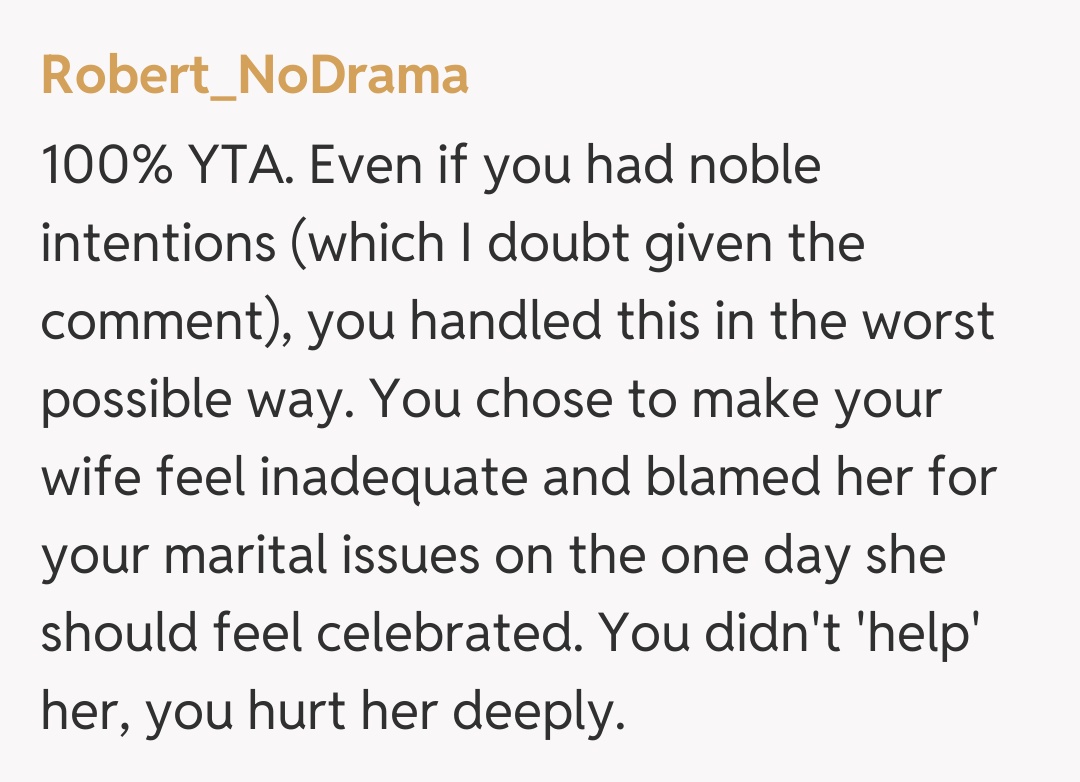
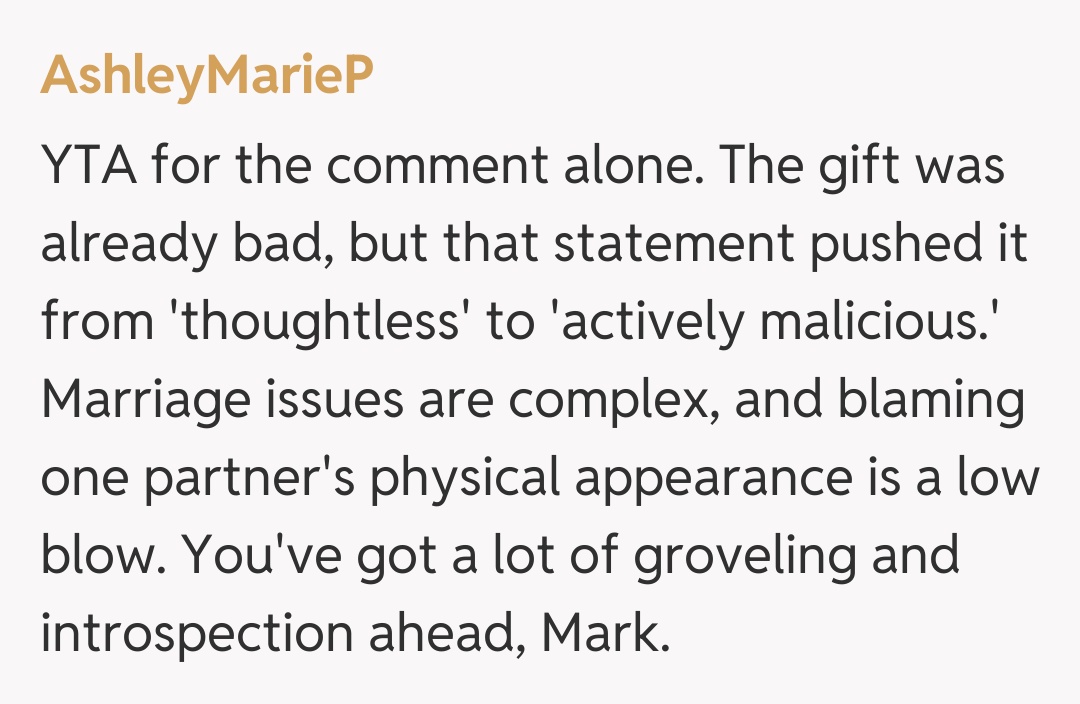
The comment section exploded, as expected! The overwhelming consensus leaned heavily towards YTA for Mark, with many users expressing shock at both the gift choice and, more acutely, his devastating statement. The phrase 'fix what’s broken in our marriage' struck a nerve with almost everyone, highlighting the deep insensitivity and blame he placed on his wife on her special day. Many felt he had weaponized her birthday.
Commenters repeatedly pointed out that marriage issues are rarely one-sided and that blaming Sarah's weight for their problems was a massive misstep. The core theme was that communication, respect, and joint effort are crucial, not a condescending 'gift' that essentially tells your partner they're the problem. It seems Mark's actions have truly created a much bigger 'break' in their relationship than he intended to 'fix.'

This AITA story is a stark reminder that intent, no matter how 'good' it might seem to the giver, can be completely overshadowed by a thoughtless or hurtful delivery. Mark learned the hard way that a birthday is for celebrating, not for critiquing or assigning blame, especially regarding sensitive topics like body image and relationship issues. True support and marital 'fixing' stem from empathetic conversation, mutual respect, and shared effort, not from a scale and a blaming statement. Let this be a lesson for all of us: choose your gifts and your words wisely, or risk breaking more than you intended to fix.