AITA for telling my 19-year-old daughter she should accept she’s built like a boy and stop trying to dress feminine?
Welcome back to another edition of 'Am I the A**hole?' where we dissect life's stickiest situations. Today's submission dives deep into the fraught territory of parental advice, body image, and self-expression. It’s a tale that many young adults, particularly women, can unfortunately relate to: navigating a parent's unsolicited opinions about their appearance and choices, especially when those opinions feel less like guidance and more like a harsh critique. Prepare yourselves, because this one hits close to home for a lot of people.
Our poster, Robert, finds himself in hot water after a conversation with his 19-year-old daughter, Maya, about her fashion choices. What he intended as 'helpful' advice has clearly backfired, leaving his daughter deeply hurt and their relationship strained. This scenario perfectly illustrates the delicate balance parents must strike between offering support and overstepping into their children's personal autonomy, particularly when it involves something as personal as how they choose to present themselves to the world.

"AITA for telling my 19-year-old daughter she should accept she’s built like a boy and stop trying to dress feminine?"

From the father's perspective, it seems he genuinely believes he was offering practical advice, albeit delivered in a very blunt manner. He saw his daughter struggling with her fashion choices and, in his mind, was trying to guide her towards styles that he perceived would be more flattering for her specific body type. His intention, perhaps, was to save her from disappointment and help her build confidence based on what he considers 'realistic' self-perception. This is a common parental impulse, wanting to 'fix' perceived problems for their children.
However, the impact of his words on Maya cannot be overstated. At 19, she is forming her identity and exploring different facets of herself, including her style. To be told by a parent that her body is 'built like a boy' and that she should 'stop trying to dress feminine' is incredibly damaging. It’s not just fashion advice; it’s a direct critique of her physique and an invalidation of her desire to express her femininity, regardless of her natural build. This undermines her autonomy and self-esteem during a crucial developmental stage.
The specific phrasing 'built like a boy' is particularly harsh and can easily lead to body image issues or feelings of inadequacy. While honesty is often valued, there’s a critical difference between constructive feedback and shaming. Parental communication should prioritize support and understanding over blunt assessments of physical appearance, especially when it comes to a young woman's body. There are more sensitive ways to discuss clothing styles without making a child feel like their body is fundamentally 'wrong' for certain garments.
Ultimately, a parent's role is to foster a child's confidence and self-acceptance, not to dictate how they should look or express themselves. While the father might have had good intentions, his method was deeply flawed and hurtful. It broke trust and made his daughter feel judged rather than supported. Rebuilding that trust will require genuine empathy and an apology that acknowledges the pain his words caused, rather than focusing on his own misunderstood intentions.
The internet weighs in: Is 'tough love' just plain cruel, or a necessary dose of reality?
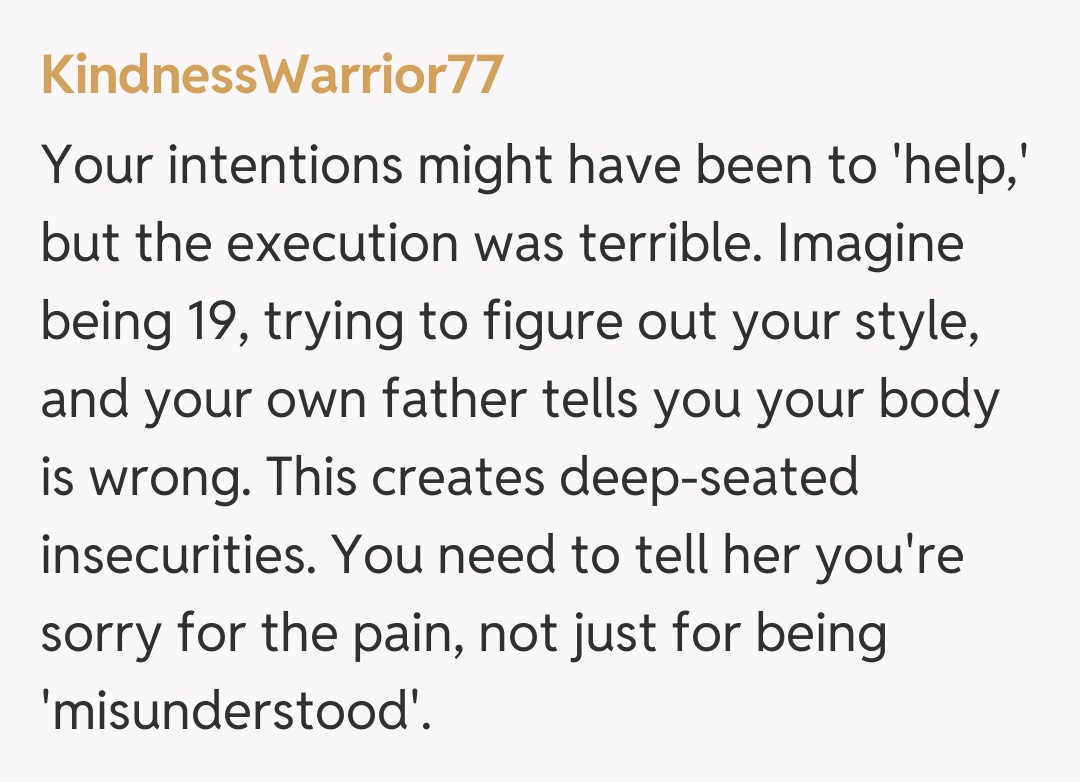
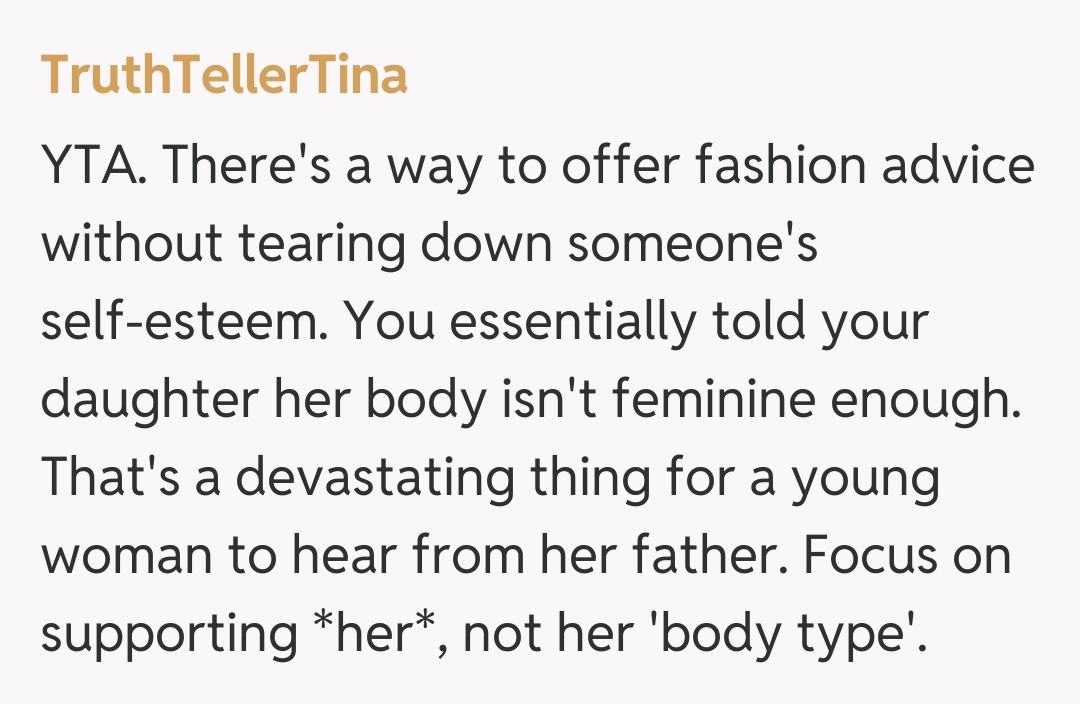
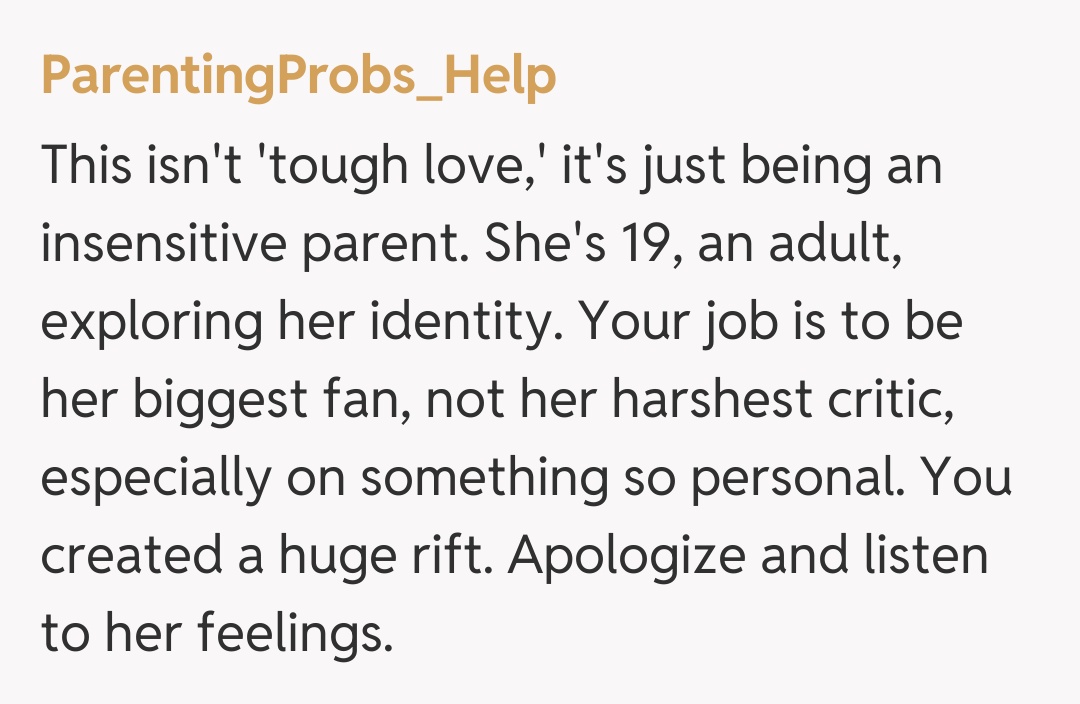
As anticipated, the comments section lit up with strong opinions, and the consensus was overwhelmingly clear: Robert, the father, is firmly in the AITA camp. Many users pointed out the deep psychological harm that phrases like 'built like a boy' can inflict on a young woman, regardless of perceived good intentions. The prevailing sentiment is that a parent's role is to uplift and support their child's self-expression, not to police their body or dictate their style choices, especially at 19.
Commenters emphasized that Maya's frustration likely stemmed from societal beauty standards, not her body itself, and her father's words only exacerbated those insecurities. Several users suggested that Maya's pursuit of feminine styles is a healthy exploration of her identity, and her father should have encouraged her to find what *she* loves, rather than telling her what her body *can't* wear. The advice for Robert was uniform: a sincere apology, focusing on the pain he caused, is absolutely essential to begin repairing their strained relationship.

This story serves as a potent reminder for all parents: words have immense power, particularly when spoken to our children. While we might believe our intentions are pure, the impact of our language can linger and cause significant harm, especially when it touches upon sensitive areas like body image and self-expression. Robert’s situation highlights the necessity of empathy and respect in parental guidance. Ultimately, fostering an environment where children feel safe to explore their identities, free from judgment, is paramount to building strong, trusting relationships that last a lifetime. Let's learn from this and strive to uplift, not tear down.