He Built a Hospital and Entered as a Cleaner to See Who Truly Cared About People
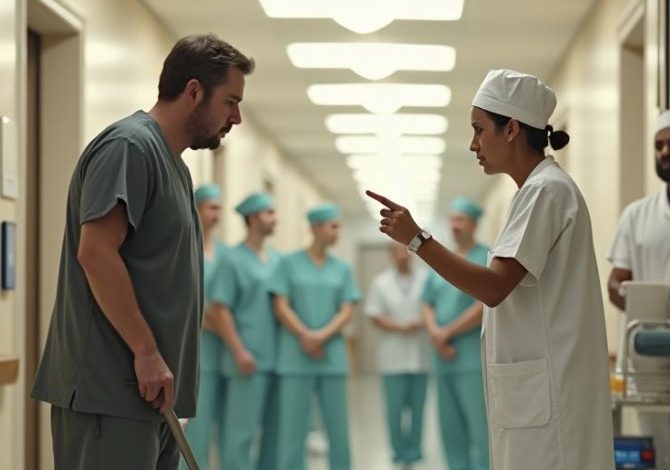
A billionaire pretended to be a lowly cleaner in his own brand-new hospital to find out who had a heart—and who only respected titles.
Malik Okoye, a 35-year-old billionaire, sat in his penthouse staring at a perfect city view that felt meaningless. He had money, status, access—yet every relationship in his life seemed to orbit one thing: his bank account. One night, he told his childhood friend and lawyer, Evan Pierce, “I don’t want another person who loves my name more than me.”
Evan asked what he planned to do. Malik smiled, almost mischievous. “I’m opening the biggest hospital in the city. And I’m going in as a cleaner. Different name. Different uniform. No one knows.”
So on opening day of Aurora Crown Hospital, Evan addressed the staff and announced the owner was “overseas.” In the back, among the maintenance crew, Malik stood in a simple uniform under the name “Caleb.” He watched how people behaved when they thought power wasn’t looking.
It didn’t take long.
Some nurses mocked the cleaners openly. Nurse Fallon Drake—flawless uniform, sharp tongue—treated the custodial staff like they were invisible furniture. In the halls she snapped, “Watch where you’re going,” and in the cafeteria she laughed about “people with no ambition” as if dignity had a pay grade. An older cleaner, Omar, quietly warned Caleb, “Don’t take it personal. Some folks wear arrogance like a badge.”
Malik kept his head down, absorbing everything. He wasn’t there to punish anyone yet—he was searching for someone who respected people without needing a spotlight.
That person arrived in the most unexpected way.
Across town, Naomi Brooks, a young single mother and trained nurse, raced to Aurora Crown after seeing the recruitment flyer. She arrived too late—the nursing role had been filled. Crushed, she admitted she’d take any job. Even cleaning. She needed to provide for her little daughter, Hope, and her elderly father who had sacrificed everything to raise her.
So Naomi—qualified, capable, and proud—put on the same cleaning uniform as Malik and started work without complaint.
The bullying found her immediately. Fallon and her friends sneered, “Weren’t you here for a nurse interview? And now you’re holding a mop?” Naomi swallowed the humiliation and kept cleaning. When Malik asked how she stayed so calm, she gave a small, steady smile. “I’ve survived worse. Words don’t hit the same when you’ve already learned how to stand up again.”
Then the real test came.
Naomi received a frantic call: Hope was sick—vomiting, feverish. Naomi rushed her child to the hospital, desperate. At the desk, Fallon’s group tried to block her with cold policy and colder eyes: “Pay first. Go to a public hospital.”
Malik stepped forward. Omar did too. “She works here,” Malik said, voice firm. “Treat the child first—paperwork later.”
A principled pediatrician, Dr. Julian Hart, overheard and cut through the noise. He touched Hope’s forehead and said, “She needs help—now.” He had Hope taken in immediately. Naomi cried—not from weakness, but from relief that someone still remembered why hospitals exist.
The next days proved Naomi’s skill wasn’t luck. When a pregnant woman collapsed in a corridor and staff froze, Naomi dropped her mop and took control with calm, trained precision, guiding the emergency until help arrived. Doctors who witnessed it were stunned. “Who handled that?” someone demanded. Naomi answered quietly, “I’m a nurse. I’m just working as a cleaner.”
Rumors spread. Respect started to shift.
That’s when Malik decided it was time.
Evan quietly announced the owner would “return” to visit the hospital. Panic swept through the staff—sudden makeovers, forced smiles, rehearsed professionalism. Naomi, meanwhile, only hoped the owner would be human.
On the day of the reveal, the lobby filled with staff in perfect formation. Malik walked in—no uniform now, dressed like the man he truly was. Faces went rigid. Omar nearly dropped his mop. Fallon’s confidence evaporated.
Naomi turned and froze. “Caleb…?”
Malik removed his glasses. “My real name is Malik Okoye. I’m the owner.”
Naomi felt betrayed—because she had trusted him as an equal. She walked away in tears, not wanting money, not wanting favors—only truth.
Malik didn’t chase her with excuses. He did what he’d come to do.
He gathered the entire hospital and spoke calmly, clearly: “I built this place to save lives. What I saw broke my heart—arrogance toward staff, cruelty toward patients, contempt disguised as ‘standards.’ If your heart isn’t in service, you don’t belong here.”
Then he made decisions—public, irreversible ones.
He elevated Dr. Julian Hart for treating patients first.
He promoted leaders who defended integrity.
He reassigned roles so the most vulnerable staff had protection and support.
And then he said the name everyone wasn’t expecting:
“Naomi Brooks.”
He announced her appointment as Head Nurse, citing her skill, composure, and courage under pressure. The room erupted—part applause, part shame.
But Naomi wasn’t there to hear it.
Two days later, Naomi saw the news and couldn’t speak. Her father cried with pride. Malik, unable to let the silence stand, asked Evan for her address and went himself—not with cameras, not with gifts, but with an apology.
“I hid my identity,” Malik told her. “But what I felt was real. I shouldn’t have tested your trust.”
Naomi looked at her daughter, then at her father’s tired eyes, then back at Malik. “I don’t forgive easily,” she said. “But I believe people can learn.”
In time, Naomi stepped into her role. The same people who mocked her now greeted her carefully. She accepted their apologies with one condition: “Never look down on anyone again.”
And when Malik finally proposed—not as a billionaire performing romance, but as a man choosing partnership—Naomi said yes.
They married quietly, with Hope calling Malik “Dad” like it had always been true. Later, Naomi addressed the staff with a message that became policy:
“This hospital is not just a building. It’s a place where every person deserves respect—patient, doctor, cleaner, everyone. Contempt has no home here.”
That was the point of Malik’s disguise.
He wasn’t hunting love.
He was hunting character.
If you found out your coworker “Caleb” was actually the hospital owner, would you feel betrayed like Naomi—or understand why he did it?
Who deserves the biggest consequence in this story: Nurse Fallon (for contempt), or the system that rewards arrogance and ignores kindness? Why?
What moved you more: Naomi choosing a mop over giving up, or her saving a life in the hallway when others froze?