AITA for refusing to forgive my father for divorcing my mother even though he was the one who suffered abuse?
Welcome back to 'AITA Insights,' where we dissect the tangled webs of human relationships and moral dilemmas. Today's story plunges us into the complex world of family dynamics, specifically the tricky terrain of divorce, abuse, and the incredibly personal journey of forgiveness. Our OP is grappling with a situation that challenges the very notion of who the victim is and who holds the key to reconciliation.\nThis isn't just about a broken marriage; it's about the lingering shadows of a parent's suffering and a child's inability to reconcile that with their own lived experience. When one parent endures abuse, and the other leaves, how does that impact the children caught in the middle? Is forgiveness a mandatory act, even when your own childhood was shaped by the fallout?

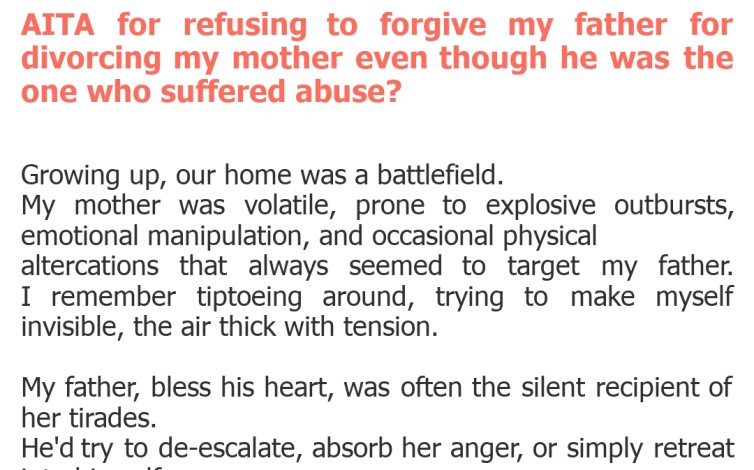
"AITA for refusing to forgive my father for divorcing my mother even though he was the one who suffered abuse?"
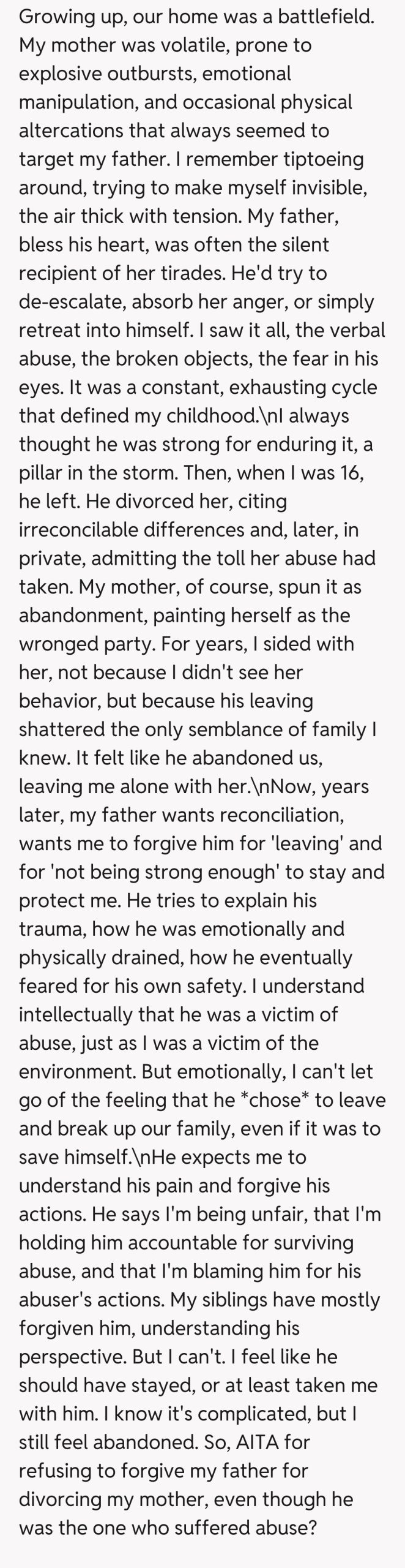
This story highlights the incredibly difficult position children are often placed in during parental conflict, especially when abuse is present. While the father was clearly the victim of abuse from the mother, the child's perspective is equally valid. Children do not process events with the same emotional maturity or understanding as adults, and a parent leaving, regardless of the reason, can feel like abandonment. This doesn't negate the father's suffering, but it explains the OP's reaction.\nThe concept of forgiveness itself is deeply personal and cannot be forced. The father's expectation that OP forgive him for 'leaving' or 'not being strong enough' places an undue burden on the child. While he was a victim, his actions (or inactions, from the child's perspective) still had consequences for OP. Forgiveness is a process, not a switch, and it often requires the one seeking it to first acknowledge the other person's pain and validate their feelings.\nIt's important to recognize that experiencing a parent being abused, and then that parent leaving, creates a unique and profound trauma for a child. The 'battlefield' environment described by OP is deeply damaging. The child lost the stable family unit, perceived a protector leaving, and was left with the abusive parent, or at least the lingering presence of that abuse. These are significant wounds that deserve acknowledgment.\nUltimately, OP is not obligated to forgive anyone. Forgiveness is a gift given freely, often for the giver's own peace, but it must come from an authentic place. The father needs to understand that while he was abused, his leaving had a profound, negative impact on his child, even if it was the right decision for his own survival. Healing for both parties might require professional guidance to unpack these complex layers of trauma and abandonment.
The Internet Weighs In: Can You Blame a Victim for Escaping?
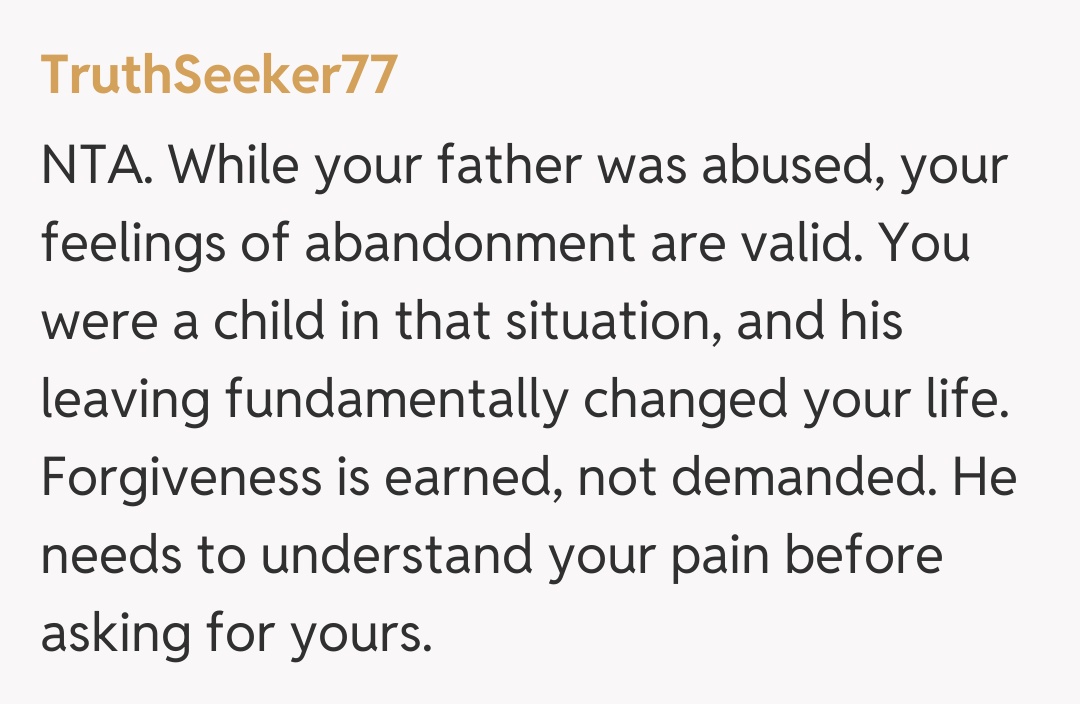
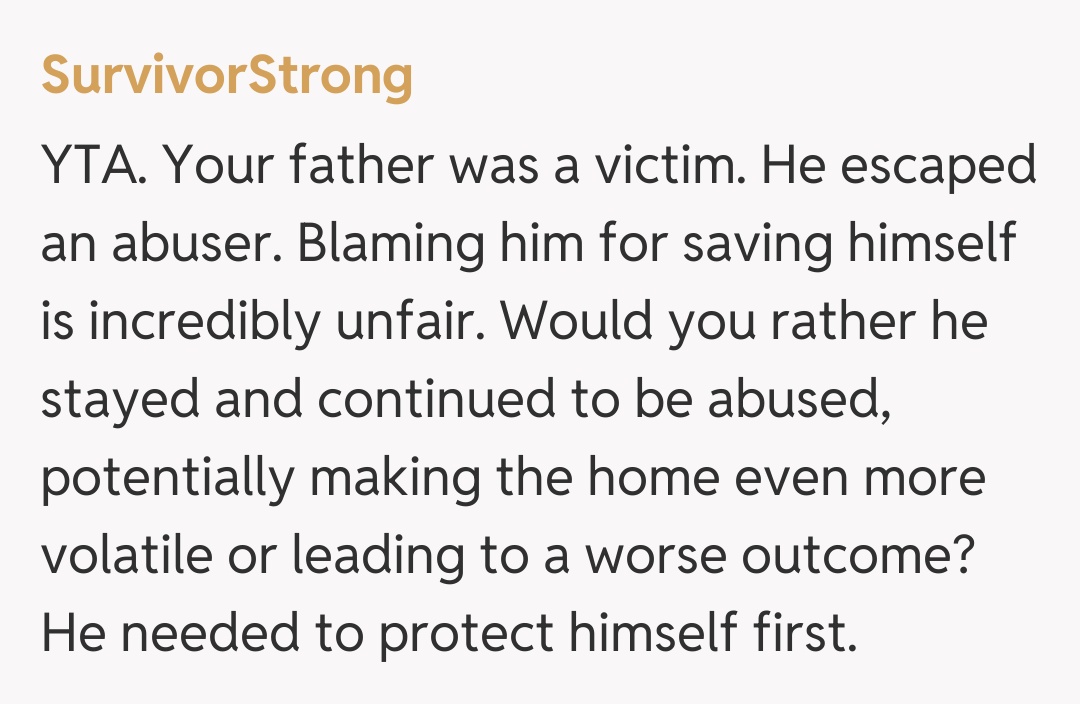
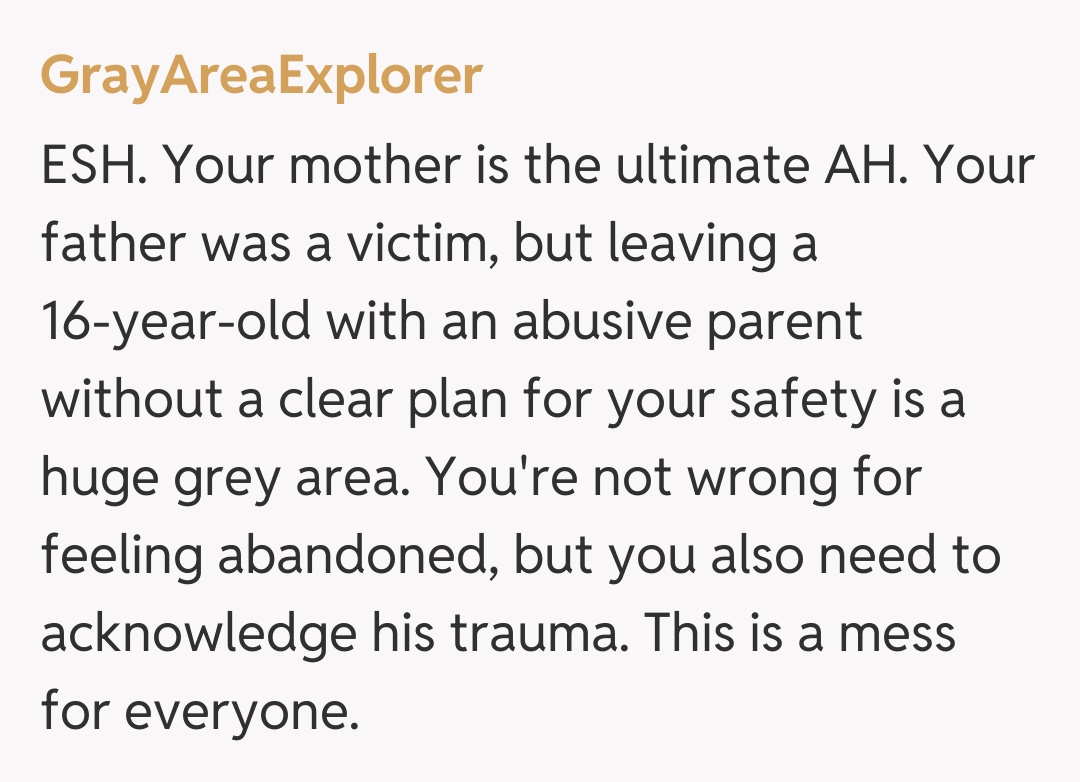
The comments section for this post was, as expected, a whirlwind of complex emotions and differing viewpoints. Many users empathized deeply with the father, highlighting that he was a victim of severe abuse and made a choice to save himself, which no one should be condemned for. They pointed out that staying in an abusive environment might have been even more damaging for the children, and that his survival was paramount.\nHowever, a significant number of commenters also validated OP's feelings of abandonment. They acknowledged the father's trauma but argued that a child's experience of a parent leaving is distinct. Some suggested the father should have sought therapy sooner or made plans to take the children, while others simply stated that the OP's emotional response, though perhaps unfair to the father's intentions, is completely understandable given the circumstances.
This AITA story serves as a stark reminder that trauma ripples through families in intricate and often contradictory ways. While the father's abuse is undeniable, the child's feeling of abandonment is equally real and valid. Forgiveness is a journey of personal healing, not a mandatory obligation. It's clear that both OP and their father carry deep wounds from their shared past. Perhaps professional help can guide them toward understanding, even if full forgiveness isn't immediately possible. Boundaries and self-protection are crucial for everyone involved.