“I Drove Through the Night After My Daughter’s Desperate Call, Uncovering a Truth No Parent Should Face”
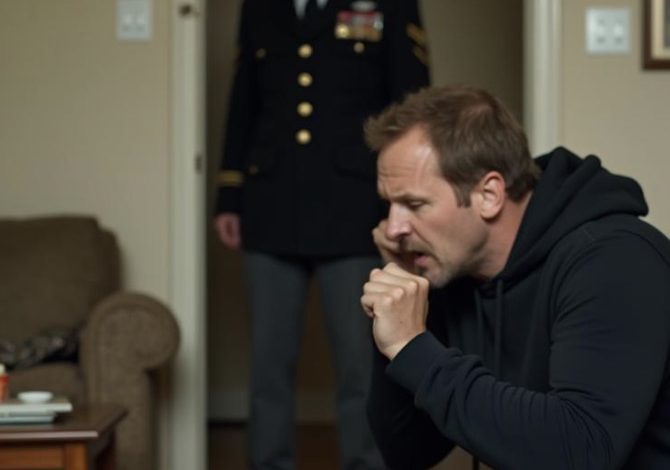
My daughter called me while she was crying. “Dad, please come get me.”
When I reached her in-laws’ home, her mother-in-law stepped in front of the door and said, “She’s not going anywhere.” I pushed past her—and the second I saw my daughter on the floor, I understood this was not simple “family drama.” It was something hidden, something done on purpose. They believed I would turn around and leave without making trouble. They had no idea that a father’s anger, once awakened, could tear their whole world apart.
The phone rang at exactly 11:43 p.m.
It didn’t sound like a normal call. It cut through the quiet of my bedroom like an alarm. I had been drifting into sleep, half-lost in a peaceful dream about fishing by the lake, when that sharp digital sound dragged me back. I sighed and reached for the phone, expecting a wrong number or maybe a late emergency call—old habits from years as a paramedic never really fade.
One name glowed on the screen: Emily.
My chest tightened instantly. My daughter never called at that hour. She was twenty-four, married a little over a year, living several states away. We usually talked on Sunday afternoons. Those calls were calm and cheerful—updates about her job at the library, the books she loved, or something small she’d bought for the apartment.
I answered right away. “Emily? Are you okay?”
For a few seconds, there was nothing but breathing. Not calm breathing. It was broken and shaky, like she was struggling to pull in air.
“Dad,” she whispered, her voice cracking. “Dad, please. Please come get me.”
I sat up so fast the room tilted. “Emily, what’s wrong? Where are you?”
“I’m at Mark’s parents’ house,” she said quietly. “I can’t… I can’t leave.”
“What do you mean you can’t leave? Put Mark on the phone.”
“No!” Her voice spiked with fear. “No, please don’t. Just come. I need you.”
Before I could ask if she was hurt or tell her I was calling the police, the call ended.
I didn’t try to call back. Something deep in my gut told me that calling again might make things worse for her.
I was dressed in seconds. Jeans, jacket, boots. I grabbed my keys, wallet, and a heavy flashlight. I didn’t know what I was walking into, but I knew this: my daughter was scared, and I was far away.
I drove onto the highway just after midnight. The road stretched ahead, empty and dark, the white lines flashing by. For hours, I drove with one thought in my head. I didn’t slow down. I didn’t stop.
My mind kept circling back to Mark Wilson. He had seemed fine when I first met him. Polite. Educated. A little controlling, maybe, but I had told myself it was nothing serious. When Emily mentioned visiting his parents—Linda and Robert—she hadn’t sounded excited. She sounded tired.
“It’s just for the weekend,” she had said. “I’ll be home Sunday.”
I squeezed the steering wheel until my hands ached.
Why hadn’t I paid closer attention? Why do we teach our children to keep the peace instead of protecting themselves?
The GPS announced my arrival around 4:15 a.m. The neighborhood was quiet and wealthy, the kind where everything looks perfect from the outside. The house was large and dark, but lights glowed behind heavy curtains.
I parked and got out.
I didn’t ring the bell. I slammed my fist against the thick wooden door. The sound echoed through the night.
Open the door, I thought. Open it now.
Two long minutes passed. I could see shadows moving behind the glass. They were talking. Waiting.
Finally, the door opened just a few inches, held by a chain.
Linda Wilson looked out. She was fully dressed, hair neat, eyes cold.
“It’s four in the morning,” she snapped. “What are you doing here?”
“Open the door, Linda,” I said quietly. “I’m here for Emily.”
“She’s sleeping,” she replied smoothly. “She had an episode. She needs rest.”
“She called me,” I said. “Undo the chain, or I will force this door open and let the police sort it out.”
Her jaw tightened. She glanced back, then slowly removed the chain.
I stepped inside. The house smelled like old coffee and something sour beneath it.
Mark stood by the fireplace, pale and silent.
And then I saw Emily.
She was curled up on the floor, tucked into the corner, knees pulled to her chest.
“Em?” I said softly.
She looked up, and my heart dropped. Her face was bruised and swollen. But worse than that was the fear in her eyes.
I dropped to my knees and pulled her close. “I’m here.”
Linda and Robert followed, already explaining, already lying.
“She fell,” Linda said. “She was hysterical.”
I didn’t answer her. I looked at Mark.
“Did she fall?” I asked.
He said nothing.
When I helped Emily up, she winced. I gently pushed up her sleeve and saw the marks. Fresh ones. Old ones too.
This wasn’t an accident.
I wrapped my jacket around her. “We’re leaving.”
Linda tried to stop us. Robert threatened lawyers.
I looked at all three of them. “This isn’t a family problem,” I said. “This is abuse.”
We walked out.
In the car, Emily cried quietly. I took her to the hospital. The doctors confirmed what I already knew.
Later, when the police came, Emily told the truth.
The drive home the next day was quiet. When she woke, she asked if I had known.
“I knew something was wrong,” I admitted. “I just didn’t want to believe it.”
“You came,” she said. “That’s what matters.”
The weeks that followed were hard. Paperwork. Therapy. Fear. Healing.
Mark didn’t fight the divorce. The evidence was too strong.
Emily slowly found herself again. She laughed. She cooked. She planned her future.
One night, sitting on the porch, she thanked me.
“There was never a world where I wouldn’t come,” I told her.
And I meant it.
I learned that abuse hides behind smiles and nice homes. That silence protects the wrong people.
If you’re reading this and it feels familiar, please listen:
Love does not require fear.
Family should not trap you.
Asking for help is not weakness.
Make the call. Break the silence.
Because sometimes, that call is what saves a life.