“My Boss Punished Me for Helping a Stranger — But What Happened Next Left the Whole Food Court Speechless”
I once paid an old man to collect spare change in the food court. He looked at me, gave a small nod, and walked away without saying a word. A few days later, his lawyer came in, carrying a brown leather folder with my name embossed on top — and called me into a meeting that changed my life.
I was twenty-seven, working behind the counter of a small coffee stall in a nearly dead food court off the highway. The place had its own sad smell — a mix of old fryer grease, wet coats, and tired air that seemed to have settled there forever. My shoes stuck faintly to the floor if I stopped moving for too long, and the dull hum of fluorescent lights filled the silence between customers.
That afternoon, the court was crowded with the local high school hockey team — loud, sweaty, still half-dressed in their gear, throwing fries at each other and shouting across tables. The kind of chaos that made time feel even slower. I was running behind on my closing checklist, thinking about the long, wet bus ride home and the bills waiting for me there.
That’s when I saw him.
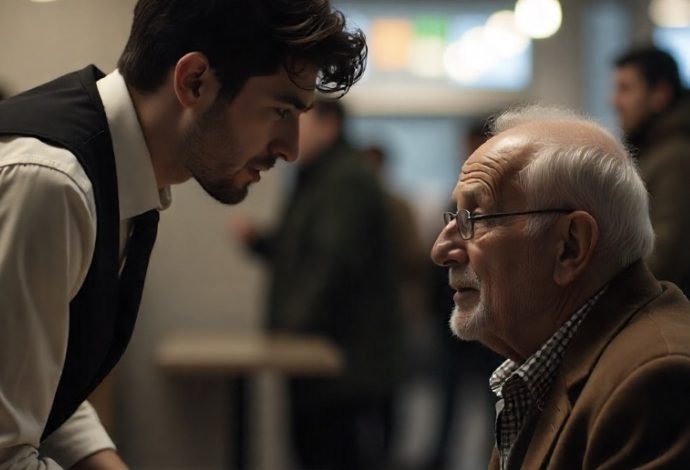
An old man stood near the dying plant by the entrance, looking completely out of place among the noise. He wore a long black coat, pressed and spotless, with an ironed tie that looked like he still cared about dignity — even if the world around him didn’t. There was something about him, a quiet loneliness that felt too familiar.
Without overthinking, I grabbed the old folding chair we kept near the mop sink, wiped it clean, and called out to him.
“It’s not much,” I said softly. “But it’s warm here. No one will bother you.”
He gave me a faint, grateful smile — the kind that felt both shy and proud. Every step he took looked like it cost him effort. When he finally sat down, he looked at the menu board, then back at me. His face turned red.
“I think I forgot my wallet,” he admitted, his voice gentle but steady. The words seemed to hurt his pride more than anything else.
I didn’t hesitate. I’d seen that same look before — on my mom’s face when her medication cost more than she expected, and on my sister’s when she tried to afford her schoolbooks. That quiet panic of pride meeting reality.
“I’ll take care of it,” I said, turning slightly so the security camera above the register couldn’t see. “A soup from Hank’s and a coffee from here. My treat.”
I took eight crumpled dollars and a few coins from the corner of my tip jar — money I usually saved for the bus — and paid at both registers. The old man didn’t argue. He just nodded in thanks and sat quietly, watching the rain beat against the skylight.
After a few minutes, he spoke again.
“My wife used to sit with me right here,” he said, looking at the empty chair beside him. “Back when this place still played music.”
He paused. “Her name was Ruth.”
He said her name softly, with such tenderness that I didn’t dare interrupt. I just kept wiping the counter, pretending to be busy. Some moments deserve silence.
When he finished his meal, he came up to the counter and placed a steady hand on my shoulder.
“You’re a good man,” he said.
“It was just soup and coffee,” I replied, feeling embarrassed.
He smiled faintly. “That’s what makes it good.”
He asked for my name, and I told him. “Elliot.”
He nodded once. “Keep that chair ready, Elliot. Someone else might need it.”
Then he left, stepping into the sleet, disappearing into the gray afternoon.
The next morning, my manager, Vernon, called me to the back hallway behind the soda machine. He held a clipboard like it was a weapon.
“Unauthorized product distribution,” he said, his voice flat and rehearsed. He showed me a printed image from the security feed — me handing the old man a tray with soup.
“Are you serious?” I said. “I paid for that myself.”
“The POS doesn’t take tips,” he replied coldly. “Tips aren’t valid payment for company stock. It’s in the handbook — section four, paragraph seven.”
He reduced my hours by twenty that day. “You’ll work two short shifts a week — no register access. Only cleaning duties.”
My chest tightened. “You’re cutting my pay because I gave someone a bowl of soup?”
“Because you violated procedure,” he said. “We’re not a charity. We’re a business.”
He made me sign a final warning form under the red light of the security camera. When I signed, my hands were shaking with anger I couldn’t show.
That shift, I spent hours scrubbing drains and wiping down soda machines. My back ached, my knuckles cracked, and every time someone ordered soup, I thought of that empty chair and the man who once sat there.
Later that night, as I took the bus home, my phone buzzed. It was my sister, Claudia, sending pictures of her college books and her empty bank account. I texted her back: Don’t skip meals. I’ll figure it out.
By the next week, things had only gotten worse. My mom’s nurse left a note saying her dialysis equipment needed replacement, but insurance wouldn’t cover it for another ten days. I was already behind on rent.
This job — this whole place — felt like it was built to drain you slowly. I wasn’t the only one. The falafel guy, Tariq, complained that new “mall fees” kept showing up on his rent. The taco stand owner, Marisol, said the same. Vernon claimed it was “corporate policy.” But something didn’t feel right.
Then one afternoon, Rosa walked in — a retired math teacher from my high school. She ordered a small coffee and fries from Hank’s next door. When I handed it to her, she smiled and slid a five-dollar bill across the counter.
“This,” she said, tapping the bill, “is for the next person who needs it. Just… one of those days, you know?”
Her words stuck with me. That night, I set up a small corkboard next to the sugar packets. I printed a fake receipt for “coffee and soup” and pinned it up with a note: Paid for — take it if you need it.
I didn’t advertise it. I didn’t even name it. But people noticed.
The next day, another customer left money for “the next one.” By Thursday, the corkboard was covered with receipts — each one a small act of quiet kindness. One note said For a tired mom. Another said For someone having a hard day.
It became our secret kindness exchange — a rebellion against how cold the world could be. Even Hank joined in, slipping extra fries into boxes when no one was looking.
Then came the day everything changed.
It was a slow, gray afternoon. I was refilling napkins when a tall man in a gray suit walked into the food court. He looked completely out of place — polished shoes, perfect tie, calm eyes. He stopped at my counter.
“Are you Mr. Elliot Webb?” he asked.
“Yes, sir,” I said, unsure what was happening.
He nodded. “I’m Franklin Shore. Attorney for the estate of Mr. Milton Wear.”
The name froze me. Milton — the old man from the chair.
Franklin continued, his voice firm but respectful. “Mr. Wear passed away peacefully last week. He left specific instructions for this location — and for you.”
By now, the entire food court had gone silent. Even Vernon had come out of the back, pretending to tidy something near the counter.
Franklin opened the leather folder and read aloud:
“To the young man named Elliot, who gave me soup, warmth, and asked for nothing in return — thank you. My wife Ruth and I spent many afternoons here when life still felt kind. For one hour, you reminded me of that kindness.”
Franklin folded the paper carefully and looked at me. “Mr. Wear’s will includes a clause transferring his minority ownership share in this food court, as well as a waterfront property license, to you — effective immediately.”
The room went completely still.
Vernon cleared his throat. “This must be some kind of error—”
Franklin didn’t even look at him. “It’s verified, notarized, and filed. You, Mr. Webb, now hold a legal ownership interest and voting rights in this food court.”
Vernon turned pale. Hank gave a low whistle. I just stood there, gripping the counter, my heart hammering.
Franklin extended a document across the counter. “Sign here to acknowledge receipt.”
Vernon signed too — reluctantly, his jaw clenched tight. A few customers clapped softly. Rosa smiled at me from her table, her eyes shining.
Franklin snapped the folder shut. “Congratulations, Mr. Webb. Mr. Wear believed the world needed more people like you.”
Then he left, just as calmly as he had arrived.
After the shock faded, I went to the back room with Hank. We looked at months of old sales logs. Something wasn’t right — too many “training mode” voids, missing receipts, unaccounted transactions.
We printed them all, and the numbers told the story: over eight thousand dollars had quietly disappeared. Vernon had been skimming money from every stall.
I called Franklin that night. He didn’t sound surprised. “Document everything,” he said. “I’ll send a forensic accountant. Don’t confront him yet.”
So I didn’t. I just watched. And I started planning.
When the audit was complete, the truth came out — Vernon’s fraud, the fake “mall fees,” everything. He was gone within a week.
And me? I stayed. I didn’t just keep my job — I built something new from it. I turned that same corkboard into a permanent “Kindness Wall.” Every customer could prepay a small meal or coffee for someone else. We even called them “Kindness Tokens.”
Soon, every stall in the food court had one. Rosa came back to help organize it. Hank printed a new sign that read:
“Good food. Good people. Pass it on.”
Months later, the once-empty food court was alive again — laughter, chatter, families, music. Not because of a business plan. Because of small, quiet kindness that refused to die.
And sometimes, when the rain hits the skylight just right, I look at that same chair near the entrance — the one where Milton once sat — and I swear I can almost hear him say it again:
“Keep that chair open, Elliot. Someone else will need it.”