Before leaving, I returned home and heard my daughter’s disturbing whispers
Just before heading to the airport, I suddenly realized I had left behind a very important file connected to my late husband’s estate. It wasn’t just any file—it was something that could cause real problems if I didn’t retrieve it. So I turned the car around and drove back home.
When I quietly stepped inside, ready to grab the file and rush back out, I heard voices. Not strangers—these were voices I knew better than my own heartbeat: my daughter, Rebecca, and her husband, Marcus. They were whispering, their words sharp and low, carrying a tone that made my skin crawl. They were supposed to be in Atlanta. Instead, they were in my house, talking about me. What I overheard would change everything.
My name is Florence Hitcher, and at seventy-eight years old, I believed I’d seen every kind of cruelty people were capable of. I was wrong. Six months had passed since I buried my husband, Harold. This was supposed to be my first Christmas without him, and I had planned to spend it with my sister, Margaret, in Portland, to get away from the quiet, ghost-filled house that now felt more like a museum of memories than a home.
I had been driving for nearly forty minutes when Margaret called.
“Florence, there’s an issue,” she said, her voice sharp with urgency. “The title company needs Harold’s original will for the lake house investment. A copy won’t work.”
It was an annoying legal matter—one that meant I had to go back. I checked the time. If I drove home, grabbed the will from Harold’s study, and left immediately, I could still make my flight. “I’ll head back now,” I said.
“You’re a lifesaver,” she replied smoothly.
The road back to Maple Street felt longer than usual. My home stood silent, holding onto the faint scent of Harold’s aftershave. I walked down the hallway toward the study—and that’s when I heard them.
“The bank incident was perfect,” Rebecca said, her voice filled with satisfaction. “Mr. Davidson noted her ‘confusion’ and ‘possible cognitive decline’ in her record.”
I froze. The “bank incident” she was talking about had been humiliating. I’d fumbled my PIN while Marcus stood behind me, making sarcastic comments about the new machines. My mistake hadn’t been confusion—it had been because of his deliberate pressure.
“And the missed appointment, plus her little argument with the receptionist,” Marcus added, his voice smooth and calculated. “It’s all documented.”
That appointment had been on the wrong date because they gave it to me incorrectly on purpose. Piece by piece, I began to see the pattern. The last few months hadn’t been filled with small, harmless mistakes. They had been laying bricks—one by one—to build a case against me.
“With her going to Portland, the timing is perfect,” Rebecca said. “We’ll file for guardianship while she’s gone. Judge Patterson owes me a favor. It’ll be quick and easy.”
Guardianship. The word alone made my stomach twist.
“Once we have guardianship,” Marcus explained, “we’ll control everything—her finances, her medical care. We sell the house, cash out Harold’s investments… all perfectly legal, all ‘for her benefit.’” Then he laughed. “By the time we’re done, she’ll be in a nice, safe memory care facility, thanking us for taking care of things.”
Rebecca didn’t even hide her greed. “The house alone could bring in at least four hundred thousand. Add Harold’s investments, and we’re talking nearly eight hundred thousand.”
That was it—the value they placed on my entire life. My freedom, my dignity, my memories—all reduced to numbers on a balance sheet.
“I’ve already called Golden Years Manor,” Rebecca said. “They have a memory care unit that would be perfect for her.”
Golden Years Manor was no “perfect” place—it was a warehouse for the forgotten, where people went to fade away. That’s when the shock inside me didn’t break; it hardened. It turned into something cold, sharp, and far more dangerous than grief.
I backed away, silent as a shadow, slipped out of the house, and drove—not to the airport, but to a small diner.
When I told Margaret everything, she was silent at first. Then her voice turned to steel. “Those two aren’t just greedy, Flo. This is conspiracy. Elder abuse. Fraud. They could go to prison for this.”
“What do we do?” I asked.
“We take them down,” she said. “But we do it smart. They think you’re weak and confused. You’re going to give them the best performance of your life.”
The plan was bold. I would cancel my trip, pretend to be too unwell to travel, and act like the frail, forgetful old woman they thought I was. Meanwhile, we’d collect every piece of evidence we could.
I underwent full medical and cognitive tests, securing documents that proved I was in excellent mental shape. Margaret used her network to dig deeper. She found the motive: Rebecca and Marcus were drowning in debt and about to lose their home. They weren’t just greedy—they were desperate.
Then I found Harold’s final gift. Hidden behind a false panel in his file cabinet was a sealed envelope containing a letter:
My dear Florence, if you’re reading this, someone has tried to challenge your competency. I hoped this day would never come, but hope isn’t a plan. The documents in this envelope will give you not only a shield but a sword. Use it. Protect what we built. I love you.
Harold had already prepared for this. He’d kept records of their suspicious actions, hired a private investigator named Thomas Bradley, and created a trust stating that if anyone tried to challenge my competency for financial gain, their inheritance would be permanently redirected to charity. They weren’t just walking into my trap—they were walking into his.
When Rebecca called, pretending to be concerned after hearing I wasn’t traveling, I played my role perfectly. “Oh, I just can’t make sense of my checkbook lately,” I said, my voice weak and unsure.
They arrived that same afternoon, putting on their fake caring faces. The house was staged exactly as we planned—milk in the cupboard, bills scattered, my hair messy. They believed every bit of it. For two days, I listened to their fake sympathy, their whispers about my “decline,” and their hints about “assisted living options.”
On Monday, Thomas Bradley visited, pretending to be an old friend of Harold’s. In reality, he collected the audio from hidden recorders Margaret had placed in the house. We now had proof—recordings of their lies, documents of their meetings with shady lawyers and real estate agents, and surveillance of Marcus discussing a quick sale of my home.
“They’ll be facing multiple felony charges,” Bradley told me. “Elder abuse, fraud, conspiracy… this is going to end badly for them.”
By Saturday, they returned with a leather briefcase. Inside were the guardianship papers.
“This arrangement will make everything easier,” Marcus explained in his smooth, fake voice. “You won’t have to handle any stressful decisions anymore.”
“And no more confusing papers?” I asked, keeping my voice shaky.
“Never again,” Rebecca promised, patting my hand.
I let them go through their pile of so-called evidence—missed appointments, stories about me wandering outside in my nightgown (a complete lie). I asked to read before signing, watching Marcus’s face tighten.
Just then, as planned, Margaret called. I put her on speaker.
“Florence, do not sign anything,” she said firmly. “What they’re doing is elder abuse, and it’s illegal.”
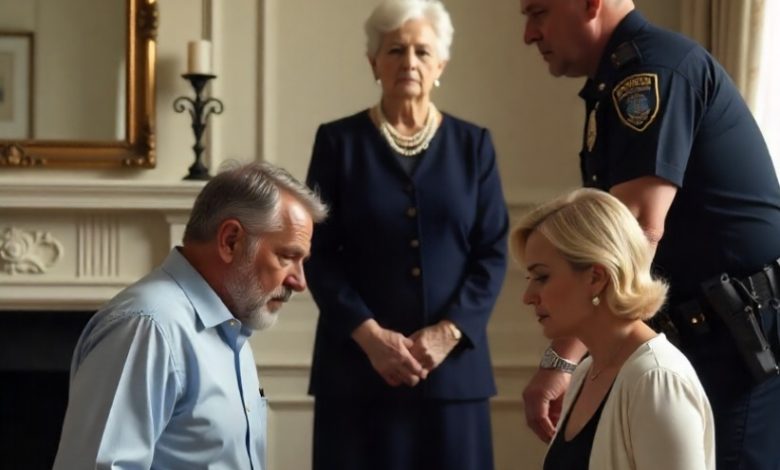
Their faces went pale. Moments later, police cars pulled into my driveway. Officers entered, reading them their rights. Margaret appeared from the basement, holding my medical records. “Florence is perfectly healthy,” she told them. “She’s been acting, giving you the exact performance you needed to incriminate yourselves.”
Rebecca started crying. “Mom, please, I’m your daughter.”
I looked her in the eyes. “No. You stopped being my daughter the moment you decided my life was yours to take.”
The trial was quick. The evidence was overwhelming. They were convicted on all charges.
I used the settlement money to start the Florence Hitcher Foundation for Elder Abuse Prevention. At eighty-five, I am no one’s victim. I am a warning—if you try to steal a life, you will face the storm you created.