“You’re going to be okay,” my dad told me while I remained motionless on the ground. My mother was upset that I was spoiling my brother’s party.
My name is Audrey, and I’m 28. I can still picture that day in perfect detail—the day my legs went numb, the day Jason laughed above me while I couldn’t move, the day my father told me to “walk it off” and my mother said I was ruining a birthday party. They didn’t know their words would come back to haunt them, or that what they ignored would be treated as a crime.
Our family looked picture-perfect from the outside. We were the Matthews: a nice house in the suburbs, a father with a good job, a mother who kept everything spotless, and two kids who looked like success stories. But inside those walls, feelings didn’t count. My father, Douglas, didn’t trust emotion; he thought it made people weak. My mother, Eleanor, kept the peace by agreeing with him—and by siding with my older brother, Jason, no matter what he did. Jason was the golden one. He was charming, athletic, and very good at getting what he wanted. He learned early that if he smiled and said the right thing, he could escape any blame.
I was the other kid—the one they corrected, doubted, and told to toughen up. When I was seven, Jason shoved me off my bike. I broke my wrist. He said I fell because I was clumsy. They believed him. When I was twelve, he locked me in the basement during a storm because he knew I was scared of thunder. They said I was making up stories. At sixteen, he messed with my science project the night before the fair. They told me to be more responsible next time. By the time I turned eighteen, I was done trying to earn their approval. I moved out the week I graduated and started building my own life. I became an elementary school teacher, saved my money, and kept my distance.
But cutting off family isn’t easy. They still called on holidays. They still sent invites I felt guilty ignoring. When my mother rang to “kindly insist” that I attend Jason’s thirty-first birthday, I gave in. “It would mean so much to your brother,” she said. I told myself I could handle a few hours. I had no idea those hours would end with an ambulance, an MRI, and a life split in two: before and after.
I pulled into their driveway at two in the afternoon, hoping to slip in quietly. The driveway was full of expensive cars—Jason’s friends. Mom opened the door with a quick air kiss and a look that went from my shoes to my hair. “Audrey, you made it. Everyone’s out back,” she said, as if she were ticking a box.
On the new pool deck, about thirty people stood around laughing, drinking, and trying to look important. Jason was in the center of it all, of course, telling stories and soaking up attention. “Little sis!” he said when he saw me. He hugged me too hard. It wasn’t affection; it was control, the kind that says, I can do what I want and you won’t stop me.
For a while, I stayed on the edges and made small talk with people I didn’t know. I laughed when it was safe to laugh and watched the clock in my head. But the later it got, the louder they became. The jokes got meaner, the comments sharper. Then Jason aimed the spotlight at me.
“Remember when we convinced Audrey the neighbor’s dog had rabies?” he called out, grinning. The group laughed. I had been eight, and I had cried myself to sleep for a week.
Tyler, one of Jason’s best friends, added, “Or when we swapped her shampoo with Nair?” More laughter. I had been fourteen. My hair fell out in clumps. My parents told me I was being too dramatic.
My chest tightened. I grabbed my bag. I’d had enough. When I turned to go, Jason stepped in front of me. “Leaving already? The party just started,” he slurred, the sweet edge gone from his voice. He was drunk. Drunk Jason was always worse—louder, crueler, harder to dodge.
“I have a long drive home,” I said. I tried to move around him.
“Come on, sis. Relax. It’s my night. You can’t just bail.” He said it like an order.
“No, Jason. I’m going.” I kept walking toward the sliding glass door that led back into the house.
To reach the door, I needed to cross a section of the new deck. The boards were a pale, pretty wood. The sun made them shine. I stepped forward—and something felt wrong. My shoe slid a little. I took another step. The surface was slick, not like water but like something greasier. I glanced down and saw a faint shine on the wood, a thin film almost too light to notice.
In the half-second before my body reacted, my brain put the pieces together. It wasn’t an accident. Someone had made it slippery. It was a setup.
My foot shot forward, and my other foot lost contact with the ground. My arms flailed, grasping for balance that wasn’t there. I saw Jason watching me with a tight smile, not surprised at all. I saw his friends leaning in, expecting a joke, a fall, a splash. Then my body crashed down, not onto the boards, but onto the hard concrete edge of the pool. My lower back and the back of my head hit at the same time. The pain was white and bright and everywhere. A voice screamed. It took me a moment to realize it was mine.
When the world stopped spinning, I was on my back staring up at the blue sky. My head pounded. But the worst part wasn’t the pain. It was the absence of feeling. I tried to wiggle my toes. Nothing. I tried to bend my knees. Nothing. Panic poured through me, cold and fast.
“Help,” I heard myself say. “Please help me. I can’t feel my legs.”
Jason’s face appeared above me, smiling like he’d just watched a funny video. “Nice fall, sis. Very dramatic.”
“I’m serious,” I said, my voice shaking. “Something’s wrong. I can’t move my legs.”
He rolled his eyes. “Get up. You’re embarrassing yourself.”
“I can’t.” Tears stung my eyes. “Call an ambulance. Please. I think I’m really hurt.”
A small crowd gathered. People whispered. Some laughed softly, like they were in on the joke. My father pushed past them. “Dad,” I said, struggling to get the words out. “I slipped and fell. I can’t feel my legs. I need a hospital.”
He looked down at me and sighed like I had dropped a plate on his clean floor. “For God’s sake, Audrey. Walk it off. Stop being a baby. This is your brother’s party.”
My mother knelt next to me and leaned in close so only I could hear. “Enough,” she hissed. “You will not take attention away from Jason today. Get up.”
The betrayal cut deep and fast. I opened my mouth to argue, but a new voice came from behind them. Calm. Firm. “Excuse me—I’m a nurse. Please let me through.”
A woman I didn’t know crouched beside me. “I’m Rachel,” she said. “I work in the ER at Mass General. Can you tell me what happened?” I told her, as clearly as I could, that I slipped and couldn’t feel my legs. She pressed along my legs in different spots. “Can you feel this?” she asked each time. I couldn’t.
“I’m calling an ambulance,” Rachel said, pulling out her phone.
“She doesn’t need one,” my mother snapped.
Rachel looked my mother straight in the eye. “Ma’am, your daughter has symptoms that suggest a spinal cord injury. Moving her could make it worse. She needs proper care now.”
My father’s face changed from annoyance to worry. “How did this happen?” he asked.
“The deck is slippery,” I said. “It felt like oil.”
Rachel rubbed two fingers along the boards and held them up. “This isn’t water,” she said, her voice tight. “Feels like deck oil or some kind of lubricant.”
Everyone turned toward Jason. His face went pale. “It was just a joke,” he muttered. “I only put a little deck oil on a few boards. I thought she might slip and fall into the pool. I didn’t think—”
He didn’t finish. The silence was louder than the music.
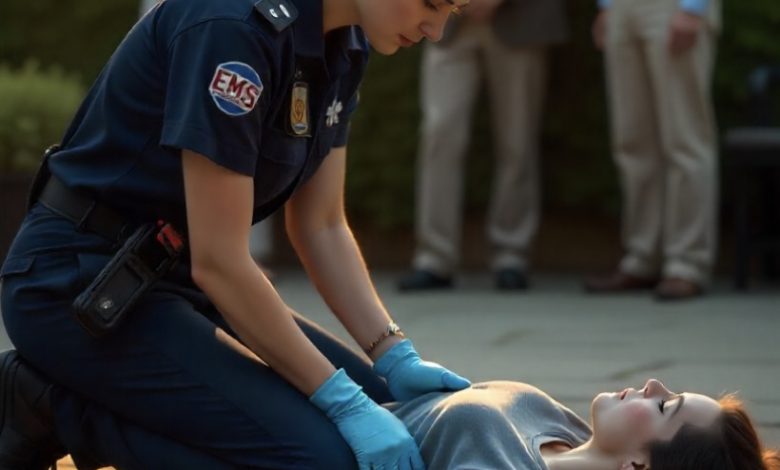
Sirens sounded in the distance. When the paramedics arrived, Rachel told them what she had seen and what I had said. The lead paramedic, Sarah, asked, “Was the surface made slippery on purpose?”
“Her brother admitted it,” Rachel said.
Sarah’s jaw clenched. She told her partner, “Mike, document the surface and what’s on it.” Then she called for police, her voice steady and professional, not angry but not casual either.
My father started to argue. “Police? That’s not necessary. This was an accident.”
Sarah looked at him without blinking. “Sir, creating a dangerous surface on purpose and causing a serious injury is not an accident. Also, your daughter reported a loss of feeling—waiting to call for help was not appropriate.”
They stabilized my neck and back, lifted me carefully onto a board, and carried me to the ambulance. As the doors closed, I saw a police car roll into the driveway. For the first time in my life, someone was treating my pain as real.
I woke up later in a hospital room to the gentle beep of monitors. A nurse said, “Hi, Audrey. You’re at Massachusetts General.” A doctor came in soon after. “I’m Dr. Martinez,” she said. “I’m the neurosurgeon overseeing your care. You suffered an incomplete spinal cord injury. Two vertebrae were fractured, and the swelling compressed your spinal cord. We took you into emergency surgery to stabilize your spine.”
My mouth was dry. “Will I walk again?”
“Spinal cord injuries vary,” she said. “The fact that it’s incomplete is hopeful. Your recovery will depend on healing, time, and a lot of therapy. Right now, you’re experiencing paraplegia. We’ll keep monitoring you.”
It felt like the floor dropped out from under me. Dr. Martinez continued gently, “One more thing. The circumstances of your injury are under investigation. Two officers would like to speak with you when you feel up to it.”
I told the police everything—how I fell, what was on the deck, what Jason said, and how my parents reacted. Detective Sullivan repeated the key points to be sure. “So, after you said you couldn’t feel or move your legs, no one called for help until the nurse intervened?”
“That’s correct,” I said.
“Jason Matthews was arrested last night for reckless endangerment causing serious bodily harm,” she said. “We are also reviewing your parents’ actions.”
I didn’t know how to feel. I had waited all my life for someone to hold Jason accountable. I had prayed for my parents to see me and hear me. I had not imagined it would happen like this.
Days turned into weeks. There were scans, checkups, and hours of physical therapy. Pain visited every day, but so did small signs of progress: a twitch in a muscle, a new sensation, a little more movement. I set small goals. Sit up without help. Transfer to a wheelchair. Learn how to bathe, dress, and cook with new tools and new routines. The MRI pictures became landmarks in my journey—proof of damage, and later, proof of healing.
The legal process moved forward too. Jason took a plea deal: five years, with two years to serve in prison and the rest on supervision. My parents agreed to plea deals of their own: probation for two years and 400 hours of community service. My lawyer filed a civil case, and after six months of tense back-and-forth, we reached a settlement. The homeowner’s insurance paid its limit—one million dollars. On top of that, my parents agreed to sell the house and use their retirement savings to set up a two-million-dollar trust for my long-term care.
Eight months after the fall, I could take a few slow steps with heavy braces and a walker. Each step felt like climbing a mountain, but I did it. I moved back to my apartment, which now had a ramp, wider doors, and grab bars in all the right places. I kept my job on hold and worked with a therapist who understood trauma and complicated families.
“What happened to your body is only part of what you’re dealing with,” she told me. “You grew up being told your feelings were wrong. This injury ripped the cover off the truth.” Hearing that hurt—but it also helped. It gave me words for things I had carried for years.
Around the one-year mark, a letter arrived from prison. It was from Jason. He wrote pages and pages in handwriting I hadn’t seen since we were kids. He said he was in therapy. He said he was learning things about himself he didn’t like. He said he was sorry—truly sorry. “You didn’t deserve what I did to you,” he wrote. “You deserved a brother who protected you.” He told me he understood if I never wanted to speak to him again.
My parents never wrote. I later heard they moved to Florida. I felt a strange mix of sadness and relief. I had spent most of my life chasing their approval. Now I was done running.
My life today looks very different. I use a wheelchair most of the time. With braces and crutches, I can walk short distances when I need to. I found a new rhythm to my days. I learned how to drive with hand controls. I stopped apologizing for my needs. The biggest change isn’t physical—it’s inside me. I am no longer the scapegoat. I am not the “dramatic” daughter. I am a person with a voice.
Six months ago, I started volunteering as a peer mentor at the rehab center where I learned to stand again. I talk to new patients who are scared and angry and tired. I tell them it’s okay to feel everything they feel. I tell them healing is slow and real. That’s where I met Thomas, a physical therapist. We talked about transfers and balance and muscle memory at first. Then we talked about books, food, and the way Boston smells after rain. We moved slowly—coffee after a session, a walk (well, roll and walk) around the park, dinner at a place with wide aisles. He sees me, not just my chair. He never treats me like I’m fragile or like I have something to prove. We’re not rushing anything. It feels honest.
My circle has changed too. It includes Rachel, the nurse who stood up for me; Sarah, the paramedic who took me seriously; the therapists who pushed me when I wanted to quit; and Thomas. These are people who show up because they care, not because they have to.
I finished my master’s in educational psychology, one assignment at a time, often from a hospital bed or a therapy waiting room. Next fall, I’ll start a new job as a consultant for the school district. I’ll help train teachers to spot trauma in kids and respond with care. Maybe I can be for them what I needed when I was small—a person who believes them.
I used to think paralysis would swallow my life. It didn’t. It changed it, yes. It slowed me down. It made me plan more. It gave me new limits and new tools. But it also gave me a voice and a purpose I didn’t expect. I won’t pretend it’s all neat and tidy. Some days are hard. Some nights I still dream about the fall, about the laughter, about the moment my body went quiet from the waist down. But I wake up, I stretch, I breathe, and I keep going.
“You’ll be fine,” my father said as I lay there on the ground. He was wrong in the way he meant it. I wasn’t “fine” in the sense he wanted—silent, obedient, easy to ignore. But I am fine in a different way. I am alive. I am building a life that is truly mine. The MRI confirmed the damage that day; time and work have confirmed something else: I am stronger than I ever knew. My paralysis will always be part of my story, but it does not get the last word. Sometimes you have to be broken open to see what you’re made of. And when you finally see it, you don’t go back. You move forward—maybe slowly, maybe with help—but you move forward, one real, honest step at a time.